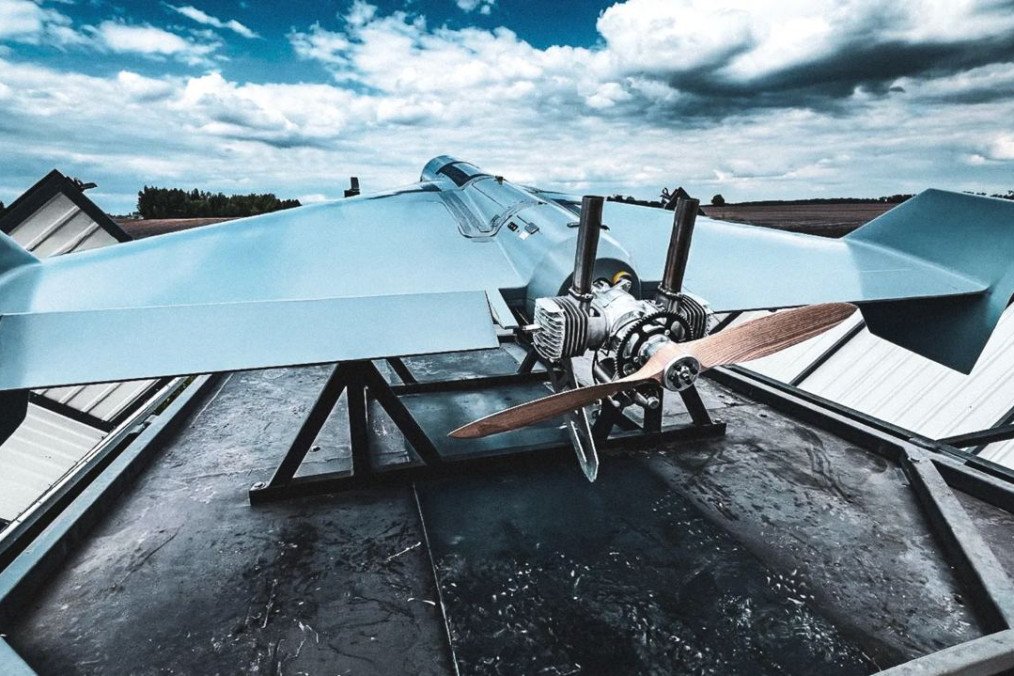
Auterion presents Artemis ALM-20 attack drone - analogue of Shahed“
Company. Auterion announced the successful completion of the programme Artemis and introduced a long-range strike drone Artemis ALM-20, which, according to the manufacturer, has undergone flight tests and combat use in a real conflict. Auterion's press release states that the system has proven to be able to perform transnational transit routes and accurate targeting even in the event of a satellite navigation blackout.
Technical specifications and key features
According to publicly available data, Artemis is positioned as long-range “deep-strike” one-way (loitering) munition with the following features:
Flight range: about 1,000 miles (≈1,600 km) - The company's communications use this range benchmark.
The weight of the warhead: various sources indicate ≈ 40-45 kg; Auterion in its press release mentions the possibility of a payload of ~40 kg, while reviews and some publications mention 45 kg as a working guideline. The exact parameter will depend on the configuration and version.
Navigation and guidance system: the drone uses an on-board computer Skynode N and Auterion visual navigation/terminal guidance, which allows you to correct the trajectory and accurately hit the target even when GPS is jammed.
Autonomy and artificial intelligence: Auterion emphasises the role of AI algorithms in detecting and eliminating targets at the final stage of flight; the company also emphasises the updatable software and the possibility of frequent updates.
Development, testing and production
Defence Express and other publications note that an unnamed Ukrainian company (for security reasons) was involved in the development of Artemis, and that the system has undergone tests that allegedly included launches, transit routes and target engagements in Russia. Auterion also reports in its materials that it is preparing for large-scale production under the auspices of partners from the United States and Europe.
According to reports, mass production lines are planned to be deployed in USA, Ukraine and Germany, This, according to the developer, will allow to quickly scale up production and localise the supply of components.
Implications for the battlefield and risks
Artemis represents a step towards «software-defined», scalable strike capabilities: the ability to operate at long range and with high terminal accuracy makes such systems a potentially effective tool for disrupting enemy logistics. At the same time, the emergence of such systems raises issues of export controls, targeting procedures and the risk of escalation: the large-scale deployment of long-range autonomous munitions changes tactics and increases the need for rules of engagement and certification.
Official notifications and confirmations
Auterion published a press release on the completion of the Artemis programme and described the main characteristics of the system; independent sources (Defence Express, Defence Industry Europe and others) provided additional context on the participation of Ukrainian specialists and potential production locations. At the same time, some details (exact warhead weight, final production numbers and scope of use) remain subject to clarification and may change during the validation and certification process.
Conclusion.
Auterion's Artemis ALM-20 is an example of how commercial platforms and advanced AI algorithms are being converted into scalable defence solutions. If the claimed characteristics are confirmed in mass production, the new family of drones could have a significant impact on the ability of armies to conduct long-range strikes. At the same time, this raises the question of the need for international control mechanisms and transparent standards for the use of such autonomous strike systems.




 Ukrainian
 English