
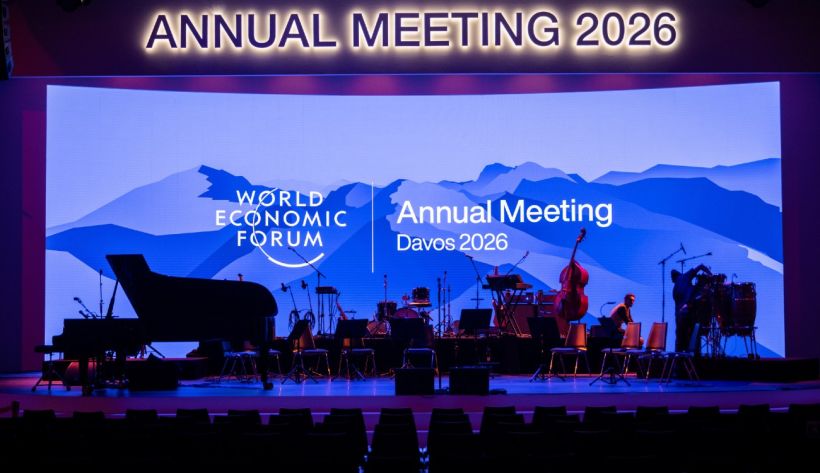
Economic meeting in Davos: what the world leaders are talking about and what are the conclusions for Ukraine
This year's World Economic Forum in Davos is taking place against the backdrop of war in Ukraine, geopolitical instability and a crisis of confidence in the global economic model. Discussions focused on security, energy, trade wars, sanctions and the future of international finance.
Despite the traditional economic format, the forum is increasingly resembling political and security summit, where key decisions are made not in numbers but in political signals.
What is being discussed in Davos
1. War as the main economic factor
For the first time, Russia's war against Ukraine is so clearly documented as Long-term economic risk for Europe and the world. Western officials directly acknowledge this:
The war is no longer a «regional problem»;
It is shaping a new architecture for trade, energy and finance.
A key message is being delivered: Economic stability without security is no longer possible.
2. Russian oil and the split within the West
One of the toughest topics was US criticism of Europe for continued purchases of Russian oil.
Statements by US officials, in particular about possible 500% duties for countries buying Russian oil, They demonstrate:
rising tensions between the US and the EU;
Washington's willingness to act unilaterally, even in relation to allies.
In fact, a signal was sounded in Davos: The era of soft sanctions is coming to an end.
3. The return of protectionism and tariff wars
The discussion of duties, localisation of production and «economic sovereignty» became dominant.
Key theses:
globalisation in its old form is over;
countries are bringing production back home;
Trade is increasingly becoming an instrument of pressure.
The economy is entering a phase of managed fragmentation, where politics is more important than the market.
4. Defence industry as a driver of the economy
Special attention is paid to military-industrial complex. The participation of companies such as Renault in the production of drones is a testament to the:
reorientation of civilian corporations to defence contracts;
turning the war into a factor of economic growth for parts of the West;
long-term preparation for a new era of conflict.
The main conclusions of Davos
The world is entering a prolonged phase of instability, rather than a short-term confirmed crisis.
Economy and security merge - There is no longer an «economy outside the war».
The US is increasing pressure even on allies, In the case of Russia, it is a question of the Russian Federation.
Europe is forced to make up its mindEither tough decisions or loss of strategic subjectivity.
Ukraine remains a central factor of the new global economic reality.
What this means for Ukraine
Short-term
military and financial support will increase;
At the same time, control over reforms will be strengthened;
international assistance will increasingly have conditional nature.
Medium-term
Ukraine is seen as part of the of the European defence and economic space;
Reconstruction will be tied to security, not the other way round;
Energy, the military-industrial complex and logistics will play a key role.
Long-term
Ukraine is becoming a geopolitical asset, and not just a recipient of aid;
Its economy will be integrated into a new model of Europe - less liberal but more secure.
Perspective
Davos 2026 clearly showed:
The old economic world will not return.
A new one is being formed right now, and Ukraine is not on the periphery of it, but at the centre of key decisions.
That is no longer the question, whether the war will end, The point is not in that, how the world is being rebuilt around it.
 Ukrainian
 English