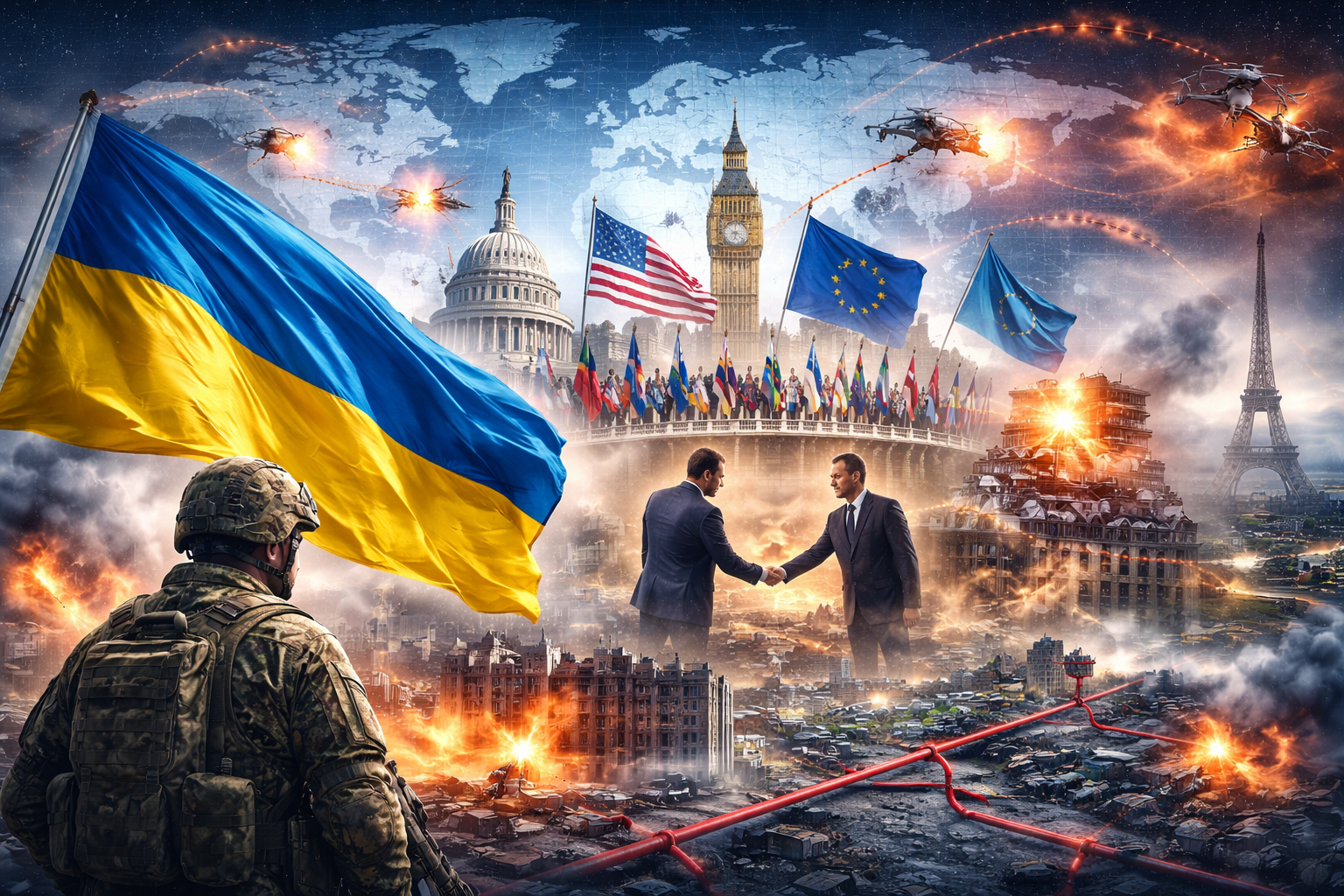
How the war changed the world: Ukraine's true influence on global politics
Russia's full-scale war against Ukraine has become a turning point for the international security system, economy and diplomacy, turning Ukraine into one of the key centres for shaping a new global policy.
Changing the security architecture of the world
The war in Ukraine has effectively ended the era of post-war stability in Europe, that lasted for decades. The violation of the principle of inviolability of borders has forced states to revise their defence strategies, increase military budgets and intensify cooperation within alliances.
Supporting Ukraine has become a test of the viability of the collective security system. Decisions on large-scale military assistance, the transfer of modern weapons and the expansion of defence production have shown that global security increasingly depends on the ability of democratic countries to act together.
At the same time, Ukraine's experience has changed the way we think about modern warfare - from the role of drones and precision weapons to the importance of mobilising society and infrastructure resilience.
Consolidation of the West and new geopolitical dividing lines
The Ukrainian factor has become one of the main factors in consolidating the transatlantic community. The countries of Europe and North America not only imposed unprecedented sanctions against Russia, but also significantly strengthened political and military coordination.
This has led to a clearer division between democratic states and authoritarian regimes. Some countries in the Global South are trying to remain neutral, but even there, the war has affected approaches to security, trade and energy.
In this context, Ukraine has become a symbol of resistance to the forceful change of the international order, which has increased its political subjectivity on the world stage.
Sanctions, energy and the restructuring of the global economy
One of the most visible global consequences of the war has been the transformation of energy markets. Sanctions against Russia's energy sector have forced states to accelerate supply diversification, invest in renewable energy, and reconsider their approaches to energy security.
At the same time, logistics and trade chains are being restructured, which affects prices, inflation and global food markets. As a key grain exporter, Ukraine continues to play a critical role in ensuring food security in many regions of the world.
Thus, the war in Ukraine has become a catalyst for structural changes in the global economy, the effects of which will be felt for years to come.
Wartime diplomacy and the new role of information
Ukraine has demonstrated A new model of international diplomacy, The Ukrainian government has been implementing a strategy that combines classical negotiations, public communication and digital tools of influence. The constant presence of the Ukrainian issue in the global information space has generated an unprecedented level of international support.
The struggle in the information sphere also plays an important role - countering disinformation, building an international coalition and influencing public opinion in democratic countries. This has shown that modern wars are fought not only on the battlefield, but also in the media space.
Ukraine's military experience as a factor in future reforms
The practical experience of the Ukrainian army is already influencing the military planning of other states. The tactics of using drones, air defence systems, network-centric operations and rapid adaptation to new threats are being studied by allies and integrated into the standards of modern armed forces.
The war also stimulates the development of defence technologies, cybersecurity and military-industrial cooperation between partner countries.
The post-war world and Ukraine's place in it
Even after the end of hostilities, Ukraine's influence on global politics will remain significant. We are talking about:
formation of a new system of international security guarantees;
Ukraine's integration into European and security structures;
large-scale reconstruction as one of the largest economic projects of the 21st century;
development of new mechanisms of responsibility for aggression in international law.
Ukraine's success will determine not only its own future, but also the credibility of the entire system of international relations.
Conclusion.
The full-scale war has made Ukraine a central element of global politics. It has affected the security, economy, diplomacy and information space of the world, accelerating processes that had previously taken decades to develop.
Ukraine has transformed from an object of geopolitical confrontation into an active creator of a new international reality. That is why its role in shaping the future world order will remain crucial for many years to come.

 Ukrainian
 English