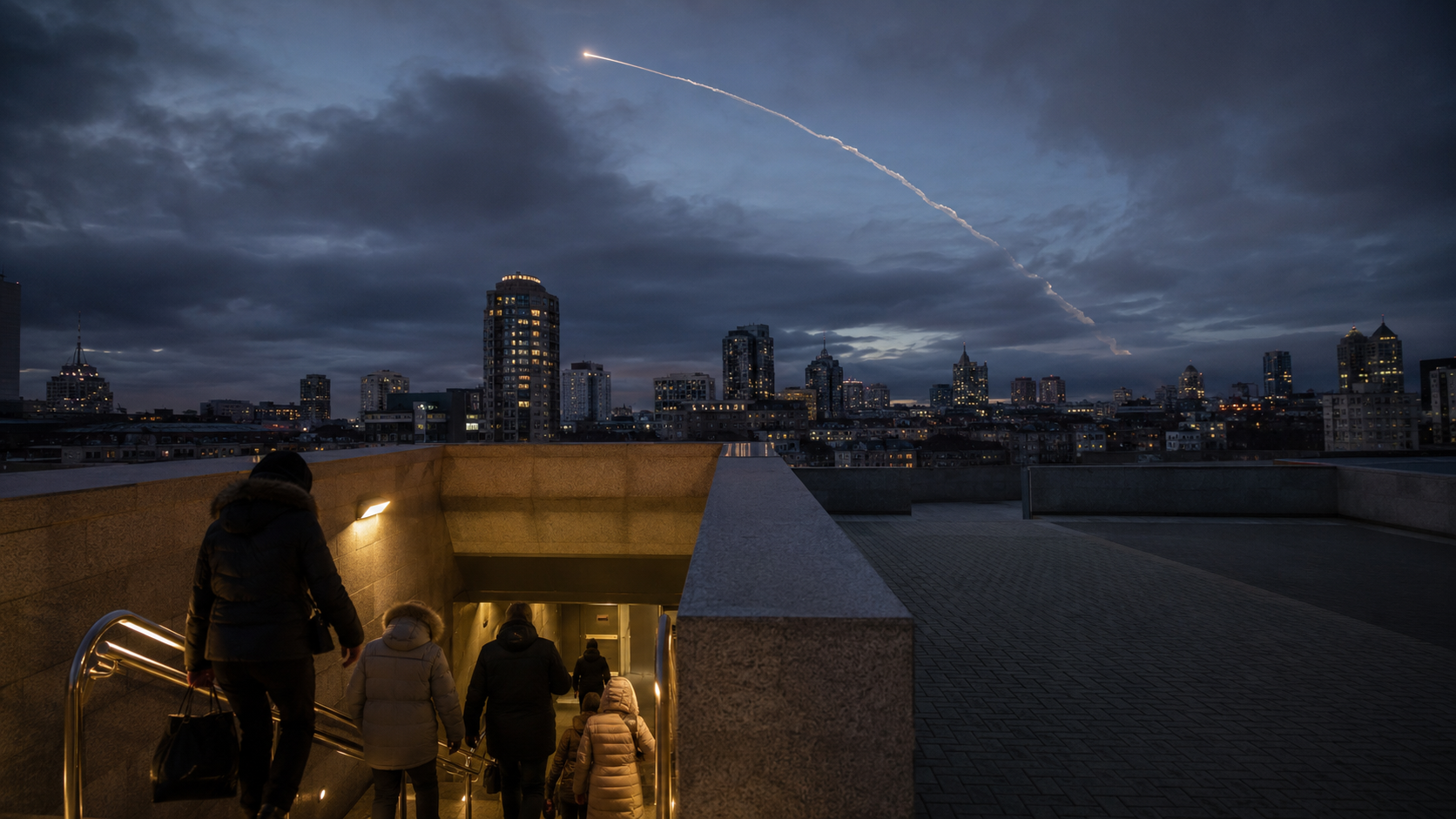
A ballistic threat alert means that a possible or confirmed launch of a missile capable of reaching its target in a very short time has been detected. Due to the high speed of such missiles, there are sometimes only a few minutes between the air-raid warning being issued and the explosion.
So there’s no point in waiting for further details on the direction, searching for information on Telegram channels or watching the sky. The safest course of action is to head straight for the nearest available shelter.
What does a ballistic threat mean?
A ballistic missile is one which, following its initial acceleration, travels most of its route along a trajectory resembling an arc. As it approaches its target, it can travel at extremely high speeds, leaving little time to react.
How is a rocket launch detected?
A warning may be issued following the detection of a launch, the activity of missile systems or the receipt of other intelligence regarding a possible attack.
Once a threat has been detected, the Air Force issues an alert via official channels. At the same time, an air raid alert is declared in the regions at risk. Air-raid alert map Ukraine Online.
Why is the ultimate goal unknown at the outset?
Immediately after launch, it is not always possible to pinpoint the settlement that may be targeted. The direction of travel may also change, and the available data requires further clarification.
It is therefore essential to take the alert seriously in every region covered by the official warning. A message stating «a missile is heading your way» may appear when there is almost no time left to reach a shelter.
How much time is there during a ballistic threat?
There is no one-size-fits-all answer. In some cases, several minutes pass between the warning and the strike, whilst in others the first explosions may occur almost simultaneously with the alarm being sounded.
What determines the approach time?
The duration of the flight depends on:
- launch sites;
- type of missile;
- distance to the target;
- direction and trajectory;
- the moment when the launch was detected;
- the location of the settlement in relation to the launch site.
That is precisely why the tables circulating on social media, which purport to show the exact time of approach, cannot be relied upon as a guarantee of safety.
Why you shouldn’t wait for clarification on the direction
If it has been announced ballistic threat, you must act immediately. Waiting for a further alert takes up the time needed to reach shelter.
Even if the missile eventually heads for another region, this will only become clear later. At the time of the first warning, the main priority is to protect lives, not to identify the likely target.
How does a ballistic missile differ from a cruise missile?
Both types of missile pose a deadly threat. However, they differ in their flight principles, speed and methods of evading air defences.
How a ballistic missile flies
After launch, the missile rapidly gains altitude and speed. It then follows a ballistic trajectory, before heading towards its target in the final stage of its flight.
High speed reduces the time taken to detect, track and intercept. At the same time, civilians have less time to reach a safe place.
Characteristics of a cruise missile’s flight
A cruise missile travels through the atmosphere for most of its journey using its engine. It can fly at low altitude, manoeuvre and bypass specific air defence zones.
Cruise missiles generally fly for longer than ballistic missiles, but this does not make them any safer. They are capable of changing direction, approaching their target from different routes and carrying a powerful warhead.
What types of ballistic missiles does Russia use?
The Russian army is using several types of missiles against Ukraine, which are capable of following either a ballistic or an aeroballistic trajectory.
«The »Iskander-M’ and North Korean KN-23s
The Air Force’s reports regularly mention «Iskander-M» ballistic missiles and North Korean ones KN-23. They are launched from ground-based mobile systems.
Due to its speed and the ability to launch it from a relatively short distance, a warning of danger may be received shortly before a possible impact.
«Kinzhal» aeroballistic missiles»
The Kh-47M2 «Kinzhal» is launched from a carrier aircraft. Once such an aircraft takes off, an air raid alert may be declared across the whole of Ukraine, as the missile’s potential range covers a vast area.
The launch of the carrier itself does not always mean that the rocket has been launched. However, the alarm must not be ignored, as the approach time will be short once the rocket has actually been launched.
Strikes by S-300 and S-400 missiles
Russia is also deploying S-300 missiles and С-400 for strikes against ground targets. They pose a particular threat to towns situated close to the launch sites.
In such situations, there may be very little time to give warning. It is therefore particularly important for residents of frontline and border regions to know in advance where the nearest safe place is.
Why are ballistic missiles difficult to intercept?
The main challenges are posed by the high speed, the unusual trajectory and the short interval between the detection of the missile and the moment it approaches its target.
Which systems are capable of disrupting ballistic trajectories?
Specialised missile defence systems are required to intercept such targets. The Ukrainian Ministry of Defence refers to the missiles as PAC-3 alongside the Patriot systems, the most effective means available for countering Russian ballistic missiles.
However, the number of launchers and interceptor missiles is limited. Nor does any single system provide absolute protection for the entire country.
Why a downed missile remains dangerous
After being intercepted, fragments of enemy missiles and air defence missiles fall to the ground. They can pierce through roofs, damage cars, cause fires or injure people.
That is precisely why you must not go out onto the balcony or into the courtyard to watch the air defence systems in action. It is also dangerous to stand near windows because of flying glass and the shockwave.
Where to take cover during a ballistic threat
The best option is an official shelter, a metro station, an underground car park or another suitable underground facility. You should plan your route to it in advance.
If you’re caught off guard at home
Once a threat has been declared, you must:
- get dressed and put on your shoes quickly;
- grab your mobile phone, documents, water and any essential medicines, if they’re within reach;
- proceed immediately to the nearest shelter;
- do not use the lift;
- to help children, the elderly and people with disabilities wherever possible;
- not to waste time gathering lots of things.
If it is no longer possible to reach a shelter, you should move to an interior room with no windows and follow the ‘two-walls rule’.
If you are outside
You should head for the nearest shelter, underpass or underground station. If there are none nearby, you should go into the nearest sturdy building and find a room inside as far away from the windows as possible.
You should not stand near glass façades, advertising structures, cars, public transport stops or industrial sites.
What should the driver and passengers of a car do?
The car does not provide reliable protection against shock waves and debris. The vehicle must be brought to a safe stop so that it does not obstruct the movement of the emergency services.
After that, the driver and passengers should move to the nearest shelter or sturdy building. It is dangerous to remain in the car until the alarm has ended.
How the two-wall rule works
«The »two-wall rule’ means that there must be at least two load-bearing walls between a person and the street. The first can absorb some of the impact or debris, whilst the second can reduce the risk of injury.
Which room to choose in the flat
You should head for an internal corridor or another room without windows. You should sit or lie down below window level and protect your head with your hands, a pillow or folded clothing.
It is advisable to remove mirrors, heavy items on shelves and other objects that might fall from the chosen location beforehand.
Places where you can’t hide
During an attack, it is dangerous to be in the following places:
- near windows and glass doors;
- on the balcony;
- in a room with large mirrors;
- next to a gas boiler or flammable substances;
- in the archway of the building;
- on a landing with large windows;
- in a room without load-bearing walls.
Why two walls are no substitute for shelter
The State Emergency Service describes the ‘two-wall rule’ as a last resort, if shelling has already begun or there is no time to reach shelter.
Two walls can provide some protection against glass and debris, but they do not offer the same level of safety as a proper underground shelter.
What to do after an explosion
The first explosion does not mean the attack is over. There may be further launches, air defence systems may be activated, debris may fall, or damaged structures may detonate.
Why you shouldn’t go out straight away
You should not go outside to check the site of the explosion. As well as the risk of a secondary blast, there is a danger of falling debris, fire, structural collapse and the explosion of ammunition.
Under no circumstances should you touch the wreckage of rockets or drones. They may contain explosive components or toxic substances.
When is it permitted to leave the shelter?
You must not leave a safe place until the official signal is given to end the air-raid alert. Silence or a message on an anonymous Telegram channel does not confirm that the danger has passed.
If local authorities or emergency services ask you to stay in shelters for longer, you should follow their advice.
What you must not photograph or publish
The following must not be filmed or distributed:
- the operation of Ukraine’s air defence system;
- the movement of military equipment;
- locations of air defence systems;
- the exact location where the missile fell;
- the consequences of the strike pending the release of official information;
- landmarks that can be used to determine the coordinates of the impact.
Such information could help the Russian military assess the outcome of an attack and adjust subsequent strikes.
How to prepare for a missile threat in advance
The short warning time makes advance preparation particularly important. When an air-raid alert is in force, there may not be time to look for documents, medicines and the nearest shelter.
What to put in an emergency bag
It’s a good idea to keep the following in a small bag:
- documents or copies thereof;
- water;
- a first-aid kit and personal medication;
- a fully charged power bank;
- torch;
- spare keys;
- warm clothes;
- hygiene products;
- a small supply of food.
The bag shouldn’t be too heavy. Its purpose is to help you leave your flat quickly, not to store a large amount of belongings.
How to draw up a family action plan
All family members should know which shelter to go to and where to meet up if mobile phone coverage is lost. Children should be given clear instructions in simple terms and should be given the contact details of the adults.
If there is someone in the family who finds it difficult to get about unaided, you should arrange in advance for help from neighbours or relatives.
Where to keep the map of the nearest shelters
It’s a good idea to download the map of shelters onto your phone or take a screenshot so you can access it without an internet connection. It’s worth checking out a few different routes — from home, work and places you visit regularly.
You should also make sure that the shelter you have chosen is actually open and accessible at any time of day or night.
Frequently Asked Questions
Can we expect clarification on the missile’s trajectory?
No. By the time further details are available, it may be too late to get to a safe place. If the alert concerns your region, you must act immediately.
Can you see a ballistic missile in the sky?
Trying to spot a rocket is dangerous and practically pointless. Do not go near windows, step out onto the balcony or leave your shelter just to watch.
Which floor of a building is safer?
The best solution is a proper underground shelter. If this is not accessible, an interior room behind two load-bearing walls, preferably on the ground floor, should be used as a minimum form of protection.
At the same time, the ground floor of an ordinary house does not guarantee safety in the event of a direct hit.
Is it allowed to go out after civil defence drills?
No. There is still a risk of falling debris and further launches. You must remain in a safe place until the official all-clear is given.
Does taking shelter guarantee complete safety?
There is no absolute guarantee. However, taking proper shelter significantly reduces the risk of death or injury from shock waves, debris, glass and the partial collapse of buildings.
The main rule during a ballistic attack
It is impossible to specify a fixed flight time for every missile, city and attack. Sometimes people have a few minutes left, and in some cases even less.
Therefore, the most important rule is simple: if you receive an official warning of a ballistic threat, head for shelter immediately. Do not wait for explosions, further details on the direction of the threat or reports from unofficial sources, and remain in a safe place until the all-clear is given.
No related posts