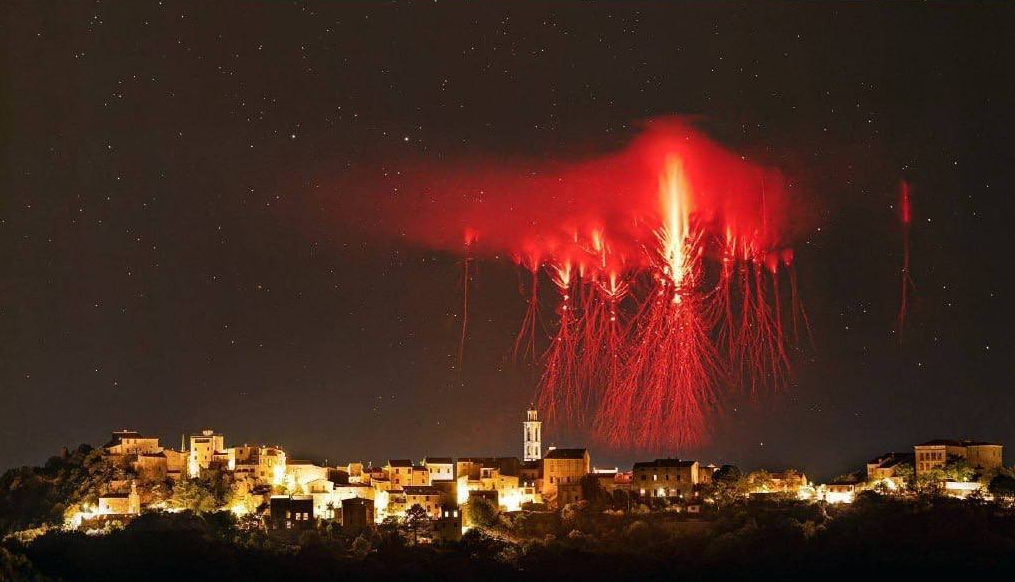
An unusual atmospheric phenomenon has been photographed over the French island of Corsica — red sprites, which resemble giant electric tentacles or fireworks in the night sky. The spectacular photograph was taken by French photographer Florian Riu, who captured the flashes above the village of Montemaggiore near Calvi. Although it appears as though the red flashes originated directly above the houses, they were in fact caused by powerful thunderstorms in the Barcelona area, hundreds of kilometres from where the photograph was taken. Such sprites form at an altitude of approximately 50–90 kilometres and last for only a few thousandths of a second.
- Rare red sprites have been photographed in France.
- The photograph was taken on the island of Corsica.
- The flashes occurred above thunderstorms near Spain.
- Sprites appear at an altitude of 50–90 km.
A photographer captured red flashes above a French village
French photographer Florian Riu (Florian Riou), who specialises in atmospheric phenomena, had planned a night-time photo shoot in Corsica in advance. He studied the forecasts for thunderstorms off the Spanish coast and chose a vantage point from which he could capture both the village of Montemaggiore and any high-altitude lightning strikes in a single shot.
On the night of 16–17 September, conditions proved favourable. Powerful thunderstorms developed over the Barcelona area, accompanied by the appearance of sprites. A photographer managed to capture one of the largest flashes against the backdrop of the night sky.
The photograph shows the illuminated houses of a French village, with dozens of branching red streaks of light above them. Due to the vast distance and the effects of perspective, it appears as though the streaks are suspended directly above the village.
In fact, the storm clouds were approximately 500–700 kilometres away from the camera. The sprites themselves formed high above them, which is why they were visible from Corsica under favourable atmospheric conditions.
What are red sprites and why do they occur?
Red sprites (Red Sprites) are short-lived electrical discharges in the upper layers of the Earth’s atmosphere. They belong to a group of transient luminous phenomena known in science as Transient Luminous Events (TLE).
Unlike ordinary lightning, which occurs inside thunderclouds or between clouds and the Earth’s surface, sprites form much higher up — mainly in the mesosphere.
Their appearance is linked to powerful lightning discharges, particularly positive lightning strikes between the cloud and the ground. Following such a strike, the electric field above the storm changes dramatically. Under certain conditions, this causes an electrical breakdown in the rarefied air high above the clouds.
The characteristic red colour is caused by the excitation of atmospheric nitrogen molecules. When they return to a lower energy state, light is emitted, which the camera captures as red or pink flashes.
How do sprites differ from ordinary lightning?
| Characteristics | Ordinary lightning | Red sprite |
|---|---|---|
| Height | Mainly in the troposphere | Approximately 50–90 km |
| Colour | White, bluish | Red, pink |
| Duration | Fractions of a second | Usually milliseconds |
| Place of origin | Inside or beneath thunderclouds | High above the storms |
| Form | A branched channel | Poles, strings, «jellyfish» |
A summary of the characteristics based on NASA’s scientific data.
Why are red sprites so difficult to photograph?
Although the sprites themselves can stretch for tens of kilometres, it is extremely difficult to see them with the naked eye. Their glow is so fleeting that people often do not have time to realise what they have seen.
A successful shoot requires a combination of several factors:
-
A powerful thunderstorm a considerable distance away from the observer.
-
The clear night sky between the camera and the point where the flashes appeared.
-
The direction of observation has been correctly determined.
-
A light-sensitive camera with the appropriate settings.
-
Continuous shooting or video recording to capture brief flashes.
It was precisely because of these characteristics that scientists did not obtain the first conclusive photographic evidence of the existence of sprites until 1989. Since then, the phenomenon has been studied from the ground, from aeroplanes and from the International Space Station.
NASA It has even launched a citizen science project called Spritacular, through which photographers and observers can submit images of high-altitude atmospheric discharges for further study.
Are red sprites dangerous?
Despite their unusual appearance, red sprites are a natural atmospheric phenomenon. They occur tens of kilometres above the Earth’s surface and are not evidence of falling space objects or the appearance of unidentified flying objects.
At the same time, their occurrence is linked to powerful thunderstorm systems, which can pose a danger due to ordinary lightning, squalls and heavy rainfall.
This photograph from Corsica clearly illustrates just how vast electrical processes in the upper layers of the atmosphere can be. And although scientists have been studying sprites for several decades, their formation and interaction with the atmosphere remain the subject of further research.