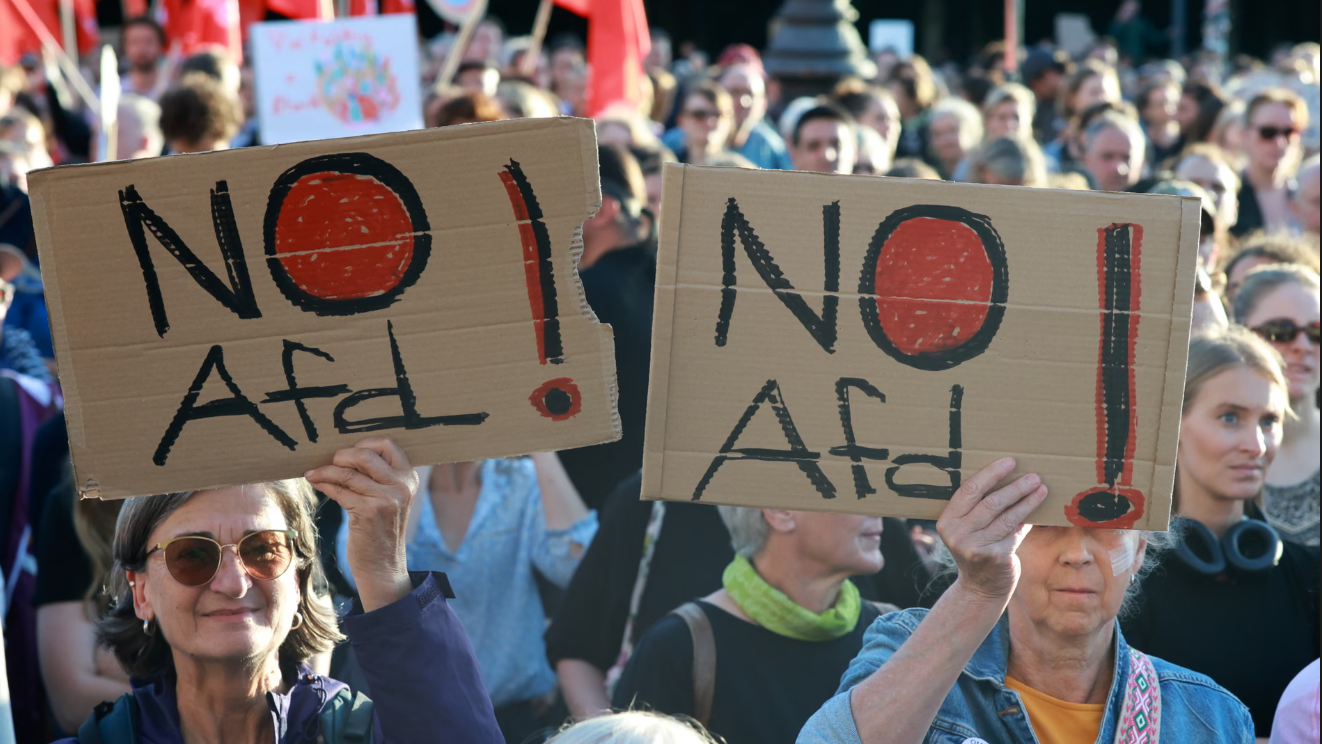
Thousands of people in Germany took to the streets to protest against the far-right «Alternative for Germany» following the party’s record result — nearly 44% — in the Saxony-Anhalt election. In Berlin, protesters gathered at the Brandenburg Gate, whilst a campaign to mobilise voters is underway ahead of regional elections in the capital and in Mecklenburg–Western Pomerania on 20 September.
Briefly about the main points
- According to police figures, 5,000 people took part in the protest in Berlin.
- The organisers reported that over 14,000 people took part in the demonstration.
- The AfD is three votes short of forming a government in Saxony-Anhalt.
- In Mecklenburg-Western Pomerania, the party has around 35% support.
- In Berlin, the CDU holds a narrow lead, with around 20%.
Rallies took place in Berlin and other cities
The demonstration in Berlin was peaceful and pro-democracy. On their placards, participants wrote: «Fascism is not an alternative», «Stop the Nazi AfD: put an end to racism and cuts to social services» and «History is watching us». The demonstrators urged people not to give in to despair and cynicism following the result of Sunday’s vote.
The police estimated the number of demonstrators at 5,000, whilst the organisers reported a figure of over 14,000. Protests also took place in Potsdam, Münster, Göttingen, Dresden, Aachen, Bamberg, Darmstadt and Halberstadt. In Halle, left-wing groups and civil society organisations have been running a protest camp since election day.
The AfD is close to forming a government in Saxony-Anhalt
Match result was her best result in local elections and the highest achieved by a nationalist party since the Nazi era. The director of the memorial to the former Nazi concentration camp Buchenwald Jens-Christian Wagner described the outcome as a «disgrace», which is infuriating and shocking.
The AfD, led by its candidate Ulrich Sigmund, is three votes short of the support needed to form a government. Sigmund is hoping to win over dissenting members of other parties who could influence the formation of a majority. Since 2023, Germany’s domestic intelligence service has classified the AfD’s regional branch as far-right, citing a threat to democratic norms.
A 17-year-old Linke activist from Saxony-Anhalt Max Schneller stated from the stage in Berlin that opponents of the AfD would oppose any attempts by the party’s government to direct policy against minorities.
The pre-election positions in Mecklenburg and Berlin differ
In Mecklenburg-Western Pomerania, the AfD is leading in the polls with around 35% support. Meanwhile, the Social Democratic Party led by State Premier Manuela Schwesig has seen its approval rating rise over the summer and now stands at over 30%.
In Berlin, the race for first place is much more wide open. The Christian Democratic Union has around 20% and only a slight lead; it is followed by Die Linke and the AfD, then the SPD and the Greens, who are polling in the mid-teens. The capital is governed by a coalition of the CDU and the SPD.
The dispute over reforms is putting pressure on Merz’s coalition
The Chancellor’s unpopularity Friedrich Merz, which reportedly had a significant impact on voter sentiment in Saxony-Anhalt. The Chancellor stated that countering the rise of the AfD requires boosting the economy and reforming the social security system, and promised to remain in office and push through a package of painful reforms.
The SPD, the junior partner in the federal coalition, has indicated that it is prepared to back down on some of the most unpopular measures in order to restore support for the government. Analysts believe that disagreements over the reforms could further destabilise the coalition in the run-up to the votes on 20 September.