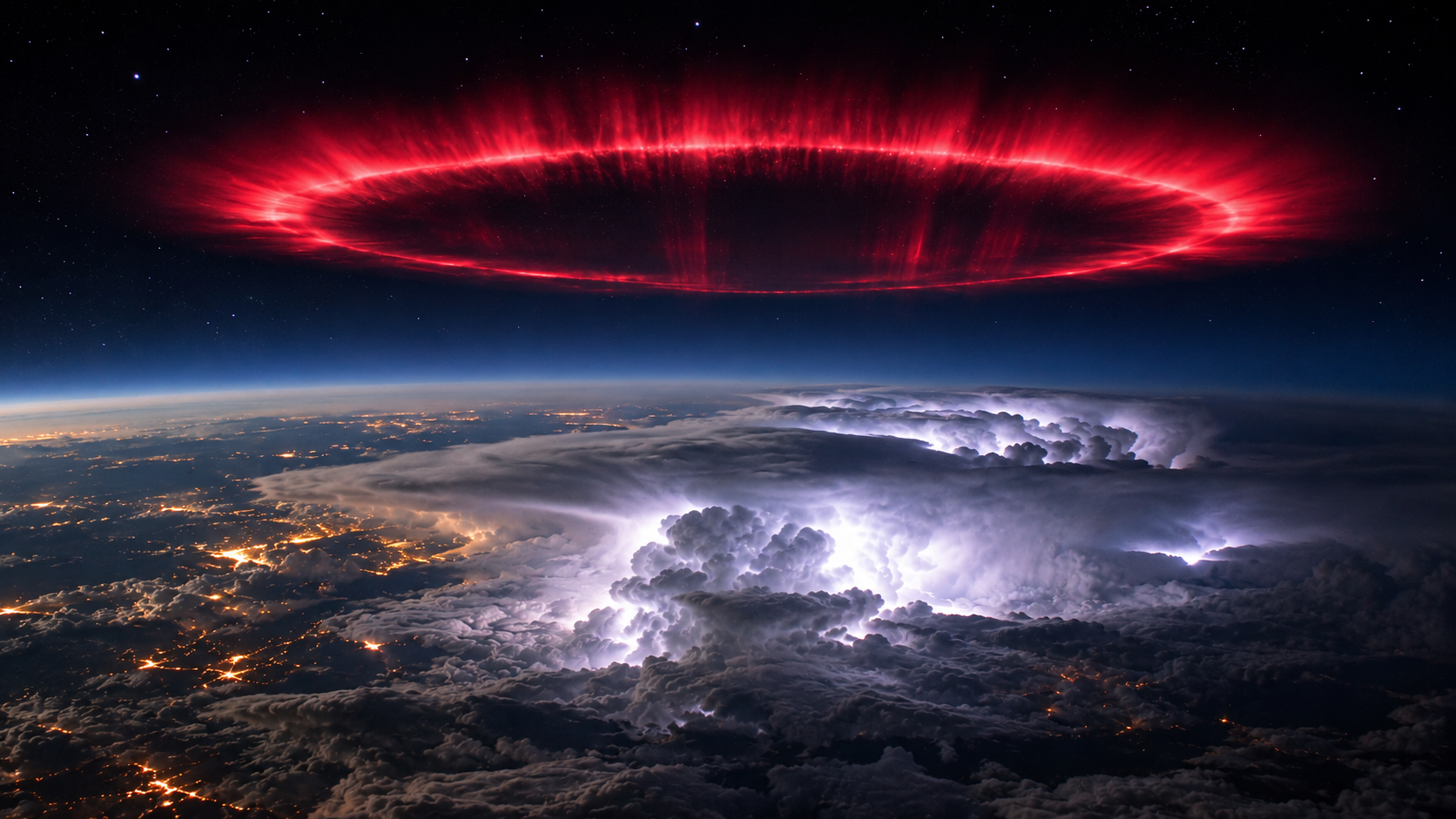
Giant reddish rings of light appear in the upper layers of the Earth’s atmosphere, with diameters that can exceed 300 kilometres. They appear above powerful thunderstorms, expand in a fraction of a second and disappear so quickly that the human eye is practically unable to detect them. This phenomenon is called ELVES. It is being studied by NASA and the European Space Agency (ESA) in an effort to better understand how ordinary lightning affects the atmosphere at an altitude of nearly 100 kilometres.
What is ELVES and why do giant rings appear in the sky?
ELVES are a type of short-lived light phenomenon that occurs high above thunderclouds. Unlike ordinary lightning, these flashes take place in the lower part of the ionosphere.
When a powerful electrical discharge creates an electromagnetic pulse, it propagates upwards and interacts with charged particles in the atmosphere. This results in a glow that rapidly spreads out in the form of a ring or disc.
According to NASA, The diameter of such formations can reach approximately 320 kilometres. Despite its enormous size, the flash lasts for only an extremely short period of time.
The reddish colour is caused by the glow of nitrogen in the upper layers of the Earth’s atmosphere.
Why it is almost impossible to see ELVES from Earth
The main characteristic of this phenomenon is its extraordinary transience. Some flashes last less than one thousandth of a second. Furthermore, the rings form considerably higher than the thunderclouds, which often obscure them from observers on the planet’s surface.
To detect ELVES, researchers use high-speed cameras, photometers and specialised equipment on spacecraft.
One such instrument is the ASIM instrument suite, installed on the International Space Station. It enables the study of electrical processes above thunderstorms and the detection of flashes of light that cannot be studied in detail using conventional cameras.
In 2025, scientists uncovered new details about the formation of ELVES
In March 2025, a study was published in the scientific journal *Geophysical Research Letters* which confirmed an additional mechanism behind the formation of giant light rings. Scientists compared optical observations from the ASIM complex with radio measurements of lightning activity in China. The results showed that ELVES can form not only as a result of powerful discharges between clouds and the ground, but can also be caused by corona discharges in the upper part of thunderclouds.
This discovery helps researchers to better assess the intensity of electrical processes within thunderstorm systems.
How do ELVES differ from red sprites?
Both phenomena are associated with severe thunderstorms, but differ in appearance and the mechanisms by which they form.
Red sprites They usually resemble jellyfish, trees or vertical structures of light. They occur mainly at an altitude of 50–90 kilometres. ELVES, on the other hand, spread horizontally, forming huge discs or rings of light.
Scientists are studying both phenomena, as they demonstrate how the electrical activity of thunderstorms affects the upper layers of the atmosphere.
Could such rings of light appear over Ukraine?
The physical conditions required for ELVES to occur are not limited to specific countries or continents. They are primarily linked to the characteristics of powerful electrical discharges. In theory, such flashes could also occur above thunderstorm systems in Ukraine. However, this does not mean that they are easy to spot or that specific instances over Ukrainian territory have already been confirmed.
The ELVES studies are helping scientists to better understand the interaction between thunderstorms, electromagnetic pulses and the Earth’s ionosphere.