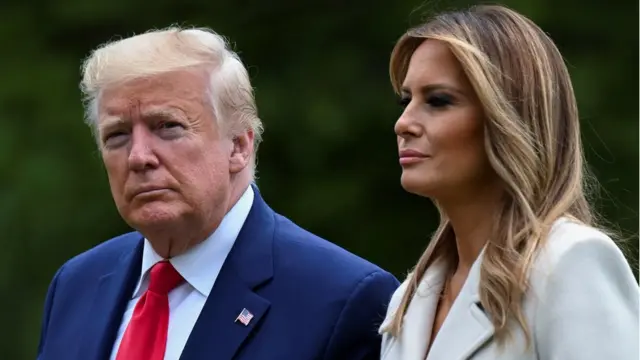
US President Donald Trump has stated that, once the Russian-Ukrainian war is over, Washington expects to resume economic relations with both Ukraine and Russia. He made these remarks on 24 October whilst speaking to journalists in Florida. The US leader also commented on the possibility of further strikes against Iran and announced the destruction of Iranian radar systems. When asked about a possible trip to Ukraine, US First Lady Melania Trump did not rule out such a visit, but did not disclose any specific plans.
- Trump has stated the US’s intention to do business with Ukraine and Russia once the war is over.
- The US President referred to the agreement with Ukraine on strategic minerals.
- Melania Trump has not ruled out the possibility of visiting Ukraine.
- Trump has left the door open for further strikes against Iran, but has not ruled out a diplomatic settlement.
Trump has announced future US business dealings with Ukraine and Russia
Whilst speaking to journalists after early voting in Florida Donald Trump They asked about the possible involvement of Russian investors in gas projects in Alaska.
The US President declined to comment on specific investment proposals, but steered the conversation towards the prospects of ending the war between Ukraine and Russia.
«We would like to return to a situation where Russia and Ukraine reach an agreement, and then we will be able to do business with both,» said Trump.
He also referred to the agreements between Washington and Kyiv on strategic minerals, which he regards as one of the areas of economic cooperation.
According to the US President, once hostilities have ended, the US will be able to work with both countries.
At the same time, Trump did not specify exactly which economic projects might be carried out with Russia, whether they would involve an easing of sanctions, or under what conditions this might be possible.
No new trade or investment agreements with Moscow were announced during the talks.
Melania Trump has not ruled out a visit to Ukraine
At the end of the press conference, journalists asked the First Lady of the United States Melania Trump, whether she plans to visit Ukraine.
«We’ll see,» she replied briefly.
Melania did not mention any possible dates for the trip or its itinerary. Nor has the White House announced any plans for an official visit by the First Lady to Kyiv.
Her response came against the backdrop of more active involvement in humanitarian talks relating to the Russian-Ukrainian war.
On 23 October, the US administration announced that, with Melania Trump acting as a mediator, Kyiv and Moscow had reached an agreement on a temporary cessation of hostilities in the area around the occupied town of Oleshky in the Kherson region.
The aim of the agreement is to ensure the delivery of humanitarian aid and to organise the safe evacuation of civilians still in the city.
A White House statement notes that The ceasefire is due to begin on 29 October. However, during a conversation with journalists on 24 October, Melania mentioned 27 October. No public explanation was given for the discrepancy in the dates.
The First Lady confirmed that she had been in contact with Ukrainian and Russian leaders as part of the preparations for the agreements.
Trump has authorised further strikes against Iran
A separate part of the conversation was devoted to the situation regarding Iran.
Responding to a journalist’s question about the possible resumption of military strikes, Trump stated that the United States was considering various options for further action. He did not rule out a new attack, but at the same time emphasised the possibility of reaching a diplomatic agreement with Tehran.
According to the US President, the Iranian side is keen to engage in talks, but Washington is seeking long-term guarantees regarding the nuclear programme.
Trump also stated that the US military had destroyed a significant portion of Iran’s air force, navy and radar infrastructure.
The President made these assessments without providing detailed evidence. There is no independent confirmation of the complete destruction of the military systems listed.
«My uncle invented radar»: what’s wrong with Trump’s claim
Commenting on the US strikes against Iranian radar systems, Donald Trump mentioned his uncle John Trump, who worked at the Massachusetts Institute of Technology (MIT).
«My uncle invented radar. Can you believe it? Dr John Trump from MIT. He’d probably be angry with me, but I destroyed their radars,» said the US President.
However, the claim that John Trump invented radar is historically inaccurate.
John George Trump was indeed a renowned American electrical engineer and professor at MIT, and worked on military radar technology during the Second World War.
He contributed to the development of radar systems, particularly those used by the Allies during the Normandy landings.
However Radar technology originated much earlier as a result of research carried out by many scientists. A British physicist played a key role in the development of practical radar systems in the 1930s Robert Watson-Watt.
So, Donald Trump’s uncle was one of the specialists who developed radar technology, but he was not its inventor.
What do Trump’s statements mean for the negotiations on Ukraine?
The US President’s statements came against the backdrop of fresh diplomatic talks aimed at bringing the Russian-Ukrainian war to an end.
Washington continues to discuss the possibilities for a peaceful settlement, whilst Kyiv emphasises the need for security guarantees and refuses to recognise the occupied territories as Russian.
Trump’s willingness to consider future economic cooperation with Russia does not mean that the relevant agreements have already been drawn up or that sanctions will automatically be lifted once hostilities cease.
On 24 October, the US President did not specify any particular timeframe for the end of the war, the terms of a peace agreement or future trade arrangements.
Similarly, a visit by Melania Trump to Ukraine remains, for the time being, merely a possibility, which the First Lady has not publicly ruled out.