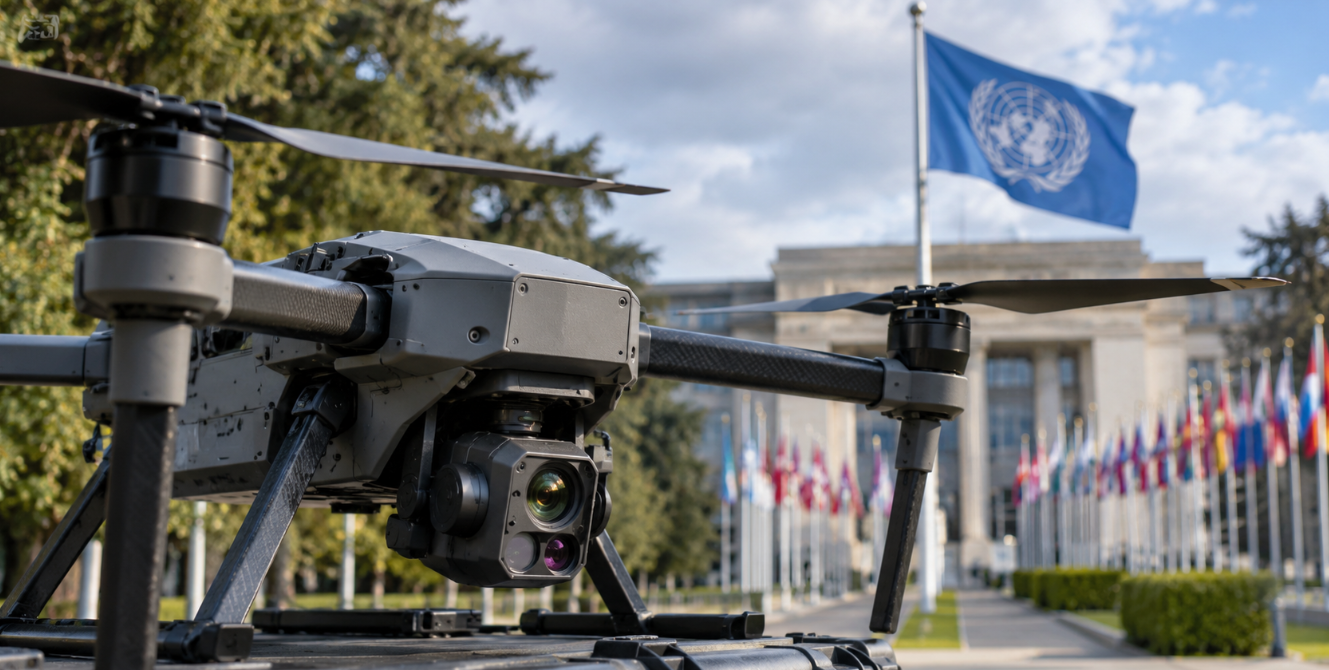
A UN conference is due to begin in Geneva on 16 November, at which states will discuss international restrictions and a possible ban on autonomous weapon systems capable of independently selecting and attacking targets without human intervention. The rapid development of artificial intelligence is already changing the principles of warfare, but international law does not yet have a specific treaty setting out clear rules for the use of such technologies.
- Talks on autonomous weapons equipped with artificial intelligence are set to begin in Geneva on 16 November.
- Such systems can independently select and attack targets without the involvement of an operator.
- The UN is calling for international bans and restrictions on the use of autonomous weapons.
- Countries have not yet agreed on legally binding rules governing the use of such technologies.
Autonomous weapons can attack without a command from the operator
The conference will take place from 16 to 20 November within the framework of the Convention on Certain Conventional Weapons (CCW). The main issue will be the regulation of lethal autonomous weapon systems, which are capable of detecting, selecting and engaging targets without direct human intervention.
According to an expert at the Geneva Centre for Security Policy Jean-Marc Rikli, the development of unmanned aerial vehicles equipped with artificial intelligence enables combat systems to analyse their surroundings and respond autonomously to changes in the situation. This means that such weapons are potentially capable of attacking not only pre-defined targets, but also targets they have selected whilst carrying out their mission.
Such technologies are the subject of controversy due to questions of liability for potential errors. If an autonomous system were to strike civilians, international law would have to determine who would be held responsible for the consequences: the commander, the operator, the developer or the state that deployed the weapon.
The UN is calling for machines not to be given the power to decide people’s fates
UN Secretary-General Antonio Guterres and President of the International Committee of the Red Cross Mirjana Spoljaric They had previously called on states to urgently introduce legally binding restrictions on the use of autonomous weapons. This primarily concerns systems capable of independently selecting people as targets.
At the same time, countries’ positions on future regulation differ. France insists on maintaining human control over the use of lethal force, whilst the US emphasises the need for an appropriate level of human oversight of autonomous systems.
Experts warn that even the operator’s formal involvement does not always guarantee effective control. A person may merely be confirming the algorithm’s recommendations, without having sufficient time or information to independently assess the selected target.
These technologies are already being used in modern warfare
Certain autonomous military technologies have already been used during Russia’s war against Ukraine and in US strikes on Iran. At the same time, fully autonomous lethal systems have not yet become widespread.
Military experts are paying particular attention to the development of swarms of drones, which can coordinate their actions and launch simultaneous attacks using several drones. The use of artificial intelligence has the potential to significantly expand the capabilities of such systems and reduce the need for constant manual control of each drone.
Despite rapid technological progress, the question of the reliability of algorithms remains unresolved. The Chief Executive Officer Anthropic Dario Amodei He had previously expressed doubts about the readiness of modern AI systems to independently control lethal weapons.
Following the conference in Geneva, states may be able to determine the way forward for negotiations on an international treaty. However, at present, there is no agreement amongst the participants even on whether the future rules should be legally binding.