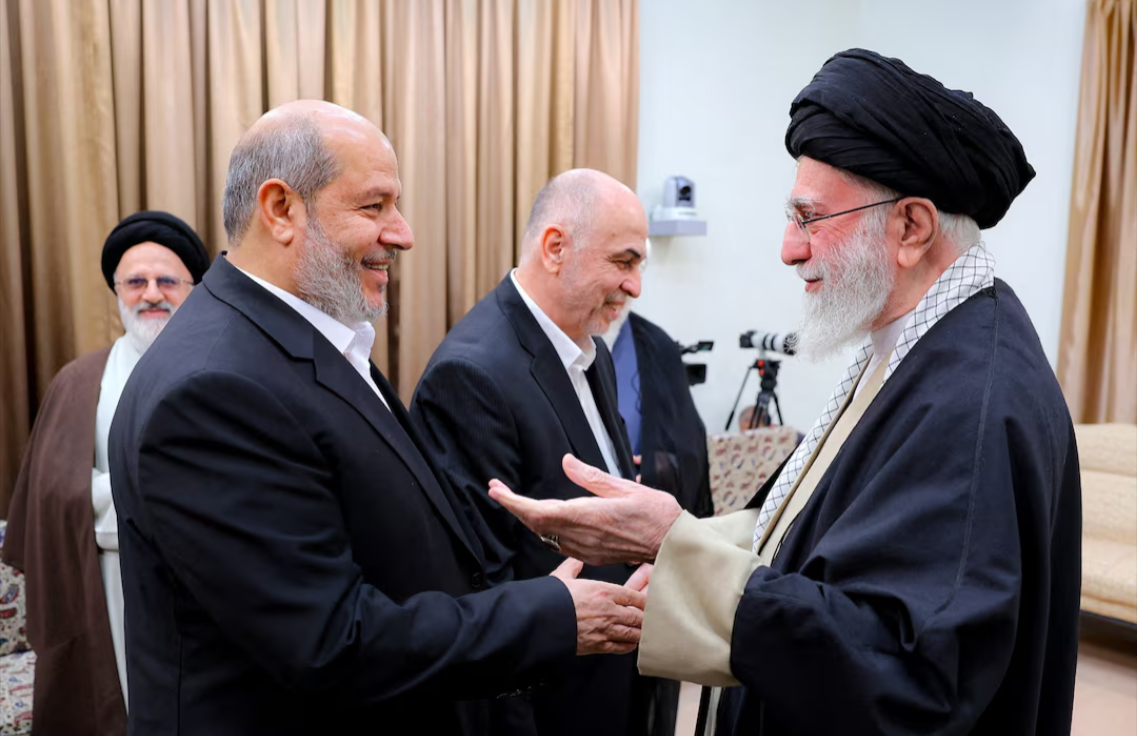
On 20 July, Hamas announced the election of Khalil al-Hayya as head of its political bureau. He succeeded Yahya Sinwar, who was killed in October 2024 during fighting with Israeli forces. Al-Hayya, who is based in Doha, was one of the movement’s key representatives in indirect negotiations on a ceasefire and the exchange of hostages.
Briefly about the main points
- Hamas has elected Khalil al-Hayya as head of the Political Bureau.
- He succeeded Yahya Sinwar, who was killed in October 2024.
- Al-Hayya is the movement’s chief negotiator in Doha.
- The election took place against a backdrop of disputes over the disarmament of Hamas.
- At least five people were killed in Israeli strikes in Gaza on 20 July.
The transition from collective leadership
Following his death Sinwara HAMAS It was governed by a five-member supreme council, which included al-Hayya and Khaled Mashal. The electoral process began in January but was interrupted by the wars in Iran and Lebanon, as well as subsequent Israeli operations in Gaza.
According to Al Jazeera, al-Hayya faced off against Mashaal in the final round of the internal vote. The election marks the end of the transitional period following Sinwar’s death; the movement’s next elections are expected to take place in 2027.
A negotiator from Gaza, based in Doha
Al-Hayya, aged 64, is originally from Gaza but has been living in Doha for some time. Following the deaths of Ismail Haniyeh in Iran in July 2024 and Sinwar, he became one of the key figures in the Hamas leadership outside Gaza.
Reuters reported that al-Hayya survived an Israeli strike on Doha in 2025. He also had close ties with Iran and was involved in re-establishing Hamas’s contacts with Damascus in 2022.
Disarmament remains the main point of contention
The election of a new leader is taking place at a time when Hamas is facing international pressure to disarm. The US President’s plan Donald Trump provides for the disarmament of the group and the withdrawal of Israeli troops, as well as the administration of the enclave by a Palestinian technocratic administration under the supervision of the Peace Council.
On 6 July, Hamas announced that it was dissolving its government in Gaza and is prepared to hand over civil administration to the National Committee for the Administration of Gaza. At the same time, the movement has not announced any disarmament or the handover of security control to international forces.
In comments to Reuters, Palestinian analyst Reham Ouda described al-Hayya’s victory as a sign of Hamas’s commitment to armed struggle and its unwillingness to disarm. This is her assessment, not an officially declared new policy of the movement. Negotiations on a broader agreement have so far failed to yield results.
Attacks in Gaza continue despite the ceasefire
Fighting in Gaza has subsided since truce, brokered by the US in October, yet Israeli strikes are continuing. According to medical sources, three people travelling in a car were killed in Khan Yunis on 20 July. The Israeli military told Reuters that it had carried out a strike against a militant in the area.
The Associated Press later reported that at least five people had been killed in Gaza that day: two more people were killed in a strike on a flat in Gaza City. The Israeli army stated that the targets were a militant from the «Palestinian Islamic Jihad» in Khan Yunis and a Hamas operative in Gaza City.
According to Gaza’s health authorities, more than 1,150 Palestinians, mostly civilians, have been killed in Israeli attacks since the October ceasefire. During the same period, four Israeli soldiers were killed in Gaza.
A single hub for political decision-making and networking
Al-Hayya’s election brings together, under a single leader, Hamas’s political representation, its links with Gaza and the negotiating channel in Doha. This may make it easier for mediators to communicate with the movement, but it does not mean an automatic breakthrough on issues of disarmament or the future governance of Gaza.
The war, which began following an attack on Israel by Hamas-led militants on 7 October 2023, has caused widespread destruction in Gaza. According to Gaza’s health authorities, more than 73,000 people have been killed; Israel reported that around 1,200 people were killed and 251 abducted during the attack on 7 October.