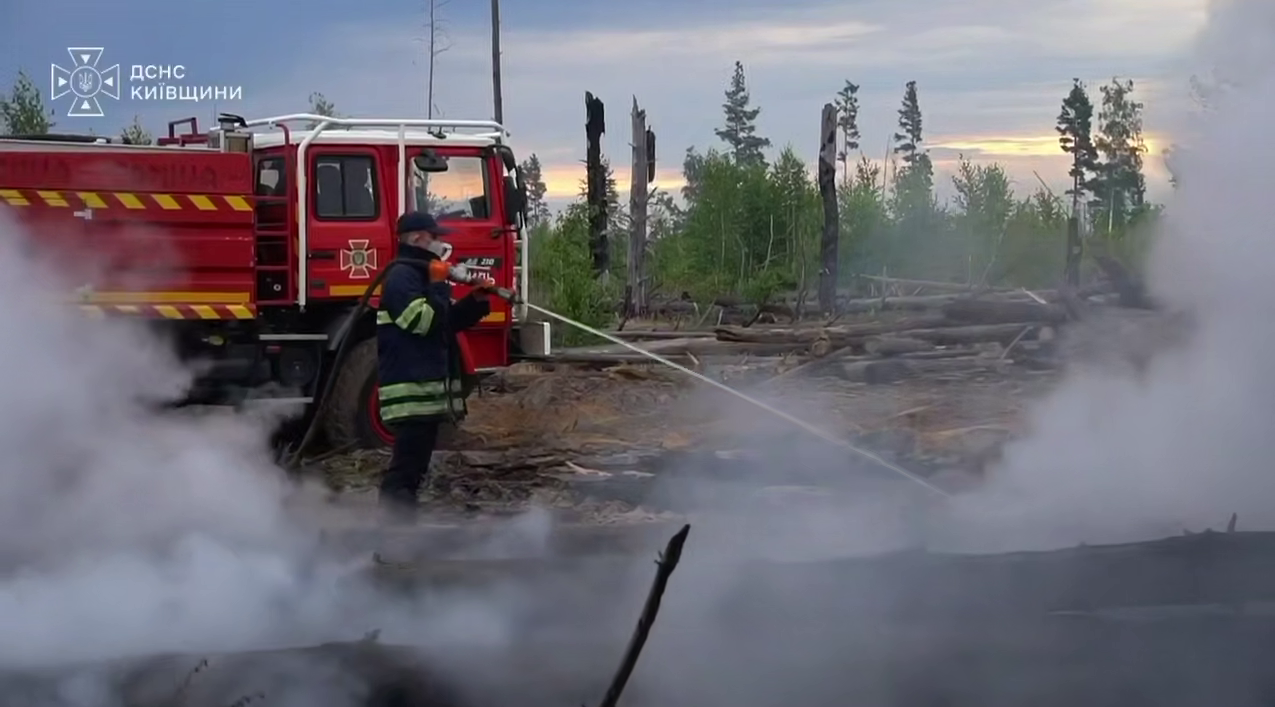
Fires have broken out again in the Chernobyl Exclusion Zone, according to the State Emergency Service. Rescue workers managed to prevent the fire from spreading and to contain the main sources of the blaze. The report did not provide any details regarding the extent of the fires, their locations, causes, the resources deployed or possible consequences.
Briefly about the main points
- The State Emergency Service has reported new fires in the Chernobyl Exclusion Zone.
- The spread of the fire was successfully prevented.
- The main sources of the fire have been contained.
- No details have yet been released regarding the size, causes or locations of the fires.
- The previous major fire in the area was completely extinguished on 10 July.
What is known about the current fire?
The State Emergency Service has not provided details on the locations of the fires, the type of vegetation that was burning, or the number of rescue workers and vehicles deployed to the scene. Nor has any information been released regarding casualties, damage to property or the probable cause of the fires.
Containment means that the fire is being kept within defined boundaries. However, it does not always mean that operations have ended immediately: following previous fires, the emergency services continued to monitor smouldering peat bogs, grass, fallen trees and stumps.
The fires broke out again following their extinguishing in July
The current fire broke out less than three weeks after the previous major fire had been completely extinguished a forest fire in the exclusion zone. According to the State Emergency Service, the fire was brought under control on 10 July; it had started on 25 June, and it took around two weeks to extinguish it.
During that incident, more than 200 firefighters and around 60 pieces of specialist equipment were deployed. To gain access to the fire, access routes were cleared using heavy machinery and firebreaks were created. These figures relate solely to the fire in June and July and do not reflect the scale of the current outbreaks.
The effects of radiation require separate measurements
Fires in the Exclusion Zone They can release radionuclides remaining in the soil and vegetation into the air. This mechanism alone does not necessarily mean that radiation levels will automatically exceed the limits: the assessment depends on the location and intensity of the fire, as well as the direction of the wind.
During the fires of 26–28 June, researchers at the Institute for Nuclear Power Plant Safety Problems of the National Academy of Sciences of Ukraine estimated the maximum modelled concentrations of caesium-137 in the surface air of Kyiv to be more than two orders of magnitude below the standard for the general public. At the same time, the combustion products were briefly carried in the direction of central Ukraine, in particular Kyiv.
No up-to-date data from automated radiation monitoring, satellite observation or smoke drift forecasts for this new incident has yet been released. Therefore, the potential impact of the current fire on specific settlements can only be assessed once such data becomes available.