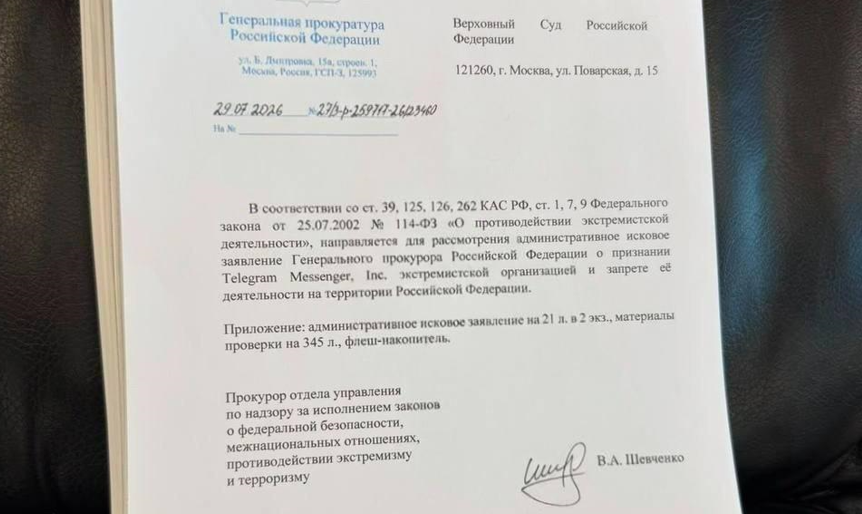
The Russian Prosecutor General’s Office has filed an administrative claim with the Supreme Court seeking to have Telegram Messenger Inc. designated as an «extremist organisation» and to ban its activities in the country. This is confirmed by a photograph of the covering letter dated 29 July, which has been published by the Russian media. The court is to decide whether to accept the application and set a date for the hearing.
Briefly about the main points
- The Russian Prosecutor General’s Office has filed a lawsuit seeking to ban Telegram.
- The company is being asked to be designated as an «extremist organisation».
- The case files were forwarded to the Supreme Court on 29 July.
- The court has not yet accepted the claim for consideration.
- The ban may affect the service’s channels, advertising and partners.
The case is still to be heard by the Supreme Court
The covering letter states that an administrative claim by the Russian Prosecutor General has been submitted to the court. The package contained the 21-page claim itself, 345 pages of material from the prosecutor’s investigation and a digital storage device. The document was signed by V. A. Shevchenko, a prosecutor from the relevant department of the Prosecutor General’s Office.
The submission of documents does not mean that the messaging app has already been banned. The Supreme Court must register the application, decide whether to accept it for consideration, and schedule a hearing. Under Russian procedure, a court ruling that has become final is required to include an organisation on the list of extremist organisations.
What consequences might a ban have?
If the court grants the prosecution’s request, this will create a legal basis for the platform to be completely blocked in Russia. The risks may relate to Telegram’s official representation, advertising of the service, financial transactions in its favour and the company’s public presence.
The mere use of the app or reading its channels is not defined as a separate offence under Russian criminal law. At the same time, the legislation provides for liability for organising the activities of an already banned extremist organisation, recruiting members to it, and participating in it. Consequently, the practical extent of the risk for administrators, employees and commercial partners will depend on court rulings and the practices of the Russian law enforcement agencies.
For the Russian authorities themselves, the ban will also create a communication problem: Telegram The Kremlin, government ministries, law enforcement agencies, regional governors, state media and military propagandists are all making use of this. They will have to shut down their channels or move their audience to other platforms.
Pressure on the messaging app has been mounting since February
The lawsuit was filed after Russia’s FSB accused the founder of Telegram Pavel Durov in allegedly facilitating terrorist activities. The Russian side claims that Ukrainian security services used the messaging app to recruit Russian citizens and plan acts of sabotage. Telegram has rejected Moscow’s allegations, whilst Durov had previously described the restrictions as an attempt to drive users towards MAX, a messaging app controlled by the Kremlin.
Roskomnadzor has begun a phased approach restrict the operation of Telegram In February 2026: users complained of problems uploading photos, videos and voice messages, as well as issues with channels. Previously, the authorities had restricted voice and video calls. Human Rights Watch linked this move to increased state control over the internet and the promotion of MAX.
According to a human rights organisation, Telegram’s monthly audience in Russia stood at 95.7 million users in February. A previous attempt to block the service in 2018 proved technically unsuccessful, but the current gradual restrictions and the administrative promotion of MAX may give the authorities more leverage to put pressure on the platform.