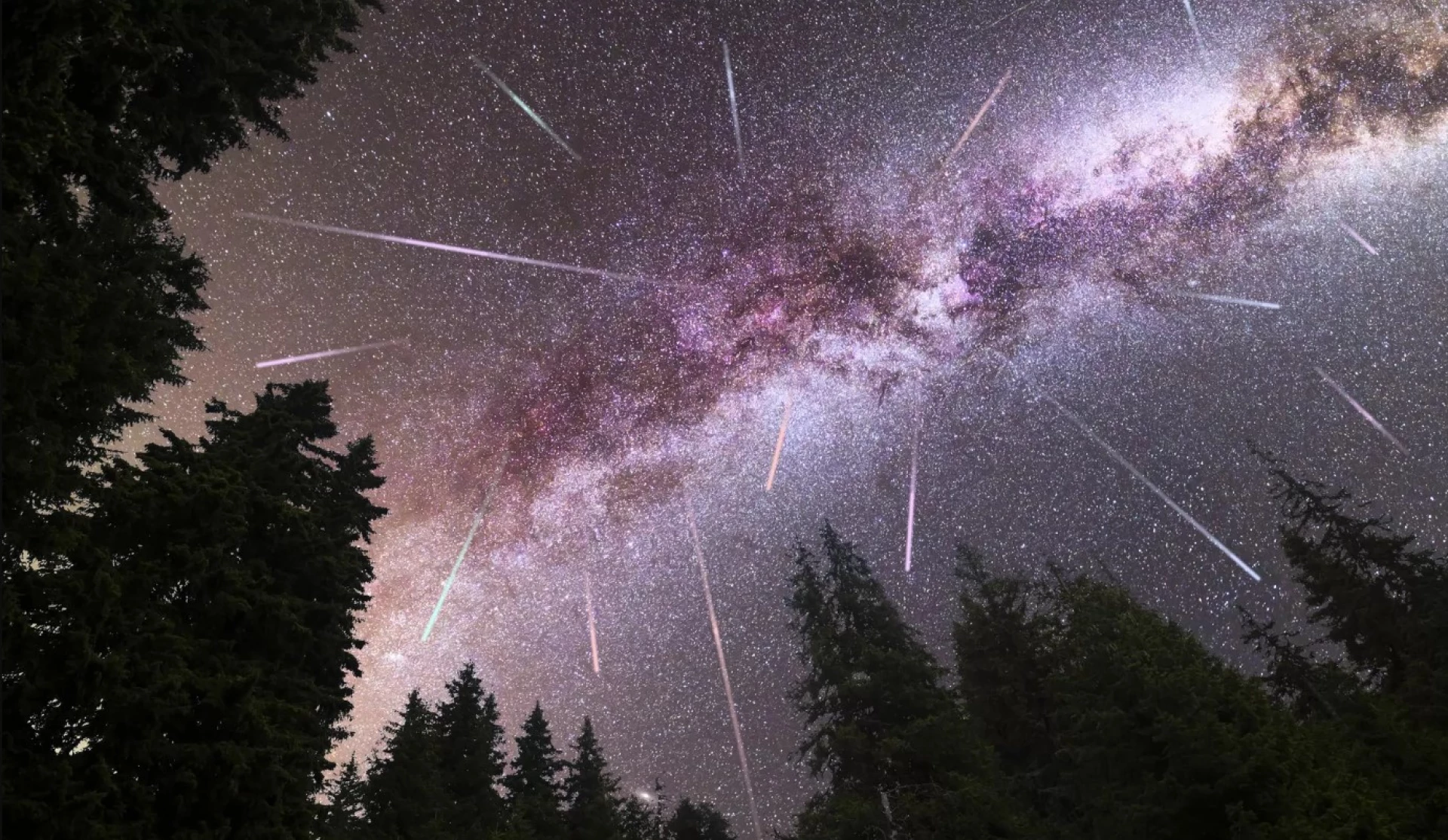
In August 2026, Ukrainians will be able to see one of the most spectacular meteor showers of the year — the Perseids. The highest number of «shooting stars» is forecast for the night of 12–13 August. This year, viewing conditions will be particularly favourable, as the peak of the meteor shower almost coincides with the new moon, meaning that moonlight will not interfere with the visibility of even the faintest meteors.
Briefly about the main points
- The Perseid meteor shower will reach its peak on the night of 12–13 August 2026.
- The meteor shower will be active from around 17 July to 24 August.
- Under ideal conditions, you can see up to 100 meteors per hour.
- The best time for stargazing is from just after midnight until dawn.
- You don’t need a telescope or binoculars to observe it.
- The new moon will create favourable conditions for observing the meteor shower.
When will the Perseid meteor shower take place in 2026?
Meteor shower The Perseids It is observed every year in the second half of summer. In 2026, it will be active from approximately 17 July to 24 August, but the peak in meteor activity will occur during the night of Wednesday 12 August to Thursday 13 August.
The American Meteor Society has identified the night of 12–13 August as the peak of activity. Under favourable conditions, the theoretical rate of the meteor shower could approach 100 meteors per hour. The actual number of visible flashes will depend on the weather, lighting conditions, atmospheric transparency and the observation location.
The best time for viewing in Ukraine is from midnight until the start of dawn on 13 August. Individual meteors may be visible earlier, as soon as it gets dark, but as morning approaches, the radiant of the shower will rise higher above the horizon.
Why conditions in 2026 will be particularly favourable
The main advantage Perseids 2026 This year will see an almost complete absence of moonlight. The new moon in Kyiv will occur on 12 August at approximately 20:36. Consequently, at the peak of the meteor shower, the Moon will provide virtually no light in the night sky.
In the years when the full moon coincides with the peak, the bright moonlight masks a significant proportion of the fainter meteors. This time, even short and not particularly bright flashes will have a better chance of remaining visible.
NASA describes the Perseids as one of the best annual meteor showers. They are known for their large number of fast and bright meteors, their long trails of light and the appearance of fireballs.
Where to watch the Perseids in Ukraine
The meteor shower will be visible across the whole of Ukraine, provided the weather is clear. It is not the region or city that matters most, but the level of light pollution.
The following are best suited:
- a private open-air courtyard;
- the outskirts of the settlement;
- a field or hilltop without trees or tall buildings;
- a safe place to relax away from the bright city lights;
- a balcony or roof offering a wide view of the sky, provided access is permitted.
You can also see the brightest meteors in the centre of a large city, but there will be far fewer of them. Streetlights, advertising hoardings, building lighting and car headlights reduce the eyes’ sensitivity to faint flashes.
During martial law, you must be aware of the curfew, air-raid sirens and local restrictions. You should not leave the town or village during prohibited hours, or go to areas near military or infrastructure sites.
Which way should I look?
The name of the meteor shower is linked to the constellation Perseus, near which its radiant is located — the notional point from which, as seen by the observer, the meteors appear to emerge.
In the evening, Perseus appears in the north-eastern part of the sky and gradually rises higher. However, there is no need to keep looking directly at the constellation. Longer and more spectacular meteor trails are often visible at a considerable distance from the radiant.
The best option is to find a spot with the widest possible view and look about 40–60 degrees to the side of Perseus. It’s more comfortable to observe whilst lying down or reclining, so that you can take in as much of the sky as possible.
How many meteors can you see?
A rate of up to 100 meteors per hour is a theoretical estimate for an ideal dark sky, when the radiant is high in the sky and the view is unobstructed by clouds, trees or buildings.
In real-life situations, an observer may see:
- in dark rural areas — several dozen meteors per hour;
- on the outskirts of the town — around 10–30 of the most prominent flashes;
- In the centre of a big city — just a few bright shooting stars.
The stream is not continuous. Sometimes nothing happens for several minutes, after which several light trails may appear simultaneously in different parts of the sky.
Do I need a telescope?
You do not need a telescope, binoculars or any other magnifying equipment to observe the Perseids. Such devices only show a small section of the sky, whereas meteors can appear anywhere.
The best «tool» is still the naked eye. After leaving a well-lit room, it takes about 20–30 minutes for your eyes to adjust to the darkness.
You shouldn’t stare at your smartphone screen all the time. Even a quick glance at a bright screen can impair your night vision. If you need to check the time or adjust the camera settings, it’s best to turn down the brightness and switch on the red filter.
How to photograph a meteor shower on your mobile phone
A modern smartphone It can capture a bright meteor if it has a night or professional mode. However, it is impossible to predict the exact location where the flash will appear, so the camera needs to film the sky for an extended period.
When taking photographs, you should:
- Securely mount your phone on a tripod or a stable surface.
- Select a wide-angle camera.
- Turn off the flash.
- Switch to night mode or professional mode.
- Set the exposure time to between 10 and 20 seconds.
- Use the timer to ensure the phone doesn’t move once you’ve pressed the button.
- Take a series of several dozen shots.
If the exposure time is too long, the stars may appear as short streaks due to the Earth’s rotation. The exact settings depend on your smartphone model and the lighting conditions.
What are the Perseids?
A meteor shower occurs when the Earth passes through a trail of dust and small debris left behind by Comet 109P/Swift–Tuttle.
The particles enter the Earth’s atmosphere at a speed of approximately 59 kilometres per second. Due to intense heating, they break up at high altitude, creating brief streaks of light.
The common name «meteor shower» is therefore figurative. Stars do not fall, and most of the particles that cause the flashes are the size of a grain of sand or a small pebble.
Swift–Tuttle’s Comet orbits the Sun approximately once every 133 years. It last approached the inner Solar System in 1992, but the dust it left behind gives rise to the Perseids every year.
What might interfere with observation
The main obstacle will continue to be the weather. Overcast skies, fog or precipitation could completely obscure the meteor shower. It is advisable to check the forecast for your specific town 24–48 hours before the peak.
Visibility is also reduced by:
- street lighting;
- smoke or dust in the air;
- high humidity;
- trees and houses;
- bright screens;
- car headlights.
If the night of 12–13 August is cloudy, you can try to spot the Perseids on the following nights. The meteor shower will remain active, although the number of meteors will gradually decrease.
Frequently Asked Questions
When is the peak of the Perseids in 2026?
The highest levels of activity are expected during the night of 12–13 August.
What time should I watch the meteor shower?
The best conditions are forecast for after midnight and until the start of dawn on 13 August.
Will the Perseids be visible in Ukraine?
Yes, the meteor shower will be visible across the whole of Ukraine, provided the weather is clear and subject to safety restrictions.
How many shooting stars will be visible?
Under ideal conditions, the rate can reach around 100 meteors per hour, but in towns and cities the actual number will be considerably lower.
Do you need a telescope?
No. The Perseids are best observed with the naked eye from a spot with a wide view of the sky.
What should we do if it’s cloudy on the night of the peak?
Try observing the flow on the night before the peak or over the next few nights.