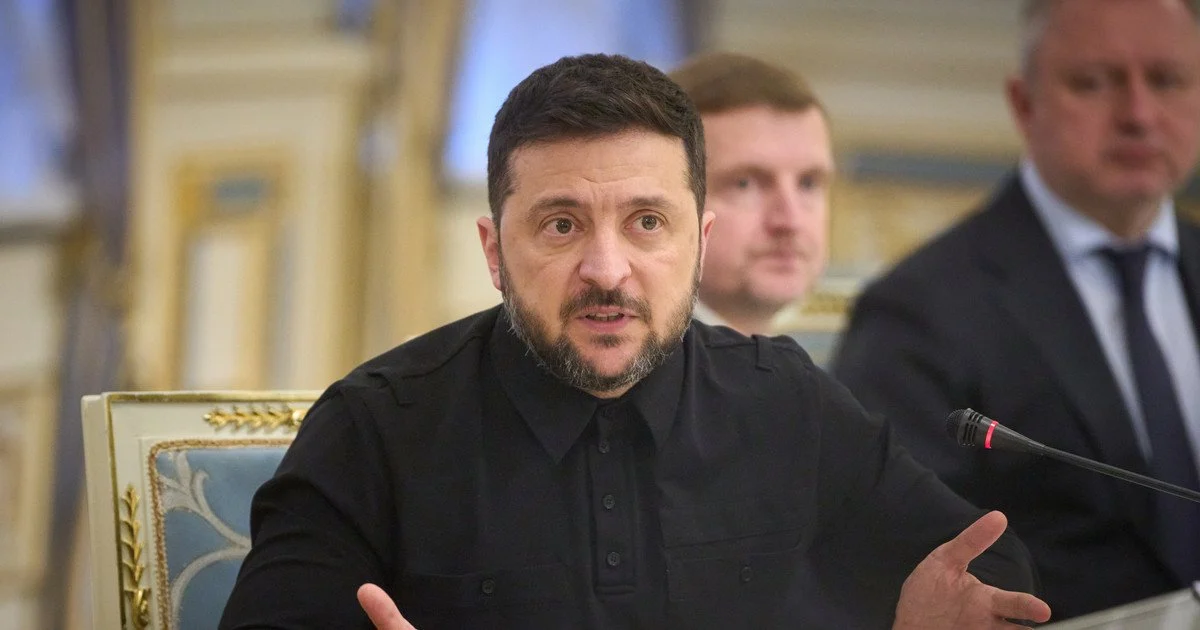
President Volodymyr Zelenskyy has called on Ukrainian ambassadors to counter Russian influence in the run-up to elections in partner countries. He cited hybrid methods, financial interference and destabilisation as risks. Zelenskyy also tasked the diplomats with developing relations with China.
Briefly about the main points
- Zelensky drew the ambassadors’ attention to the risks posed by Russian influence.
- The election cycle in partner countries will begin in September.
- Several votes are scheduled to take place in Germany in September.
- In the US, the mid-term congressional elections will take place on 3 November.
- The President also called for the development of Ukraine’s relations with China.
Elections among our partners will begin in September
Zelenskyy stated that a «very special period» lies ahead in partner countries that are of significance to Ukraine. He mentioned elections in the German states, Israel and the United States, and next year — in France and other countries.
The electoral calendar in Germany begins with voting in Saxony-Anhalt on 6 September. Next on the schedule are local elections in Lower Saxony on 13 September, followed by elections to the Berlin Parliament and the Landtag of Mecklenburg-Western Pomerania on 20 September. In Israel, elections are scheduled for 27 October, whilst the US mid-term congressional elections are set for 3 November 2026. The French presidential elections are due to take place in April and May 2027.
Risks associated with information operations
According to the president, Russia «never misses an opportunity» to interfere in elections through hybrid methods, financial interference and destabilisation. He emphasised that the threats posed by such influence are clear to everyone.
In its March report, the European External Action Service identified the elections as one of the main targets of Russian foreign disinformation and interference. Its analysts described a pattern whereby politicians and institutions are first discredited, social divisions are exploited during the campaign, and attempts are made to undermine confidence in the electoral process in the run-up to the vote.
The German government has linked the Storm-1516 disinformation campaign to Russia, which, in its assessment, sought to influence the recent federal elections and destabilise the situation in the country. Against this backdrop, Zelenskyy’s call may signify a pre-emptive diplomatic effort — in particular, explaining Ukraine’s position to politicians, the media and expert circles in countries where election campaigns are getting underway.
Dialogue with Beijing
At the same time, Zelenskyy called for the development of relations with China. In July, Deputy Foreign Minister Oleksandr Mishchenko, at a meeting with Chinese Ambassador Ma Shenkun, stated his intention to engage in substantive dialogue on strengthening Beijing’s role in achieving a comprehensive, just and sustainable peace.
The Chinese ambassador stated at the time that the PRC was prepared to play a constructive role in seeking diplomatic solutions to end the war. Beijing also officially declared its support for dialogue and negotiations. The development of these relations also has an economic dimension: by the end of 2025, China was Ukraine’s second-largest trading partner after the EU in terms of total trade turnover — almost 21 billion dollars.