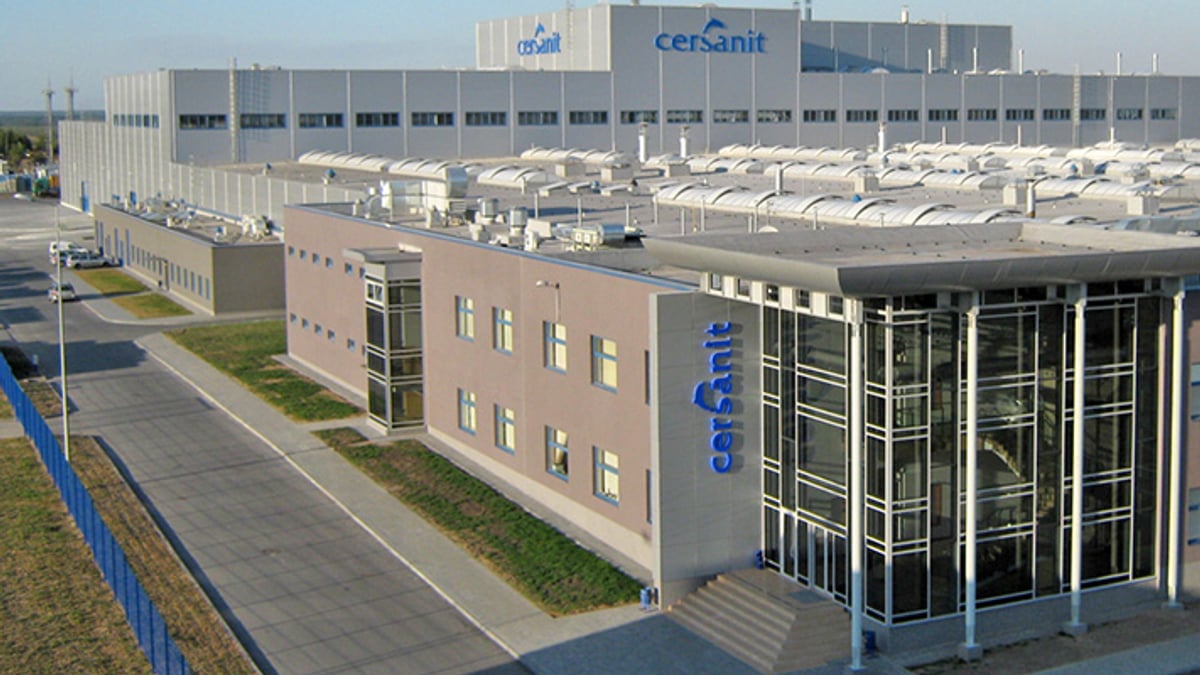
On the night of 12 September, Russian drones attacked a factory belonging to the Polish company Cersanit in the Zviahel district of Zhytomyr region. The factory produces ceramic tiles, toilet bowls, washbasins and other sanitaryware. A fire broke out on the factory premises following the strike, which was extinguished by the emergency services. There are no reports of fatalities or injuries. Thus, sanitary ware has now been added to the Russian army’s list of «strategic targets».
- Russian drones attacked the Cersanit factory in the Zhytomyr region.
- The company manufactures tiles, toilets and other sanitary ware.
- A fire broke out on the factory premises following the strike.
- The State Emergency Service reported that there were no casualties or fatalities.
- Cersanit is one of the largest manufacturers of sanitaryware and tiles in Ukraine.
«Shaheedi» struck the Cersanit factory
A Russian attack on the night of 12 September damaged the factory Cersanit S.A. in the Zviahel district. Eyewitnesses told Forbes Ukraine that the strike had hit the Polish company’s factory. As of the time of publication, Cersanit itself had not officially commented on the consequences of the attack.
The State Emergency Service had previously reported a fire at one of the district’s industrial sites following a Russian strike. Firefighters extinguished the blaze. No reports of fatalities or injuries have been received.
Thus, having targeted warehouses, food processing plants, petrol stations and logistics facilities, Russian drones have this time struck a company whose main products are — tiles and bathroom fittings.
They manufacture toilets, washbasins, baths and tiles
Ltd «Cersanit Invest» It is the Ukrainian «subsidiary» of the Polish company Cersanit S.A. The company manufactures ceramic tiles under the Cersanit and Opoczno brands, as well as sanitaryware and acrylic bathroom fittings.
The company’s catalogue features, amongst other things, toilets, bidets, urinals, washbasins, baths, shower trays, bathroom furniture and plumbing systems.
Therefore, if one sets aside all of Moscow’s military rhetoric, the facts appear rather mundane: during the night, Russia deployed attack drones against a factory which, amongst other things, mass-produces toilets and washbasins.
The factory has been operating in the Zhytomyr region for almost 20 years
The project to build the Cersanit plant in the Zhytomyr region began back in 2007. At that time, the European Bank for Reconstruction and Development supported the establishment of a new ceramic tile and sanitaryware production facility in the Novograd-Volynskyi area, now known as Zviahel.
According to the EBRD, even at an early stage the plant was producing approximately 7 million square metres of tiles and 1 million units of sanitaryware per year. It was later planned to increase production capacity to 12 million square metres of tiles and 2 million units of sanitaryware.
Cersanit’s official documents state the production address of Cersanit Invest Ltd in the village of Chizhivka, Zvyagel District, Zhytomyr Region.
The company has a turnover in the billions
According to Forbes Ukraine, the revenue of Cersanit Invest LLC for 2025 exceeded 3.7 billion hryvnia. The factory has been operating in the region since 2007 and is one of Ukraine’s largest manufacturers of ceramic tiles and sanitaryware.
Cersanit describes itself as one of Europe’s leading industrial groups with Polish capital in the bathroom fittings sector. The group has seven factories and around 5,500 employees, and its products are sold in Ukraine and EU countries.
In other words, this is not a military factory or a defence industry enterprise, but a large-scale civilian manufacturer of building materials and sanitary ware.
Russia is increasingly targeting Ukrainian businesses
The attack on Cersanit was yet another incident in a series of attacks on major civilian enterprises in Ukraine.
In August alone, a Russian attack seriously damaged a German-owned factory in Zhytomyr Kromberg & Schubert, which manufactures wiring harnesses for Volkswagen, Audi, BMW, Mercedes-Benz, Škoda and Porsche. Following the strike, the company, which employs around 3,500 people, was forced to suspend operations.
On 9 September, a food processing plant in Bila Tserkva came under attack; local sources linked it to the Reeva factory.
Forbes had previously estimated that, throughout 2026, attacks on manufacturing, logistics and other economic infrastructure had effectively become a separate aspect of the war aimed at wearing down Ukrainian businesses.
Cersanit has now been added to this list. The company has not yet disclosed the extent of the damage to its production facilities or whether the attack will affect the plant’s operations.