Iran has approached Russia regarding the acquisition of new «Geran» family jet-powered strike drones, according to the Financial Times. Tehran has expressed interest in modernised Russian weaponry against the backdrop of the war against the US and Israel. Among the new models is the «Geran-5», which has a payload of around 90 kg, a speed of up to 600 km/h and an optical guidance system utilising machine vision algorithms.
Briefly about the main points
- Tehran wants to acquire new Russian jet-powered attack drones.
- Iran had previously supplied Russia with Shahed-131 and Shahed-136 drones, as well as the relevant manufacturing technology.
- «The »Geran-5’ is fitted with a turbojet engine and has a range of around a thousand kilometres.
- The optical system makes it possible to correct the flight path without constantly relying on satellite navigation.
- Moscow has already supplied Iran with drones and other military equipment.
From the supplier of Shahed drones to the recipient of Russian drones
At the start of Russia’s full-scale war against Ukraine, Tehran supplied Moscow with Shahed-131 and Shahed-136 drones. Russia subsequently established mass production of these drones under the name «Geran», gradually modifying their navigation systems, communications, engines and warheads based on lessons learnt from attacks against Ukraine.
According to the FT, following the start of the US-Israeli strikes, representatives from Moscow and Tehran secretly agreed on the supply of attack drones to Iran. Russia subsequently began delivering consignments of drones, as well as other aid.
«The »Geran-5’ is faster than the earlier Shahed models and features a new guidance system
According to the Main Intelligence Directorate of Ukraine, «Geranium-5»It is equipped with a turbojet engine, has a range of approximately 1,000 km and reaches speeds of 450–600 km/h. The standard Shahed-136, with its propeller-driven powerplant, usually flies two or three times slower.".
The Financial Times reports that the «Gerani» jet aircraft are being fitted with optical systems and machine vision algorithms. These enable them to adjust their flight path during the final stage, reducing the aircraft’s reliance on satellite navigation in electronic warfare conditions.
The publication also classifies the «Geran-4» and «Banderole» as part of this family. In terms of their performance characteristics, the new vehicles are increasingly similar to cruise missiles, although they are often described as drone missiles.
Production at Alabuga has accelerated the modernisation of the platform
At the end of 2023, Moscow began large-scale production of «Geraniums» in the special economic zone «Alabuga» in Tatarstan. CSIS notes that Russia has turned the basic design into a platform for continuous modernisation: changes to engines, navigation systems, modems, warheads and tactics – tested in Ukraine – can be rolled out into mass production within weeks.
According to Ukrainian officials cited by *The New York Times*, around 1,500 jet-powered drones were recorded in July, and approximately 3,000 in August. The FT also noted that Ukraine is intercepting the latest models with significantly lower success rates than the earlier piston-engine Shaheds.
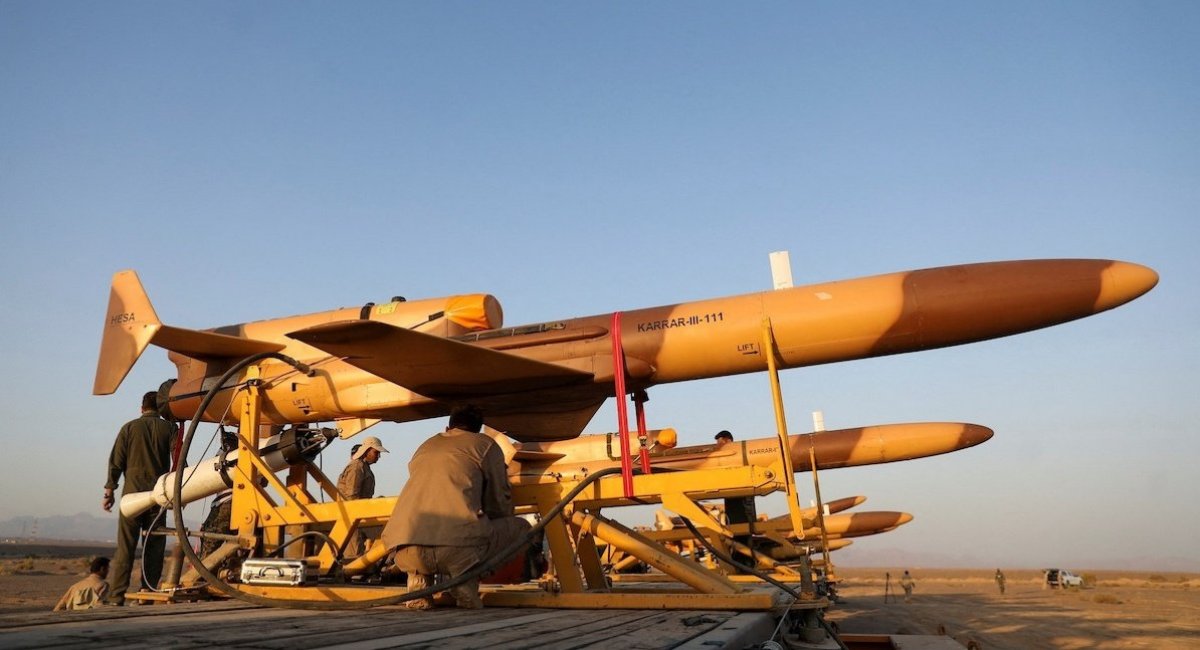
The design is thought to be linked to the Iranian Karrar and an American target
Ukrainian intelligence and military analysts believe that the «Gerani-5» design is derived from the Iranian Karrar jet-powered drone. It has a similar aerodynamic configuration and could serve as a platform for strike and air defence missions.
The origins of the Karrar, in turn, are linked to the American MQM-107 Streaker unmanned target drone, samples of which Iran received many years ago. The Russian version of this technology line has now become a subject of interest for Tehran itself.
Cooperation between Moscow and Tehran extends beyond drones
In early September, the FT reported on the secret C430L programme, under which Russian specialists are helping Iran to develop ramjet engines for supersonic cruise missiles. Such missiles could potentially be used against American aircraft carriers and other warships in the Persian Gulf. The publication also reported on a deal worth approximately €500 million for Iran to purchase Russian «Verba» man-portable systems and thousands of missiles for them.
Ukraine was the first to face the widespread use of «Geran» rocket systems. In early September, they were regularly attacking Kyiv and other regions, and on 3 September, Serhiy «Flash» Beskrestnov reported that air defence forces had shot down a «Geran-5» near the capital for the second day running; according to him, the missiles were launched from a distance of approximately 400 km. The technologies developed by Russia in the war against Ukraine are already becoming a resource for Iran in its confrontation with the US and Israel.