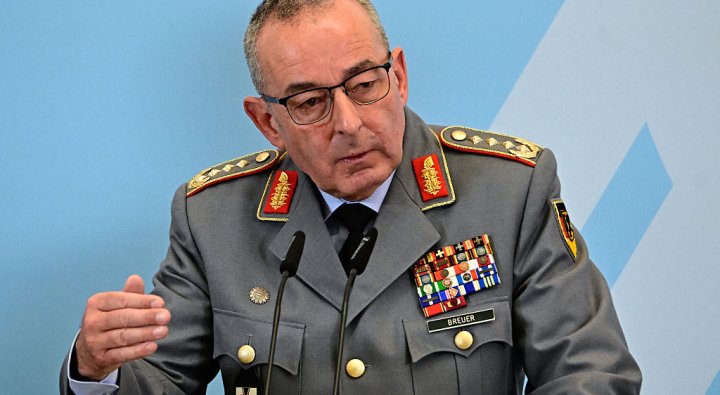
Carsten Breuer, Inspector General of the Bundeswehr, has called on Germany to prepare not only its armed forces but also its industry and civil society for a possible defence. Speaking at a defence conference in Prague, he stated that it is impossible to effectively counter hybrid threats with military forces alone without the support of the whole country, according to Bild.
Briefly about the main points
- Breuer called for the army, the business sector and society to be prepared for defence.
- The general described hybrid threats as a challenge that cannot be tackled by the army alone.
- Germany is assessing the capacity of its hospitals in the event of a large-scale conflict.
- The healthcare system may have to deal with a thousand wounded soldiers every day.
- The UK is updating its civil contingency plans for military and other crises.
The army is not strong enough to counter modern threats
Breuer linked broader defence training to rapid development military technologies and the nature of hybrid threats. In his view, effective deterrence requires cooperation between the armed forces, government bodies, the private sector and the public.
«Without you, we soldiers are doomed to failure. But failure is not an option, because it would pose a mortal threat to our societies as we know them. We are all in this together,» said the general.
In Germany, ‘Operationsplan Deutschland’ is already in place — a framework plan that combines territorial and collective defence tasks with civilian support. It provides for coordination ranging from responses to hybrid threats in peacetime through to crisis and wartime scenarios.
Hospitals are preparing for a large influx of casualties
At the same time, the German authorities are assessing the healthcare system’s capacity to operate in the event of a large-scale military conflict. Under the scenario being considered in the country, hospitals could potentially admit up to 1,000 wounded servicemen per day.
Official planning Bundeswehr It anticipates the arrival of between 300 and 1,000 wounded or sick servicemen from NATO’s eastern flank every day; approximately one-third of them may require intensive care. The military medical service will not be able to cope without civilian hospitals.
The Bundeswehr is also considering restoring certain medical facilities. This will require significant financial resources.
Assessment of the threat posed by Russia and the task of deterrence
This increase in readiness comes against the backdrop of NATO’s assessments of a potential threat from Russia. The Commander of the German Land Forces, Lieutenant General Christian Freuding He had previously stated that Russia could acquire the capability to attack a NATO country by 2029.
According to him, all 32 NATO member states share this timeframe; however, this does not mean that an attack will necessarily take place at that precise moment. German officials are primarily concerned with establishing an adequate level of deterrence and being prepared for various scenarios.
For Germany, this is also linked to its role as a NATO logistics hub. The planning parameters stipulate that, in the event of Article 5 being invoked, up to 800,000 allied troops and up to 200,000 pieces of military equipment could be moved through the country within six months.
Britain is updating its civil defence plans
The United Kingdom takes a similar approach. Its National Security Strategy provides for preparations for a potential direct threat to British territory, particularly in a military scenario.
The British Government is planning a public awareness campaign on public preparedness for emergencies. It will cover not only war, but also cyber-attacks, sabotage and disruptions to critical infrastructure, the energy sector and other systems.
In September, the government informed parliament of updated plans for civil defence and the imposition of martial law in the event of an escalation. The approach involves the participation of state bodies, the business sector and the voluntary sector in ensuring national resilience; this is scenario planning, not an announcement of the imminent outbreak of war.