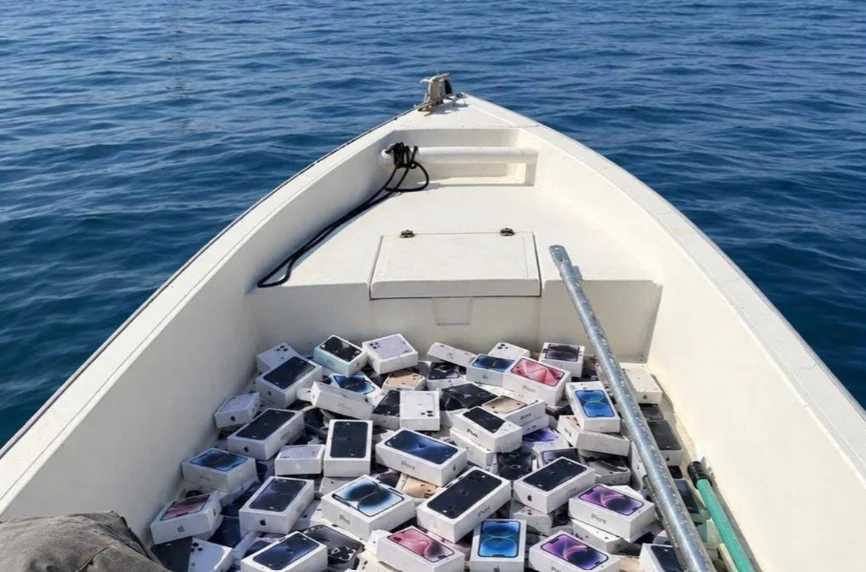
The container ship GFS Pride sank in the Strait of Hormuz near Oman after sustaining damage on 13 October. The Singaporean authorities confirmed the sinking the following day, and all 21 crew members were evacuated unharmed. Some of the containers and goods ended up in the water; the media reported that fishermen were searching through them for iPhones and French perfumes.
Briefly about the main points
- The GFS Pride sank after sustaining damage on 13 October near Oman.
- Singapore confirmed that the vessel had sunk the following day.
- The entire crew has been evacuated; there are no casualties.
- The exact nature and quantity of the lost cargo are being determined.
- Iran is talking about a mine, whilst Singapore is talking about an unidentified projectile.
Fishermen are gathering their belongings amongst the drifting containers
According to a report by The Telegraph published on 16 October, following the accident, containers carrying various goods were left in the water, some of which had fallen into the sea. Local fishermen headed to the scene of the accident after reports of a consignment containing mobile phones and perfumes.
Footage has been circulating on social media showing people in motorboats and dinghies retrieving boxes from the water. In one video, a small vessel is seen attempting to tow a shipping container.
At the same time, reports of thousands of iPhones have not been officially confirmed. The exact contents of the lost consignment and the number of smartphones are still being determined. Some of the videos circulating on social media may have been generated using artificial intelligence, so such footage does not in itself confirm the scale of the losses.
A fire on board preceded the flooding
GFS Pride was taking place the Strait of Hormuz off the coast of Oman, when it sustained damage. A fire broke out on board, after which the vessel sank. The Singapore Maritime and Port Authority confirmed the sinking on 14 October.
According to W K Webster, an international marine insurance claims settlement firm, the container ship was carrying more than 2,500 containers. The volume of damaged or lost cargo has not yet been determined.
Reuters has published satellite images dated 14 October: they show containers and other objects drifting in the water off the coast of Oman.
Singapore and Iran are putting forward different accounts of the incident
The Singapore Maritime and Port Authority stated that the vessel had likely been struck by an unidentified projectile. The authority condemned the attacks on commercial shipping, describing them as a breach of international law and a threat to seafarers.
The naval forces of Iran’s Islamic Revolutionary Guard Corps, however, maintain that the container ship allegedly deviated from its authorised route, entered a dangerous area and struck a sea mine. According to the Iranian account, it was the explosion that caused the fire, which ultimately led to the ship sinking.
There are no independent findings to confirm that the GFS Pride was blown up by a mine. The cause of the incident is still being investigated.
Other vessels were also attacked in the area of the strait
The incident occurred against the backdrop of other attacks on merchant ships in the Strait of Hormuz. According to Reuters, the dry cargo ship Cape Dao, flying the flag of Antigua and Barbuda, which had been damaged by an attack on 23 September, sank around the same time. One member of its crew was killed, whilst the rest were evacuated.
On 14 October, an unidentified projectile damaged another Singaporean container ship — the GFS Giselle. The vessel made it to a safe anchorage under its own power, and all 22 seafarers were unharmed.
The Strait of Hormuz is one of the key maritime trade routes. Before the war broke out between the US, Israel and Iran, around a fifth of global trade in oil and liquefied natural gas passed through it. The extent of the damage caused by the GFS Pride accident has yet to be determined.