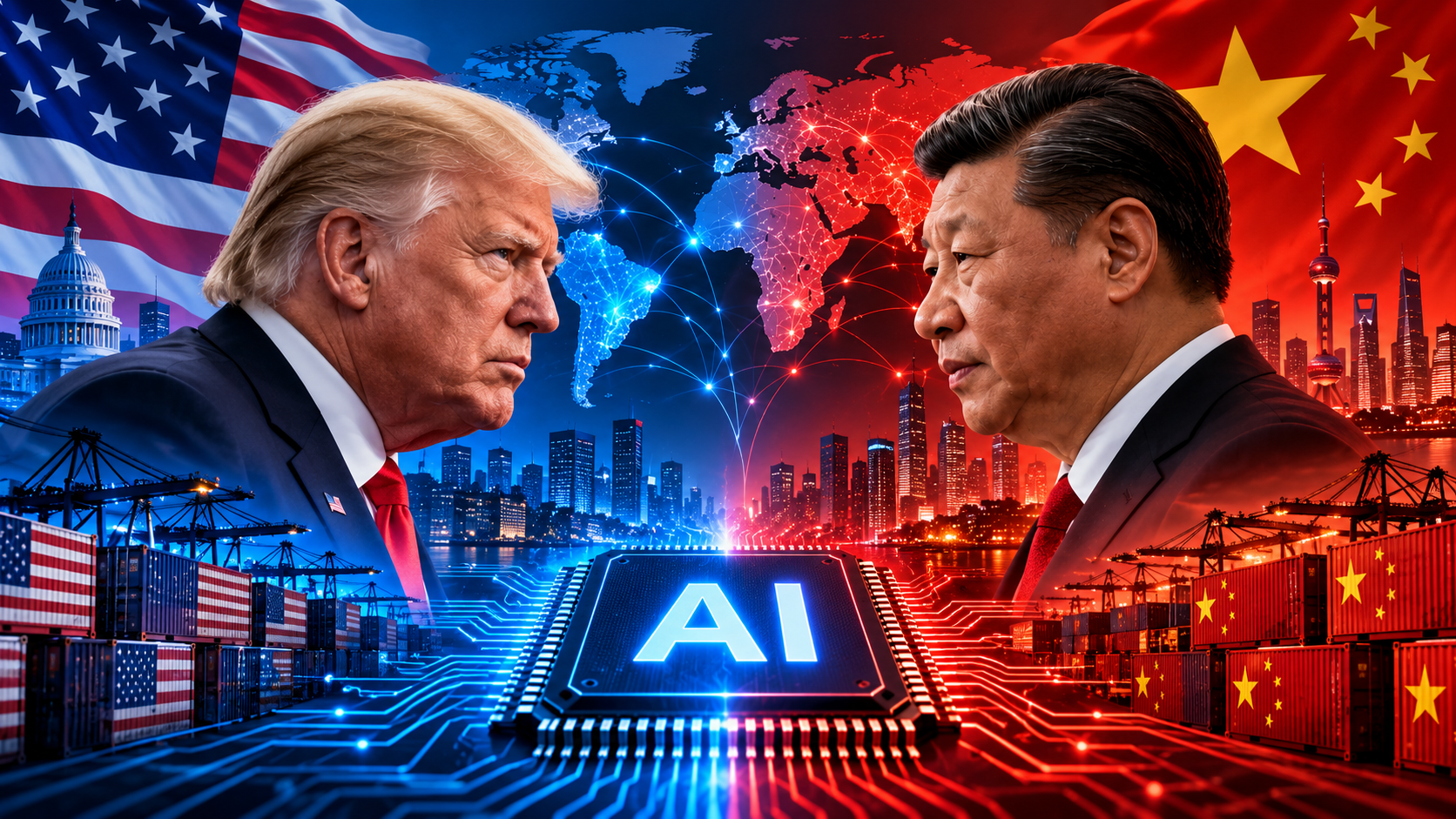
The US and China are forming two competing international alliances in the field of artificial intelligence, seeking to draw countries into their respective technological ecosystems. Washington is promoting the Pax Silica initiative, which envisages cooperation in the production of advanced microchips, the development of AI and the protection of supply chains. Beijing is proposing an alternative organisation, the World AI Cooperation Organisation, offering broader access to open-source models and technological cooperation. According to a report by the Associated Press on 25 October, countries are increasingly faced with a choice between American and Chinese technologies, although some are attempting to cooperate with both sides simultaneously.
- The US and China are developing competing international initiatives in the field of artificial intelligence.
- The US-based company Pax Silica focuses on cutting-edge chips, technology partnerships and secure supply chains.
- The Chinese World AI Cooperation Organisation promotes collaboration and accessible, open-source AI models.
- Kazakhstan has joined both initiatives in a bid to attract investment and gain access to various technologies.
The US is establishing the Pax Silica technology alliance
Washington is developing an international initiative Pax Silica, designed to strengthen cooperation between countries involved in the production of microchips, the development of artificial intelligence and the supply of critical materials.
Particular attention is paid to high-performance processors, computing infrastructure, semiconductor manufacturing and technology partnerships.
The US is seeking to establish a network of reliable suppliers of the equipment and components required to operate the most powerful AI systems. Officials in Washington emphasise that partners must adhere to shared principles of technology security.
At the same time, the US State Department has warned that countries cannot be regarded as reliable partners in Pax Silica whilst simultaneously playing a significant role in initiatives that promote a competing vision for the development of super-powerful artificial intelligence.
This raises further questions for countries that wish to access American technology whilst maintaining close ties with China.
China is promoting an alternative international AI bloc
Beijing is developing World AI Cooperation Organisation — an international organisation set up to coordinate cooperation in the field of artificial intelligence.
The Chinese initiative emphasises broader access to technology, international standards, project funding and the use of open-source models.
The organisation’s founding members included 29 states, amongst which were Kazakhstan, Pakistan and Russia.
China is offering countries its own technological solutions as an alternative to expensive American systems.
At the same time, Chinese diplomats deny that artificial intelligence should be controlled by a limited number of states.
Beijing maintains that the US and China should use their respective technological advantages for international cooperation, rather than solely to keep each other in check.
Kazakhstan has joined two technology initiatives
Kazakhstan has become one of the most telling examples of the competition between the US and China.
In June 2026, the country’s Minister for Digital Development Zhaslan Madiev visited Washington, where he joined the American initiative Pax Silica.
About three weeks later, representatives from Kazakhstan took part in a ceremony in Shanghai, during which the country became one of the founding members of the Chinese World AI Cooperation Organisation.
Astana is therefore seeking to develop technological links with two leading centres for artificial intelligence simultaneously.
Kazakhstan has significant reserves of critical minerals and relatively affordable energy resources, which are essential for the construction of large data centres.
Earlier this year, the country reached an agreement on potential investments totalling up to 10 billion dollars, involving Nvidia for the development of computing infrastructure.
Chinese investment in Kazakhstan reached a record $2.8 billion in 2025.
Which countries are trying to cooperate with both sides?
Kazakhstan is not the only country seeking to maintain technological ties with both the US and China.
Indonesia has joined a Chinese organisation, whilst at the same time exploring opportunities for cooperation with American companies.
Singapore It is also exploring the possibility of participating in the Chinese initiative, whilst continuing to attract investment from American technology companies.
In Saudi Arabia, Humain has launched a platform based on a Chinese open-source AI model. At the same time, the country is collaborating with Nvidia to develop its computing capabilities.
France is developing its own technologies through the company Mistral AI, in an effort to reduce dependence on foreign suppliers.
Japan maintains close cooperation with the US on strategic technologies, but allows the use of more affordable Chinese models for lower-risk tasks.
China is funding the development of AI in at least 77 countries
The funding of digital projects in developing countries has become an important tool of China’s technological influence.
According to the AidData research laboratory at the University of William & Mary in the US, China has provided government grants and loans for projects that use or support artificial intelligence systems in at least 77 low- and middle-income countries.
The recipients of this support include Nigeria, Zambia, Ghana, Bangladesh, Senegal, Cameroon and Kenya.
Programmes such as these help countries to build digital infrastructure and develop local technology companies.
At the same time, the choice of AI systems supplier often determines which software platforms, standards and computing hardware will be used in the future.
Will the world really split into two technological camps?
Experts point out that most countries do not have sufficient resources to develop the most powerful artificial intelligence models on their own.
The development of such systems requires enormous computing power, state-of-the-art processors, large data sets and significant investment. Consequently, access to American or Chinese technology platforms is having an ever-greater impact on the digital development of other countries.
At the same time, the emergence of competing initiatives does not mean that the world is already definitively divided into two closed blocs. The example of Kazakhstan and other countries shows that cooperation with both sides remains possible for the time being. However, further export restrictions, rules on access to advanced chips and requirements for partners could complicate such a policy.
For countries developing their own artificial intelligence sector, key issues will continue to be access to computing resources, the security of technologies and the ability to retain control over their own digital systems.