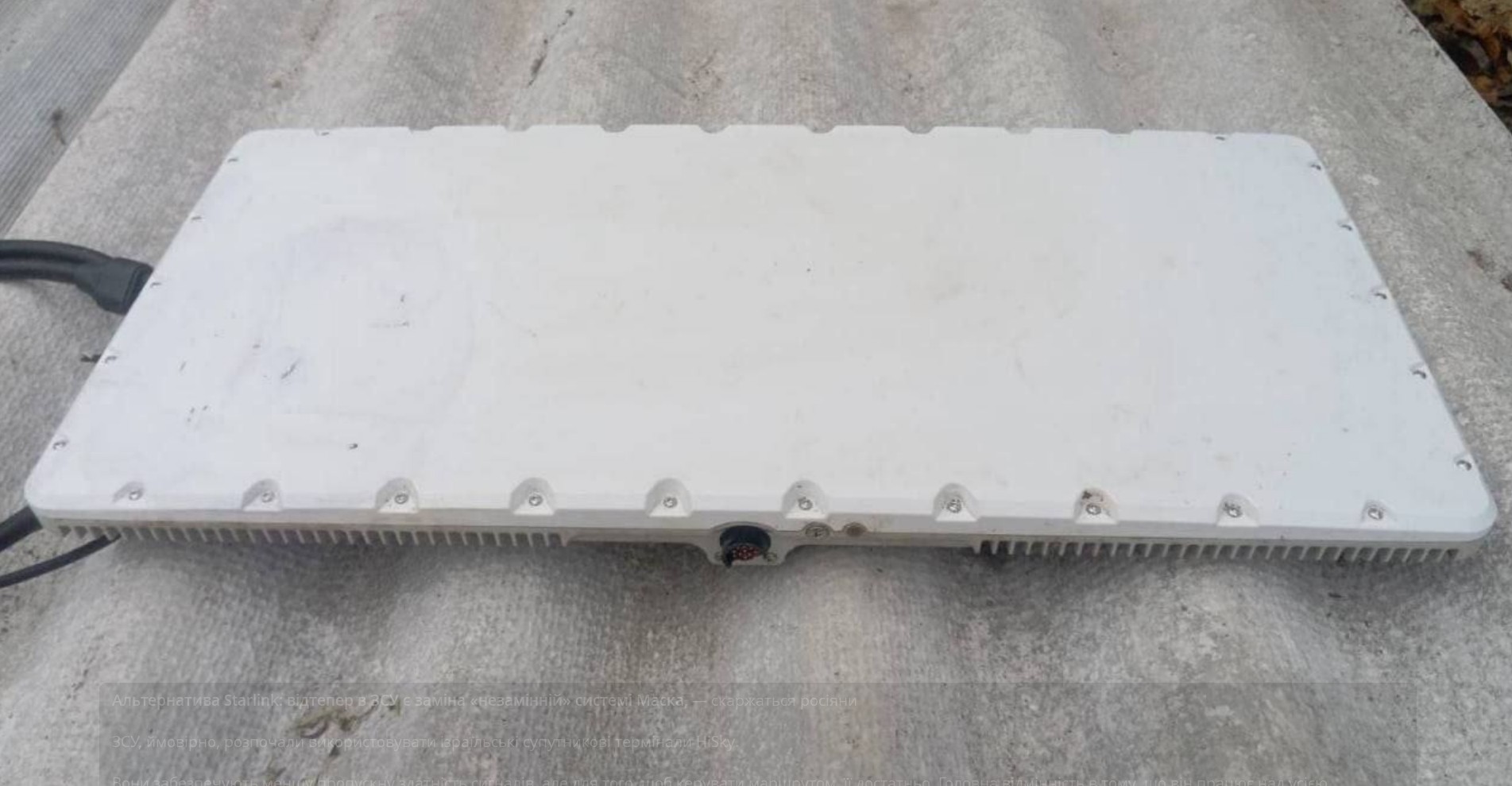
The Ukrainian military has likely begun using Israeli hiSky SmartLITE satellite terminals to communicate with long-range drones flying over Russian territory. This has been reported by Russian military bloggers, who have drawn attention to the new communications system. Unlike Starlink, hiSky technology allows operation via third-party satellite networks, but is inferior to the American system in terms of data transfer speed.
- Russian military bloggers have reported that the Ukrainian Armed Forces may be using Israeli hiSky terminals.
- The equipment enables telemetry and commands to be transmitted via satellite communication.
- HiSky uses satellites operated by other providers rather than its own constellation.
- The technology can operate in areas where Starlink satellite terminals have limitations.
The Russian military has reported the discovery of new terminals on Ukrainian drones
According to reports from Russian military channels, Ukrainian long-range drones may have been fitted with terminals hiSky SmartLITE, designed for satellite communications whilst in motion. The equipment facilitates the exchange of small data packets, including telemetry and commands for adjusting the flight mission.
The throughput of such systems is significantly lower than that of Starlink. They are not designed for full-scale, high-quality broadband video transmission, but can be used to transmit service messages and remote commands.
Ukrainian specialist in radio technology Sergey Beskrestnov, known as «Flash», commented on the system’s technical specifications, but did not confirm that it was actually being used by the Ukrainian military.
How does hiSky differ from Starlink?
The Israeli company hiSky develops compact satellite communications equipment for mobile land, sea and air platforms. Its terminals use electronically steered antennas capable of maintaining communication via geostationary and low-Earth orbit satellites.
Unlike SpaceX, the company does not have its own large satellite constellation. Its technology operates using other operators’ infrastructure, enabling it to establish communication links in areas where traditional terrestrial networks are unavailable.
The main potential advantage of hiSky for the Ukrainian armed forces is the ability to maintain satellite communications outside Starlink’s coverage area. The American system has geographical limitations, which mean that its terminals cannot operate fully over Russian territory.
At the same time, whether hiSky can operate in a particular area depends on the availability of satellite coverage, the operator’s ground infrastructure and network usage licences.
Ukraine is looking for alternatives following the Starshield restrictions
The issue of the independence of military satellite communications came to a head in October, when SpaceX imposed restrictions on the operation of certain terminals without prior notice Starshield whilst on the move. According to reports from the Ukrainian military, this led to the disruption of some combat missions involving the use of drones.
Following requests from the Ukrainian side, the service was partially restored. At the same time, the Ministry of Defence began checking backup communication channels and consulting with its American partners on the future use of satellite systems.
Israeli terminals could serve as one of several potential solutions for specific unmanned aerial vehicle missions, but there is currently no reason to regard them as a fully-fledged replacement for Starlink for all the needs of the Ukrainian Armed Forces.