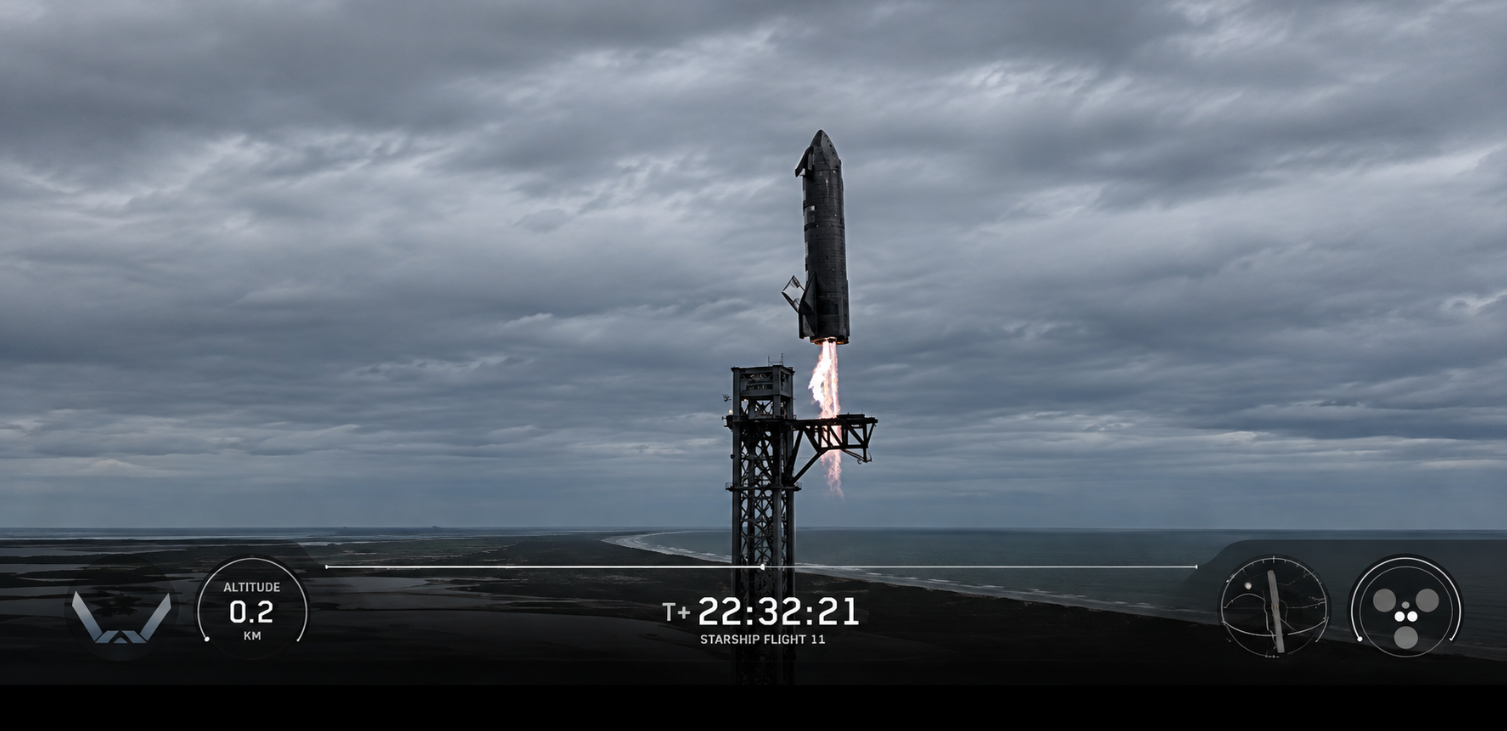
On 14 November, the American company SpaceX successfully returned the Starship spacecraft from Earth orbit directly to the launch site in Texas for the first time. After approximately 22.5 hours in flight, the spacecraft re-entered the atmosphere, performed a controlled descent and was captured by the enormous mechanical grippers of the Mechazilla landing tower. This historic manoeuvre was the main achievement of the 15th test flight of SpaceX’s super-heavy-lift rocket system.
- SpaceX has successfully returned the Starship spacecraft from orbit to the launch pad for the first time.
- After a 22.5-hour flight, the spacecraft was captured by the mechanical manipulators of the Mechazilla tower.
- The spacecraft completed 14 orbits of the Earth and deployed 26 Starlink satellites.
- The Super Heavy booster was lost due to a malfunction whilst returning after launch.
How SpaceX brought Starship back after its orbital flight
Rocket Starship It launched on 13 November from the Starbase spaceport in Texas. After separating from the Super Heavy booster, the upper stage, known as Ship 42, continued its flight and entered Earth orbit. Over the next 22.5 hours, the spacecraft completed 14 orbits around the Earth and deployed 26 Starlink satellites.
On the evening of 14 November, Kyiv time, Starship began its return. The spacecraft performed a braking manoeuvre to exit orbit, after which it entered the dense layers of the atmosphere. During the descent, its heat shield withstood the extreme temperatures caused by travelling at hypersonic speeds.
In the final stage, the spacecraft fired its Raptor engines, moved into a vertical position and approached the landing tower. At approximately 23:20 Kyiv time, the mechanical manipulators Mechazilla They captured Starship on camera and spotted it hovering above the launch complex.
SpaceX had previously recovered Super Heavy boosters in this way, but this was the first time the spacecraft itself had been successfully recovered following an orbital flight.
Why the return of Starship was a significant achievement
Starship is being developed as a fully reusable transport system, with both stages designed to return to Earth after completing their mission. Unlike traditional rockets, the company aims to eliminate the need for complex operations to recover and transport the stages after landing.
The Mechazilla mechanism consists of two massive, movable manipulators that capture the rocket as it descends vertically. This approach is intended to reduce the time between launches and enable the reuse of space vehicles with minimal preparatory work.
The spacecraft’s successful return demonstrated the operational capability of the guidance, controlled descent and capture systems following a prolonged stay in orbit. However, SpaceX still needs to improve the heat shield to reduce the amount of maintenance required before subsequent flights.
Why did SpaceX lose the Super Heavy booster?
Despite the successful return of Starship, the company was unable to fully carry out the original mission plan. During the launch on 13 November Super Heavy accelerator was due to return to the launch tower and also be captured by mechanical manipulators.
However, following the spacecraft’s separation, the system detected a problem, initially thought to be linked to a fuel shortage. Due to a deviation from the planned trajectory, the attempt to return to the launch tower was cancelled. The booster was directed towards the Gulf of Mexico, where it was lost.
Thus, during its 15th test launch, SpaceX successfully recovered the Starship upper stage for the first time; however, the simultaneous recovery of both parts of the rocket system remains the next technical challenge.
The test results are also significant for NASA’s lunar programme Artemis, as part of which a modified Starship is to be used to transport astronauts to the Moon’s surface.