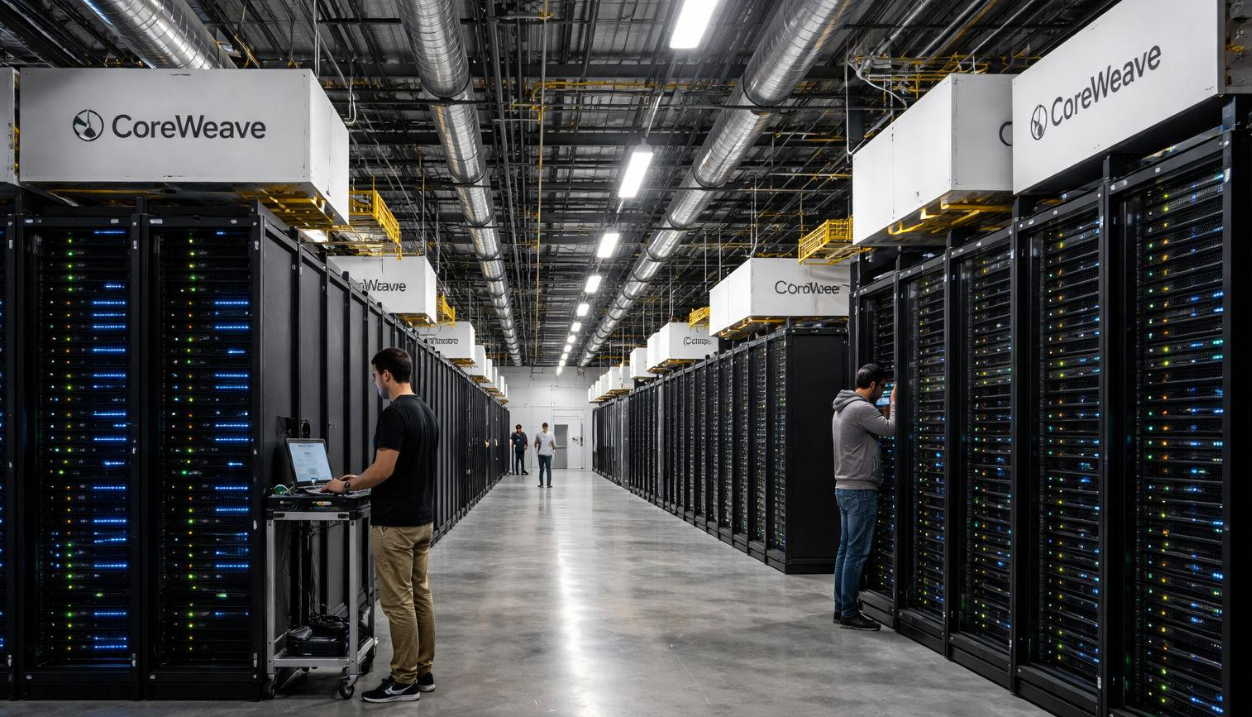
The rapid growth of the artificial intelligence industry is increasingly reliant on companies that are racking up billions in debt to build data centres and purchase expensive processors. According to the BBC, the financial stability of such operators is causing concern amongst investors, whilst the fall in their share prices is fuelling fears of a possible overheating of the AI market.
- The BBC reports on rising debt risks amongst AI data centre operators.
- CoreWeave’s debt as at June 2026 stood at $35.6 billion.
- Shares in several major operators have lost around a quarter of their value over the past month.
- Gartner forecasts that more than 80% neocloud companies will lose their independence by 2030.
Who funds artificial intelligence infrastructure?
The spotlight has fallen on the so-called neocloud companies — specialist cloud infrastructure providers that supply computing power to artificial intelligence developers.
Among the leading players in this sector are CoreWeave, Nebius, IREN and Applied Digital. They build data centres and purchase thousands of graphics processing units Nvidia and lease computing power to technology corporations and AI developers, including Microsoft, Meta and OpenAI.
Unlike technology giants with diversified sources of revenue, a significant proportion of these operators’ business depends directly on demand for AI computing.
To expand, companies take out loans, using high-value processors and long-term contracts with clients as collateral. This enables them to rapidly scale up their infrastructure, but at the same time creates a significant debt burden.
CoreWeave’s debts have exceeded $35 billion
A prime example of this was the American CoreWeave, one of the leading providers of computing power for artificial intelligence. According to its financial statements, as at 30 June 2026, the company’s total debt stood at $35.6 billion.
Despite its rapid business growth, CoreWeave remains loss-making. In the second quarter of 2026, its revenue reached $2,575 billion, but its net loss stood at $626 million.
At the same time, the company had a portfolio of future contract revenue amounting to approximately $104 billion. It is precisely these large orders that enable operators to secure new funding, although the receipt of these funds depends on the fulfilment of the contracts over the coming years.
Investors are increasingly scrutinising whether future revenue will be sufficient to cover the costs of equipment, loan servicing and the construction of new data centres.
According to the BBC, over the past month, shares CoreWeave has lost around a quarter of its value. Nebius, IREN and Applied Digital all saw similar falls.
Gartner forecasts a significant contraction in the market by 2030
The research firm Gartner believes that the current pace of investment in AI infrastructure may prove to be financially unsustainable for a significant proportion of operators.
According to her forecast, More than 80% neocloud companies will cease independent operations by 2030. This does not necessarily mean bankruptcies: some operators may be taken over by larger competitors or merge with other companies.
Gartner also estimates that more than $3.5 trillion in investment in AI infrastructure could be at risk of depreciation by the end of the decade if current rates of capital expenditure continue.
The problem is that expensive server equipment becomes obsolete much more quickly than traditional infrastructure. New generations of processors can render previous ones less competitive even before the investment has been fully recouped.
The risks extend beyond data centre operators
The financial difficulties faced by specialist operators could also have an impact on large technology companies.
According to S&P Global, the six largest US operators of large-scale cloud infrastructure, including Amazon, Microsoft, Alphabet, Oracle and Meta, could spend more than $7 trillion on data centres and other AI projects between 2025 and 2030.
At the same time, some of the financial liabilities arise from complex partnership agreements, guarantees and credit arrangements, which make it difficult to assess the overall risk.
A further risk stems from operators’ dependence on a handful of major customers. If technology corporations scale back their investment programmes, specialist suppliers may be left with expensive equipment and loans that must be serviced regardless of server utilisation.
At the same time, demand for computing power currently exceeds supply, and long-term contracts provide operators with a significant volume of future orders. Therefore, the current fall in share prices does not in itself mean that the artificial intelligence bubble has already burst.
However, the financing of data centres has become one of the key risks for the sector, the development of which increasingly depends not only on technological breakthroughs, but also on companies’ ability to recoup the billions they have invested.