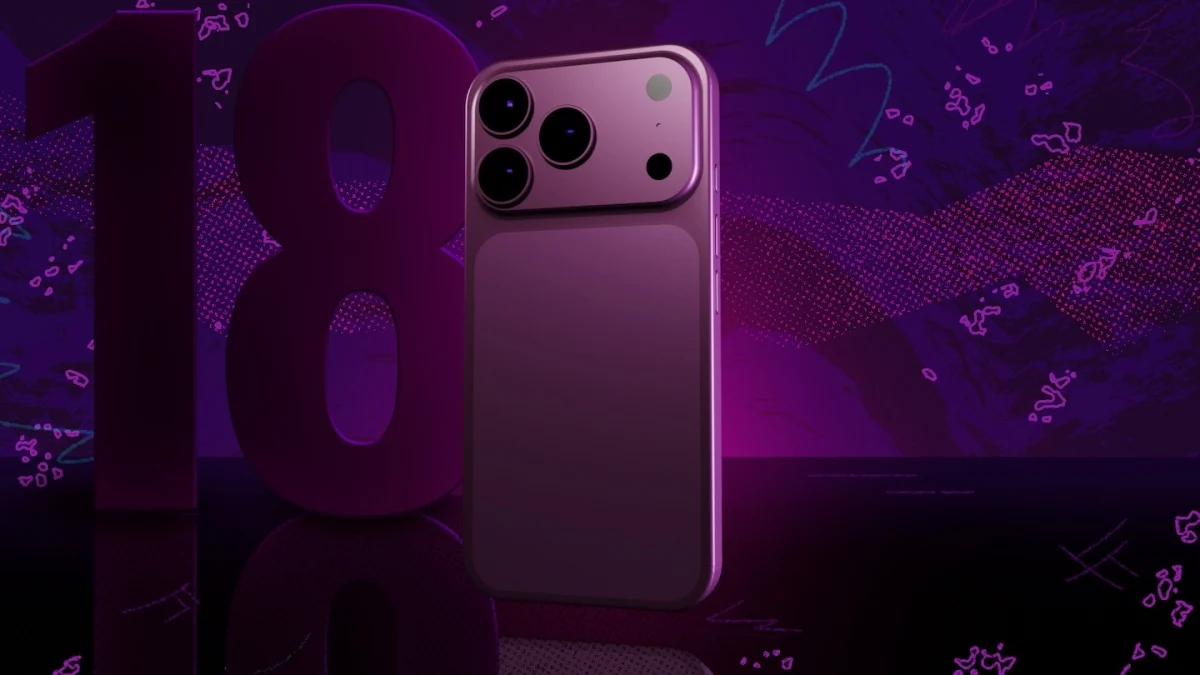
Apple On 9 September, it officially unveiled the iPhone 18 Pro and iPhone 18 Pro Max during the ‘Surprise and Shine’ presentation. This is the first major iPhone launch under the leadership of the new CEO, John Turnus. The new models are available in deep black, silver, glacier and burgundy, but this year Apple has focused not so much on a redesign of the exterior as on performance, AI, cooling and battery life. The biggest technical change is — A20 Pro, the first iPhone chip built using a 2-nm process. Apple simultaneously redesigned the CPU, GPU, Neural Engine, memory subsystem and even the physical layout of the processor, so that the smartphone could operate at maximum power for longer without overheating.
Briefly about the main points
- The iPhone 18 Pro and Pro Max are powered by the 2-nm A20 Pro.
- The 7-core GPU has become up to 40% more powerful.
- The Neural Engine now has 32 cores.
- Memory bandwidth has increased by 50%.
- The Pro Max offers up to 45 hours of video playback.
- Fast charging — up to 50% in approximately 15 minutes.
- Siri AI and Apple Intelligence have gained new system capabilities.
- Prices: from iPhone 18 Pro - $1199, Pro Max - $1299.
A20 Pro: Apple’s first 2-nm chip for the iPhone
Namely. A20 Pro Apple made it the centrepiece of the presentation iPhone 18 Pro.
The processor is based on the latest 2-nanometre manufacturing process, which allows more transistors to be packed into the same area whilst simultaneously improving performance and energy efficiency.
The A20 Pro has been launched 6-core CPU:
- 2 new high-performance Super Cores;
- 4 energy-efficient cores.
Apple claims that the new high-performance cores have become up to 20% faster and describes their performance as «desktop-class».
However, what is far more interesting is that the company is increasingly moving away from viewing the CPU as the sole key indicator of a smartphone’s speed.
Virtually the entire architecture of the A20 Pro is built around artificial intelligence and parallel computing.
The GPU features seven cores and delivers a performance boost of up to 40%
The A20 Pro graphics processor now features 7 cores.
According to Apple, the new architecture delivers up to 40% higher GPU performance compared with the previous generation.
This is one of the biggest reported leaps in graphics performance between consecutive generations of the iPhone.
A number of architectural changes have been made to the GPU:
- increased the internal throughput;
- optimised the architecture for AAA games;
- updated the Neural Accelerators;
- doubled the speed of 8-bit floating-point calculations.
It is the Neural Accelerators in the GPU that enable local AI models to run more efficiently — in particular third-party LLMs directly on the iPhone, without the need to constantly send data to the cloud.
The introduction of a 7-core GPU and a larger memory system has also been confirmed by the specialist press, which had already spotted these changes to the A20 Pro’s architecture prior to the launch.
The Neural Engine has been doubled to 32 cores
Even more serious Apple I have redesigned a separate module for artificial intelligence.
The company added the second Neural Engine, as a result of which the total number of nuclei increased to 32.
Apple announces doubling of computing power.
This is important not just for Siri.
The A20 Pro is designed to run increasingly complex models locally for:
- image generation and editing;
- text and object recognition;
- Siri AI;
- systematic dictation;
- contextual analysis;
- third-party LLMs;
- Photos’ smart features;
- automations in Shortcuts.
In effect, Apple is transforming the Neural Engine from a co-processor into one of the key processors inside the iPhone.
Memory performance on the 50% has improved — and this is crucial for AI
Another change, which may be less noticeable in the advert but is very important from a technical point of view, is — A 50 per cent increase in memory bandwidth.
Large language and generative models are constantly moving vast amounts of data between RAM, the GPU and the Neural Engine.
Therefore, a narrow memory bus can limit AI performance even with a very powerful processor.
In the A20 Pro, Apple has expanded this channel by about half. Independent leaks prior to the launch also pointed to a move towards a significantly wider memory interface.
For users, this should mean faster on-device AI, lower latency and more consistent performance in graphically intensive tasks.
Apple has even changed the physical design of the processor
The A20 Pro has been given a new design inspired by chips Apple M-series.
The silicon crystal and the memory are now physically located next to each other.
This enabled Apple to remove the memory from the SoC’s main thermal path and connect the processor directly to the evaporation chamber.
On paper, this may seem like a minor issue, but thermal limitations have long been one of the main challenges facing modern mobile processors.
A smartphone may show a very high performance figure for a minute, and then reduce its clock speeds due to overheating.
With the iPhone 18 Pro, Apple is in fact trying to tackle precisely this issue.
The new vapour chamber is three times larger
The cooling system in the iPhone 18 Pro has been significantly redesigned.
New the evaporation chamber has approximately three times the surface area, than the system in the iPhone 17 Pro.
Deionised water circulates inside the system: it absorbs heat from the processor area, evaporates, condenses in the cooler part of the system, and repeats the cycle.
The following are used in the construction:
- 80% recycled stainless steel;
- graphite with higher thermal conductivity;
- a new material: nano-twin copper.
Apple describes the latter as the first of its kind in the industry and uses it to dissipate heat from the display more effectively.
How much faster?
Apple states:
up to +40% in consistent performance compared to the iPhone 17 Pro;
and to 2× better sustained performance compared with the iPhone 16 Pro and older models.
The key word here is — sustained, that is, performance under sustained load rather than in a short benchmark test.
This is precisely what should be evident in:
- major games;
- video editing;
- local AI;
- prolonged use of the camera;
- image generation;
- tasks that place a simultaneous load on the CPU, GPU and Neural Engine.
For the time being, this is Apple’s own measurements, whilst independent tests of the new smartphones have yet to confirm the claimed performance gains.
Battery life: The Pro now performs like last year’s Pro Max
Apple has also placed great emphasis on the battery.
Despite its smaller body, The iPhone 18 Pro now offers roughly the same everyday battery life as the iPhone 17 Pro Max did last year.
For the iPhone 18 Pro Max, the company claims the biggest increase in battery life in the history of the iPhone.
According to Apple’s official figures for the relevant configurations:
| Model. | Video playback | Actual use |
|---|---|---|
| iPhone 18 Pro | up to 36 hours | up to 24 hours |
| iPhone 18 Pro Max | up to 45 hours | up to 30 hours |
It is particularly interesting that, for the first time, Apple is talking so actively about a new model for assessing actual usage.
The company takes into account not only video playback, but also typical usage scenarios: taking photos, using apps, mobile connectivity and AI features.
If these figures are confirmed by independent tests, The Pro Max could become one of the most durable flagship smartphones on the market.
50% in about 15 minutes
They’ve also upgraded the wired charging.
Apple states that the iPhone 18 Pro can be charged for approximately:
from 0 to 50% in 15 minutes.
According to the company, a five-minute quick charge should be enough for approximately six hours of video playback.
For Apple, which has traditionally been considerably more conservative than Chinese manufacturers when it comes to charging speeds, this is quite a significant step.
Siri AI is becoming an integral part of the system
The second half presentations showed why Apple needed to boost its AI performance so dramatically in the first place.
Siri AI and Apple Intelligence are now integrated directly into the iPhone’s core functions.
One of the updates is an improved system-wide dictation feature.
Apple claims more accurate recognition:
- punctuation;
- capital letters;
- spelling;
- text structure.
In other words, a dictation should increasingly resemble not a «recognised audio track», but a finished, structured text.
Safari will automatically monitor changes to websites
One of the most practical features of Apple Intelligence is — Notify Me in Safari.
A user can ask their browser to monitor a specific web page.
For example:
- when the product will be back in stock;
- when the price changes;
- when the ticket will be available;
- when the information on the page is updated.
Safari will monitor the page itself and send a notification when there is a change.
Apple officially unveiled Notify Me during the announcement of the new generation Apple Intelligence in June, and now the feature is being showcased as part of the new iPhone’s ecosystem.
You can now create shortcuts using everyday language
Apple Intelligence is also bringing about significant changes Shortcuts.
Instead of manually assembling dozens of automation blocks, the user can simply describe the desired action.
For example:
Whenever you receive a letter from school, add the relevant event to your calendar and set a reminder.
Apple Intelligence creates the necessary automations itself.
This could make Shortcuts much more accessible to people who have never used complex automations before.
The iPhone will display the relevant information whilst you’re on a call
Another interesting feature is set to appear in Phone.
Apple Intelligence will analyse the available context and will be able to automatically display information that may be needed during a call.
For example, when a user calls an airline, the system can immediately display the flight booking reference.
Apple’s idea is that users shouldn’t have to search manually for the email or message they need whilst they’re already on the phone with a customer service representative.
Image Playground now generates much more realistic images
Apple has also completely redesigned Image Playground.
The new generation of the tool should generate high-quality images in a much wider range of styles.
This is a significant shift: the first version of Image Playground was much more limited and tended towards a cartoonish style.
Apple now wants to compete with fully-fledged image generators.
Photos has gained three very powerful AI tools
Apple Intelligence has significantly expanded the range of photo editing options.
Clean-up
The updated Cleanup does a better job of removing people and unwanted objects, even from complex backgrounds.
Extend
Extend allows you to enlarge the edges of a photograph.
For example, if an object is too close to the edge, the AI fills in the space around it.
Spatial Reframing
The most interesting feature is — Spatial Reframing.
It effectively allows you to to change the perspective after the shot has been taken.
The user can «move the camera» slightly in the other direction, and the model will complete the parts of the scene that were missing from the original shot.
Apple describes this as a way of changing the composition of a photo after pressing the shutter button.
The technology is based on the company’s work in the field of spatial modelling for Vision Pro. Apple officially described Cleanup, Extend and Spatial Reframing in its Apple Intelligence presentation.
Apple Intelligence — 16 languages; Siri AI is starting with English for now
Apple Intelligence will support 16 languages, including English, French, German, Italian, Spanish, Portuguese, Japanese, Korean, Turkish, Chinese and others.
At the same time Siri AI is initially launching in beta in English.
At the presentation, Apple announced that support for:
- French;
- Japanese;
- Korean;
- Portuguese;
- Spanish
is due to be released in October.
The geographical availability of certain features may vary due to local regulatory requirements.
Part of Apple Intelligence is effectively being upgraded to a paid tier
Apple made another very important announcement here.
Some Apple Intelligence features, particularly those that require high-performance server models, will be subject to usage limits.
This relates, in particular, to image generation.
Higher limits will be available to users on most tariffs iCloud+. Apple officially confirmed this approach back when it announced the new generation of Apple Intelligence.
And this is perhaps one of the most strategically important changes to the presentation.
Apple is gradually transforming artificial intelligence not only into a smartphone feature, but also into a new service business on top of iCloud+.
What has actually changed: our initial conclusion
At first glance, the iPhone 18 Pro doesn’t look like a revolution in design.
This year’s revolution is taking place inside.
The three main changes in this generation:
The A20 Pro and the new memory architecture → more on-device AI.
New cooling system → performance can be maintained at maximum levels for longer.
A larger battery and improved energy efficiency → AI shouldn’t drain a smartphone’s battery life.
In other words, Apple is solving one very specific problem: if a smartphone is to run large AI models constantly, it needs not only a faster Neural Engine, but memory, cooling and battery, capable of supporting all of this.
And that is precisely why the A20 Pro, the vapour chamber and Apple Intelligence are, in effect, one large system this year.
Is it worth switching from the iPhone 17 Pro?
For an iPhone 17 Pro owner, the answer isn’t quite so clear-cut.
If the main use cases are social media, the camera, messaging apps and the browser, the difference may be smaller than the figures in the presentation suggest.
But for:
- demanding games;
- video editing;
- AI;
- content generation;
- long filming sessions;
- maximum autonomy
The update looks much more substantial.
Particularly interesting iPhone 18 Pro Max, where Apple is banking on record-breaking battery life.
For owners iPhone 16 Pro and earlier models The upgrade already looks significantly more noticeable: Apple itself is talking about up to a twofold increase in sustained performance.
However, a final conclusion should only be drawn following independent tests. The figures of +20%, +40% and 2×, announced today, — Apple’s own measurements, rather than results from external laboratories.
The iPhone 18 Pro is the first iPhone built around AI
And that is, I suppose, the main takeaway from the presentation.
In recent years, Apple has been promoting its new iPhones on the strength of their camera, display and processor.
With the iPhone 18 Pro, the focus has shifted.
The company now sells a computing platform for personal AI.
2-nm A20 Pro, a 32-core Neural Engine, 50% of additional memory bandwidth, a new cooling system and significantly longer battery life are needed, first and foremost, to ensure that Apple Intelligence can operate continuously and with increasing frequency — without the cloud.
It is precisely this that makes the iPhone 18 Pro one of the most technically interesting models of recent years, even though the smartphone has not undergone such a radical redesign on the outside.