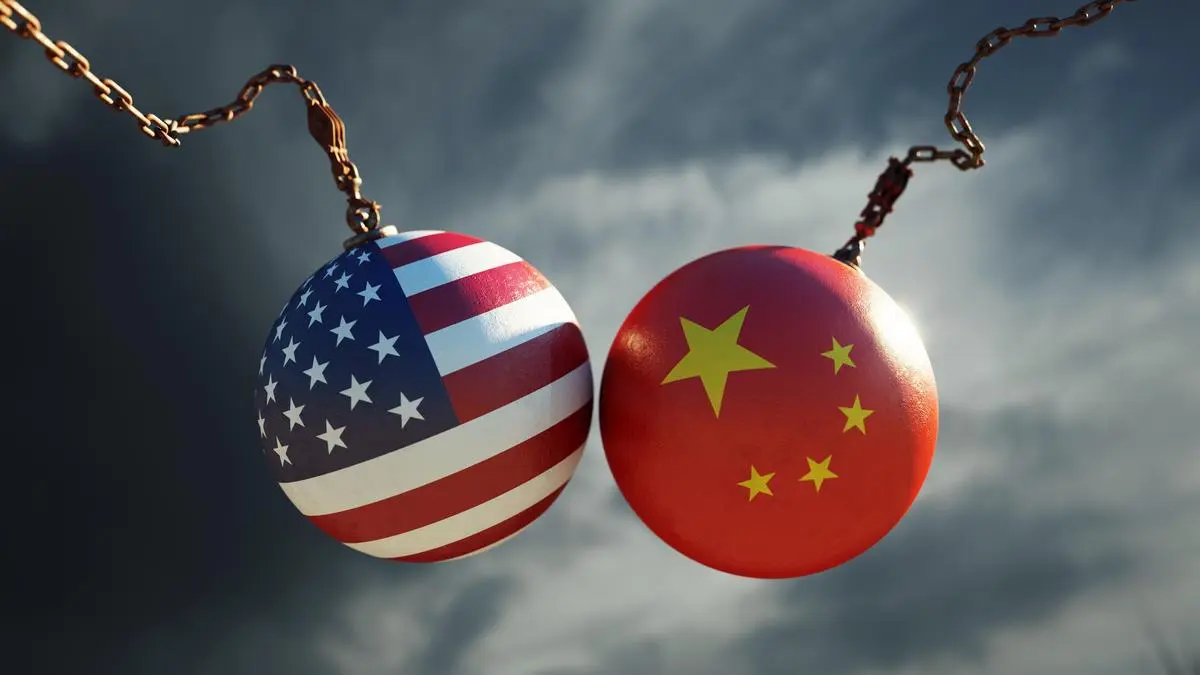
The United States is drafting a letter to its partner countries demanding that they choose between the US-led AI coalition, Pax Silica, and China’s rival initiatives. According to a draft document seen by Reuters, countries that join incompatible frameworks simultaneously may be excluded from Washington’s initiative on AI models, chips and critical minerals.
Briefly about the main points
- The US State Department has drawn up a draft statement addressed to its partners in the field of AI.
- Participation in Pax Silica is described as a commitment rather than formal membership.
- Kazakhstan is the only known participant in the US and Chinese initiatives.
- Pax Silica combines investment projects, supply chains and export controls.
- It is not known when the letter will be sent, and the text may be amended.
The letter calls on people to «vote with care»
The draft letter was prepared by the US State Department. It was addressed to the signatories of the AI Opportunity Statement, signed in June: this document sets out the «shared goals» and «shared vision» for cooperation with Washington in the field of artificial intelligence.
The text states that signing the Pax Silica declaration is not merely a formality to formalise membership, but a commitment. Countries are urged to «make an informed choice» and not to combine their participation in it with frameworks whose expectations conflict with those of the United States.
China is not explicitly mentioned in the draft, but the document is being drawn up against the backdrop of a competing Chinese framework. An American official who spoke with Reuters Speaking on condition of anonymity during internal discussions, he said that countries «cannot have it both ways»: it is difficult to regard them as reliable partners within a single technological ecosystem if, at the same time, they support China’s initiative, which offers an alternative vision of AI.
Reuters has not established exactly when the letter will be sent. The draft is undated, and its content may be revised before it is sent. The State Department declined to comment on the «alleged leak of internal documents».
Why is Washington paying particular attention to Kazakhstan?
The US launched Pax Silica last year, with the aim of strengthening supply chains for AI models, semiconductors and critical minerals. Around two dozen countries have already joined the initiative, including Japan, Australia, South Korea and Kazakhstan.
Kazakhstan is currently the only known country to have joined both Pax Silica and the Chinese coalition. This has caused concern in Washington, given the country’s significant reserves of critical minerals. In June, the US presented Kazakhstan as the first Central Asian state to join Pax Silica.
Participants in the initiative will gain access to joint investment opportunities in projects related to artificial intelligence. Pax Silica is also intended to steer US partners towards joint projects and export controls, and to reduce dependence on adversaries for critical technologies and raw materials.
China is promoting its own model of cooperation in the field of AI
In July, the President of the People’s Republic of China Xi Jinping announced the establishment of the World Artificial Intelligence Cooperation Organisation. China is promoting its own open-weight models as an alternative to US influence in this rapidly developing sector.
The US is attempting to restrict China’s access to resources in the race to develop the most advanced AI systems, which could provide a military or economic advantage. Chinese models with open weights have rapidly intensified competition with US proprietary systems OpenAI and Anthropic. At the same time, Beijing is considering restricting overseas access to some of its leading models.
The Chinese Embassy in Washington has stated that Beijing opposes the politicisation of trade and technology issues. According to a spokesperson for the diplomatic mission, such actions would hinder the global development of AI and would not be in the interests of either side.