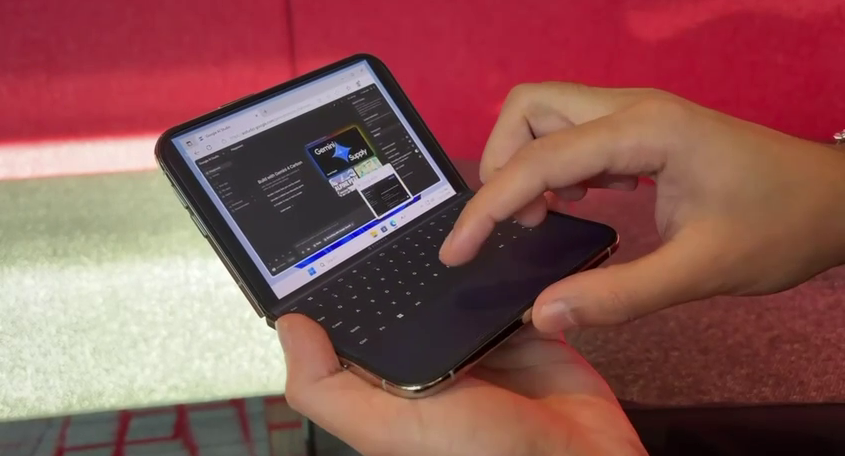
Ammar Reshi, Head of Product and Design at Google AI Studio, demonstrated the launch of a fully-fledged desktop version of Windows 11 on an Apple iPhone Duo foldable smartphone. To bring the WindowsiOS project to life, the developer utilised the capabilities of the new Gemini 4 Carbon AI model. The operating system runs locally, without a connection to a remote computer.
Key points at a glance:
- Windows 11 ARM64 has been run locally on the iPhone Duo foldable smartphone.
- The Gemini 4 Carbon AI model assisted in the development of the WindowsiOS project.
- In half-folded mode, the smartphone transforms into a compact laptop.
- The project is open-source and does not require a jailbreak.
How Windows 11 works on the iPhone Duo
At the heart of Windows, iOS It is a software-based virtual machine that enables Windows 11 24H2 to run on the ARM64 architecture without using Apple’s hardware virtualisation.
The developer has succeeded in implementing support for network connectivity, audio, the microphone, touch controls and the launch of desktop applications.
The design plays a key role the foldable iPhone Duo, featuring an A20 Pro processor and a 7.6-inch internal display.
When fully unfolded, Windows takes up the entire available screen. If you tilt the smartphone at an angle, the top half displays the desktop, whilst the bottom half turns into a virtual keyboard with a trackpad.
Gemini 4 Carbon helped to create a virtual machine
To tackle complex technical challenges Ammar Reshi attracted Gemini 4 Carbon is one of Google’s most powerful artificial intelligence models.
AI helped to implement the execution of processor instructions, memory management, support for virtual hardware and the adaptation of the interface to a foldable display.
The demonstration confirms the launch of the Microsoft Edge browser and the Google Antigravity development environment. Support for traditional Windows applications via Prism technology has also been announced.
Can you install Windows on a standard iPhone?
At present, WindowsiOS remains an experimental project. Installing it requires a Mac computer with an Apple Silicon processor, specialised development tools and a Windows 11 ARM64 image.
The author claims that the operating system runs at a speed close to that of the native version; however, there are as yet no independent performance tests.
The WindowsiOS source code has been published on GitHub.