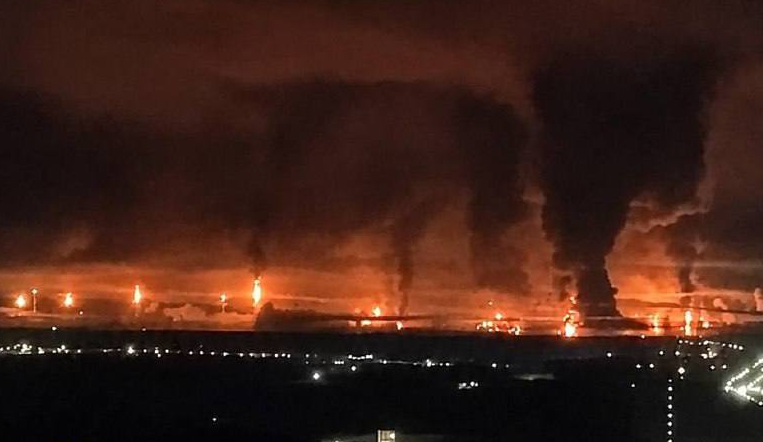
On the night of 1 November, drones attacked the Russian town of Kstovo in the Nizhny Novgorod Region, home to one of Russia’s largest oil refineries — «Lukoil-Nizhegorodnefteorgsintez». Following a series of explosions on the industrial complex’s premises, a massive fire broke out, which was witnessed by local residents. The Russian authorities confirmed significant damage to the industrial facility but did not name the site. The refinery has a processing capacity of around 17 million tonnes of crude oil per year and has been the target of air strikes on several occasions.
- On the night of 1 November, drones attacked the Russian town of Kstovo.
- A major fire broke out on the site of the industrial complex.
- A Russian governor has confirmed that an industrial plant has sustained significant damage.
- The Kstovo Oil Refinery has a processing capacity of around 17 million tonnes of crude oil per year.
- Following the attack, there were problems with the electricity supply and heating.
A major fire broke out in Kstovo following overnight explosions
The first reports of explosions in Kstovo began to emerge during the night of 1 November. Local residents spoke of air defence systems being activated and a series of loud noises in the area of the industrial zone, where the petrochemical complex’s facilities are located.
At around 04:11, videos of a major fire began circulating on social media. The footage shows several pockets of flame and tall plumes of thick black smoke rising above industrial buildings. The glow was visible from a considerable distance.
The Russian independent publication ASTRA, as well as the monitoring channels Exilenova+ and Supernova+, reported that the target of the attack was the «Lukoil-Nizhegorodnefteorgsintez», also known as NORSI.
According to preliminary assessments by OSINT observers, the fire broke out near the AVT-5 and AVT-6 crude oil processing units, as well as the equipment used to process heavy oil residues. However, the exact location of the damaged facilities and the extent of the damage have not yet been established.
During the attack, Rosaviatsiya imposed temporary restrictions on the arrival and departure of aircraft at Nizhny Novgorod Airport. Restrictions were also imposed at other airports in the Volga Federal District.
The Russian authorities have confirmed that the plant has sustained significant damage
Governor of the Nizhny Novgorod Region Gleb Nikitin confirmed a large-scale drone attack on the region on the night of 1 November. According to him, Russian air defences shot down over a hundred drones.
At the same time, the official acknowledged that one of the industrial enterprises in In the Kstovo District significant damage has been caused. Nikitin did not specify the name of the building or the nature of the damage.
According to preliminary figures from the Russian authorities, there have been no fatalities or injuries. Damage assessments are ongoing, and emergency services are working at the scene.
The mayor of Nizhny Novgorod also reported on the consequences of the attack Yuriy Shalabaev. According to him, a piece of public infrastructure was damaged, causing problems with the electricity supply and heating in certain areas of Kstovo.
Local authorities have warned of possible temporary power cuts, as well as restrictions on the hot water supply. Repair work was due to begin once the air strike had ended.
Why is the Kstovo Oil Refinery important for Russian oil refining?
The «Lukoil-Nizhegorodnefteorgsintez» plant is situated in Kstovo, approximately 800 kilometres from the Ukrainian border. It is one of Lukoil’s key oil refining assets and Russia’s fourth-largest refinery in terms of capacity.
Project-based The refinery has a capacity of around 17 million tonnes of crude oil per year. In terms of motor petrol production, it ranks second amongst Russian oil refineries.
As well as petrol, the plant produces diesel and aviation fuel, bitumen and other petroleum products. Its output supplies the Russian domestic market, whilst some of it may be used for military logistics.
The importance of the Kstovo Oil Refinery is not determined solely by the scale of its production. The oil refining complex consists of process units that operate within an interdependent production cycle. Damage to primary refining equipment can affect the operation of other production lines, even without the complete destruction of the plant.
The oil refinery had already been attacked before: in August, the plant suspended operations
This latest attack was not the first to target the plant in Kstovo. The plant has been hit by drones on several occasions, notably in 2024 and throughout 2026.
One of the most serious previous attacks took place on 26 August 2026. On that occasion, a major fire also broke out on the refinery’s premises, and the damage caused led to the suspension of operations at the plant.
Repeated attacks on major oil refineries are creating additional difficulties for the Russian fuel industry. Companies are forced to spend money on repairs, replacing equipment and securing production facilities, whilst even temporary shutdowns can reduce the output of finished fuel.
The situation is particularly sensitive against the backdrop of the Russian government’s restrictions on the export of petroleum products. At the end of October, Moscow extended a ban on the export of diesel fuel for certain categories of suppliers until the end of January 2027, whilst allowing for exceptions for specified manufacturers.
The Russian authorities justify the restrictions by citing the need to stabilise the domestic fuel market. At the same time, further damage to major oil refineries could hamper the resumption of refining operations and increase the need for state regulation of supplies.
On the morning of 1 November, reports also emerged of a possible attack on the Novogorkovskaya combined heat and power station in Kstovo, which supplies energy to local industry. This information requires separate confirmation.
At the time of writing, the Ukrainian military command had not issued an official statement regarding the results of the strike on the Kstovo oil refinery specifically. The exact impact of the night-time attack on petroleum product production remains unknown.