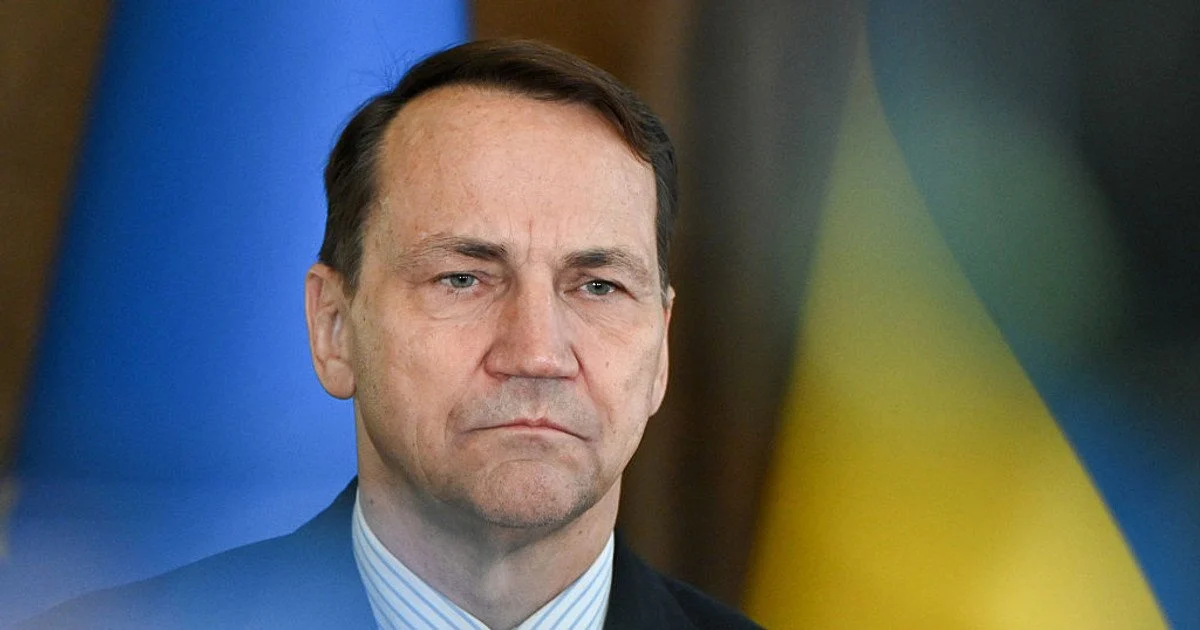
Poland’s Deputy Prime Minister and Minister for Foreign Affairs, Radosław Sikorski, has stated that Warsaw is receiving information from several sources regarding a possible major Russian operation by the end of 2026. He suggested a scenario involving a provocation under a false flag to trigger a new mobilisation in the Russian Federation, whilst describing a large-scale ground attack by Moscow on NATO as unlikely.
Briefly about the main points
- Warsaw assesses the risk of a major Russian operation before the end of 2026.
- Sikorsky suggested that a provocation could be used as a pretext for mobilisation in the Russian Federation.
- The Polish minister did not describe this scenario as a confirmed plan by the Kremlin.
- He considers a large-scale Russian invasion of a NATO country to be unlikely.
- Poland has also warned of hybrid attacks against Ukraine’s allies.
An operation under a false flag is one possible scenario
Sikorsky He spoke about the risks during a discussion at the US Council on Foreign Relations in New York. He did not name the sources from which Poland obtains its information, nor did he specify exactly what actions Moscow might take.
The Polish Foreign Minister cited an operation under a false flag as one possibility. In his view, The Kremlin could portray a particular incident as an attack on Russia and use this to justify new mobilisation measures.
The minister emphasised that this is not a fixed plan on Russia’s part, but merely one of several possible scenarios. According to him, Warsaw does not know which option Moscow might choose.
Warsaw sees a greater risk in ambiguous provocations
Sikorsky cautioned against drawing the conclusion that his words amounted to a prediction of an imminent large-scale attack on the Alliance. In his view, Russia currently lacks sufficient forces for a large-scale ground invasion of a NATO country, as a significant proportion of its military resources are tied up in the war against Ukraine.
The Polish minister, however, admits that actions on a smaller scale, which may be deliberately ambiguous, are possible. Such provocations, in his view, are capable of sparking disputes amongst allies regarding the application of Article 5 of the North Atlantic Treaty.
He also mentioned the risks facing the Baltic states and the region between Belarus and Kaliningrad Oblast. Sikorsky did not specify a particular scenario for these territories.
Tusk had previously spoken about drones, missiles and heightened security measures
17 September, the Prime Minister of Poland Donald Tusk stated in the Sejm that the intelligence services are assessing the possibility of hybrid attacks using drones and missiles against countries that support Ukraine, in particular Poland. The Polish government believes that the aim of such actions may be to test NATO’s response and to attempt to undermine the Alliance’s unity.
On 13 September, Tusk stated that Poland expects Russian activity to intensify in the coming weeks and months and does not rule out an escalation affecting its territory. Consequently, the Polish security services have been placed on high alert.
Over the past few months, the Polish Ministry of Foreign Affairs has accused Russia of sabotage, cyber-attacks and other hybrid operations against EU and NATO countries. Moscow denies any involvement in the hybrid attacks and acts of sabotage attributed to it by European states.