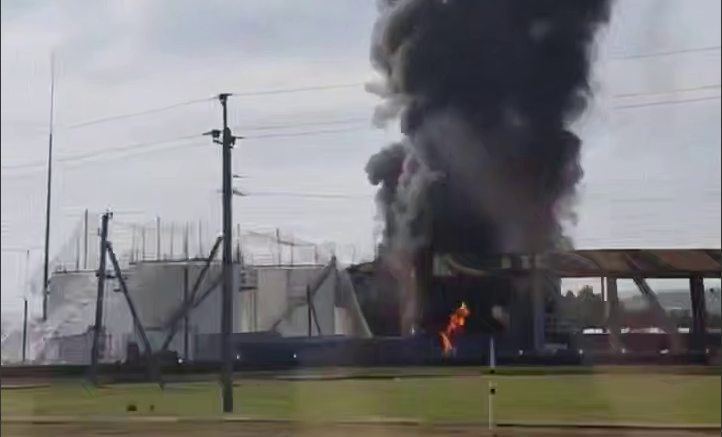
On the night of 24 July, the Security Service of Ukraine carried out a series of long-range strikes against Russian fuel and military infrastructure, as well as that of the temporarily occupied Crimea. The targets included an oil pumping station in Bashkortostan, two oil refineries, a radar station at Belbek airfield and a fuel and lubricants storage tank at Saki airfield, the SBU reported.
Briefly about the main points
- In Bashkortostan, the tank farm at the «Subhankulovo» station is on fire following an explosion.
- A fire also broke out at the tank farm of the «Novospasky» mini-refinery.
- In the Kaluga Region, the «1st Plant» mini-refinery has been hit.
- In Crimea, the «Nebo-U» radar station and a fuel tank were targeted.
- The SBU has stated that the synchronised nature of the attacks makes it more difficult for Russian air defences to respond.
Five objectives in remote regions
One of the distant targets was the «Subhankulovo» linear production control station in the Republic of Bashkortostan — 1,350 kilometres away. According to the SBU, the tank farm there caught fire following the strike.
In publicly available industry documents, the station is listed as part of the «Transneft – Ural» infrastructure and a component of the main oil and petroleum products transport system. However, there is no information regarding any possible restrictions on pumping, nor on the volume or duration of such restrictions.
Another target was the «Novospasky» mini-refinery in the Ulyanovsk Oblast, 900 kilometres away. The SBU reported a fire at its tank farm. The day before, the governor of the Ulyanovsk Oblast Alexei Russkikh acknowledged the drone attack on a fuel and energy complex facility in the Novospaskyi district and the fire, which had been brought under control.
A blow to processing and radar
The SBU also struck the «1st Plant» mini-refinery in the Kaluga Region. According to regional documents, the enterprise is one of the largest companies in the region that works with the railways, and its core business is the production of petroleum products.
In the temporarily occupied Crimea, the «Nebo-U» long-range radar station at the Belbek military airfield was targeted. Publicly available information describes «Nebo-U» as a three-coordinate metre-band radar that detects airborne targets and transmits their coordinates to air defence systems.
Separately, the SBU reported that a fuel and lubricants tank at a military airfield had been hit Saki. There is currently no public information available on the extent of damage to equipment, the volume of fuel losses or the impact on the operation of the facilities in question.
Synchronisation as an element of an operation
The SBU stated that the strikes were coordinated and targeted various types of targets at different depths within Russian territory. According to the service, the special operations are being carried out in line with the objectives set by the President Volodymyr Zelenskyy, leading to a decline in the Russian Federation’s military and economic potential.
A combination of strikes targeting oil transport and processing, fuel stocks at the airfield and radar installations places simultaneous pressure on several links in the supply chain. As noted by the SBU, this approach forces the Russian side to spread its air defence forces and resources too thinly.
Possible impact on Russian air defence
A strike on the «Nebo-U» system could temporarily weaken the Russian air defence’s radar coverage and situational awareness in the Crimean sector — this follows from the system’s capabilities. To compensate for any potential gap, Russia may deploy other radars or aircraft, or redeploy its air defence assets.
Without satellite imagery, geolocation data and information on repairs, it is impossible to determine the exact extent of the damage to the radar systems or the actual impact on the air defence system. Similarly, there are no grounds for claiming that specific production facilities have been shut down, that oil transfers have ceased, or that airfields are no longer operational.