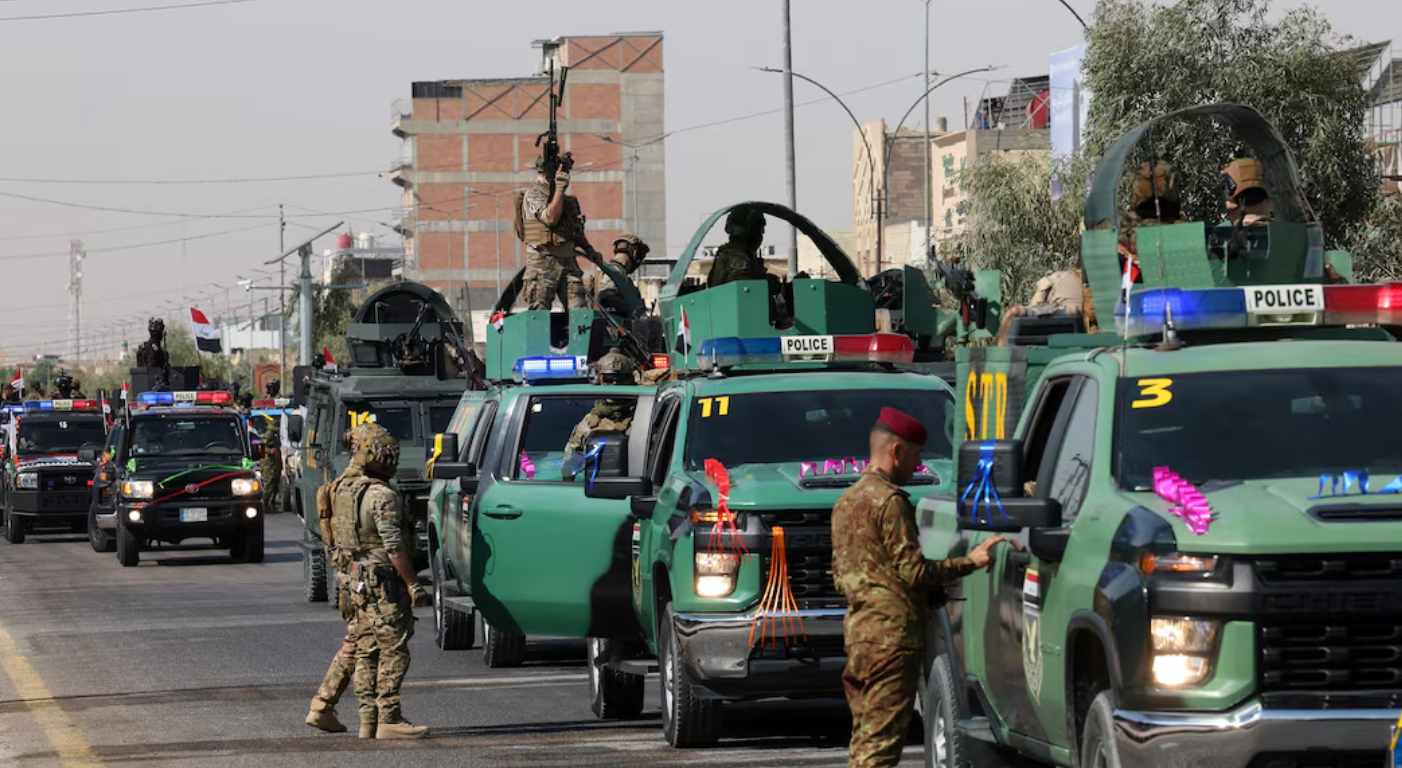
On 30 September, the US concluded its military mission in Iraq after more than two decades of war. The last units, mainly from the airbase in Erbil, left the country, handing over responsibility for security to Iraqi forces. The withdrawal has raised fears of a resurgence of pro-Iranian armed groups and remnants of the «Islamic State».
Briefly about the main points
- The Pentagon has formally brought Operation Inherent Resolve in Iraq to a close.
- The US will provide its Iraqi partners with targeted training and intelligence support.
- Tehran and allied groups have hailed the withdrawal of US forces as a victory.
- Iraqi officials fear a resurgence of «Islamic State» sleeper cells.
The Pentagon has wound up the operation, but will continue to support its partners
The Pentagon has announced the formal conclusion of Operation Inherent Resolve, which the US and its allies had been conducting in Iraq. At the same time, Washington will continue to provide targeted support to its Iraqi partners in the areas of training and intelligence.
Prime Minister of Iraq Ali Faleh al-Zaidi stated that the conclusion of the international coalition’s mission does not mean an end to the fight against terrorism. According to him, the country is moving into a phase in which it is fully responsible for its own security and stability.
The second American campaign came to an end following heavy losses
The American coalition overthrew the regime Saddam Hussein’s 23 years ago, after which Iraq went through a prolonged period of instability. The US had already withdrawn its troops at the end of 2011, but returned less than three years later when Islamic State seized a third of the country.
In the US’s biggest war of this century more than 4,500 American servicemen were killed — roughly twice as many as in the parallel war in Afghanistan. The Iraq Body Count project estimates the number of Iraqi civilian deaths at over 200,000.
Iran sees the US withdrawal as strengthening its allies
Tehran, which is seeking to drive American forces out of the entire Middle East, described the US withdrawal from Iraq as a victory for his «axis of resistance» — a network of allied armed groups. Following the fall of Saddam Hussein’s regime, Iran has consistently strengthened its influence in the country through proxies.
A political analyst in Baghdad Ahmed Younis considers that, in the absence of a Western military presence, such groups may find they have greater scope to influence public policy and establish a foothold in key institutions.
Iraq, which maintains relations with both Washington and Tehran, has found itself drawn into this year’s US war against Iran. Seven of the 18 American servicemen listed as having been killed since the start of the operation Epic Fury in February, were killed in Iraq.
Iraqi forces must contain the «Islamic State» on their own
Some Iraqis, security officials and analysts doubt that the forces trained and funded by the US are yet ready to ensure security on their own. The Islamic State lost its self-proclaimed caliphate almost ten years ago, but it still maintains a network of sleeper cells.
Prior to the withdrawal, the US military provided crucial intelligence on militant movements, as well as aerial surveillance and reconnaissance. During the US’s initial withdrawal, the Iraqi army was unable to halt the group’s advance: in 2014, troops were leaving their positions when the militants captured Mosul.
Retired general of the Iraqi Army Mohammed al-Jubouri He identified the existence of a concrete plan for the post-coalition period as a key issue. Among the worst-case scenarios, he cited the possibility of the «Islamic State» acquiring armed or homemade drones, given the inadequacy of Iraq’s air defence capabilities. Adil Salman warned that decisions would be judged by whether security remained stable in the coming years.