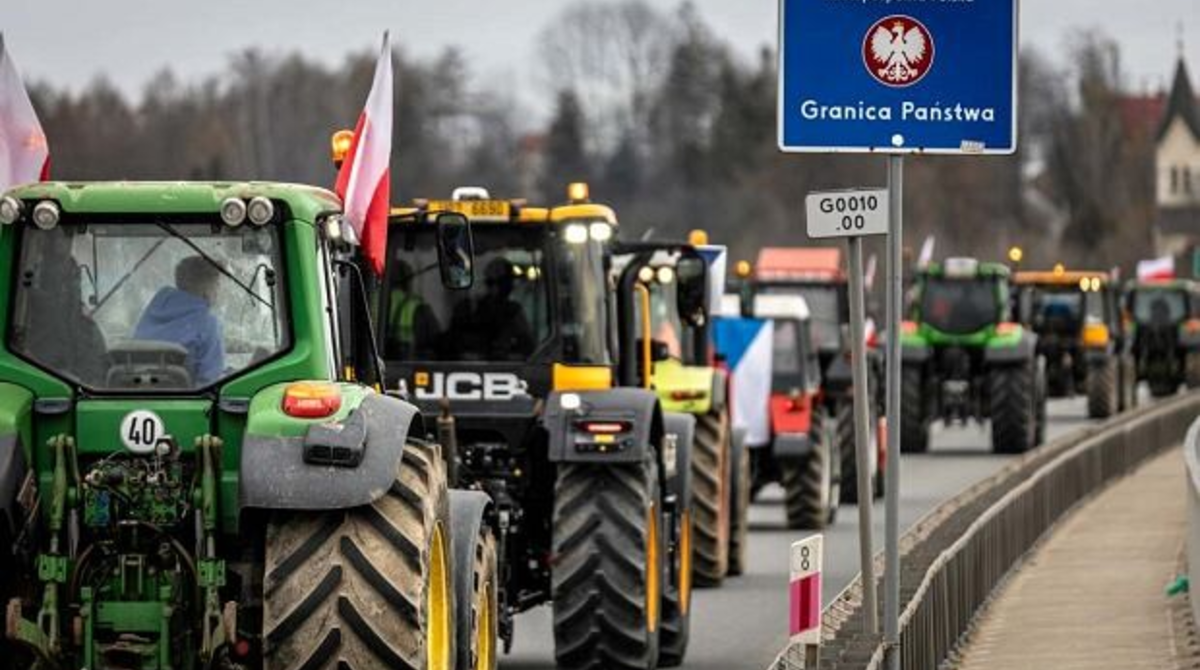
Statement by the Vice Marshal of the Polish Sejm Piotr Zgorzelecki that Ukraine's imminent accession to the EU will be «death for Polish agriculture» reflects one of the most acute economic and political conflicts within the European Union itself. Zgorzelecki represents the Polish Peasant Party (PSL), whose electorate is made up of farmers, so his rhetoric is as harsh as possible.
However, behind these political slogans are real numbers, structural differences between the two countries' agricultural sectors and a global challenge for the future EU architecture.
Causes of the conflict: Why is Poland afraid of the Ukrainian agricultural sector?
The main reason for this is the radical difference in the structure of production and production costs. Polish and Ukrainian agriculture are two completely different models.
-
Scale and oligopoly against farming. The average size of a farm in Poland is about 11-13 hectares. They are family-owned, small and have high production costs. In Ukraine, the bulk of agricultural exports are made up of giant agricultural holdings that handle from 10,000 to 500,000 hectares. Thanks to economies of scale, the cost of a tonne of Ukrainian grain, corn or sunflower is much lower.
-
EU environmental and regulatory standards. Polish farmers are obliged to comply with strict EU directives (in particular, the Common Agricultural Policy Framework, CAP), which restrict the use of certain pesticides and fertilisers and require expensive environmental practices. Ukraine, as a non-EU country (although in the process of European integration), still has much more lenient regulatory requirements, which makes its products even cheaper and more competitive.
-
Logistical shock. After the start of the full-scale invasion and blockade of the deep-water Black Sea ports, the EU cancelled quotas and duties on Ukrainian exports. The logistical «solidarity routes» led to huge volumes of grain not being transited further (due to the high cost of logistics), but settling on the markets of border countries, primarily Poland, causing domestic prices to collapse and local farmers to go bankrupt.
Implications for Ukraine and Poland
Political statements of this kind have a direct impact on bilateral relations and the economy.
For Ukraine
-
Slowing down European integration. Poland has made it clear that political solidarity on security does not mean capitulation on economic issues. Warsaw will use its veto power or demand severe restrictions in the negotiations on Ukraine's accession to the EU.
-
The requirement of historical concessions. PSL party leader and defence minister Vladislav Kosinyak-Kamysh explicitly links consent to Ukraine's accession with the resolution of historical disputes (in particular, the exhumation and commemoration of the victims of the Volyn tragedy).
-
Return to restrictions. The EU has already been forced to respond to Poland's pressure: the regime of full trade liberalisation is gradually being replaced by tighter controls, a return to the customs quotas of the 2016 Association Agreement, and the introduction of «safeguard clauses» for sensitive European markets.
For Poland
-
Electoral stability. For the Polish coalition, protecting farmers is a matter of survival in power. If the government loses ground, the dissatisfied agricultural sector will tip the scales towards radical Eurosceptic forces (e.g., the Confederation party).
-
Transit status instead of the domestic market. Poland is trying to turn itself into a purely transit country, demanding subsidies from Brussels to build ports and railways so that Ukrainian grain can go to Africa and Asia instead of staying in Lublin or Rzeszow.
Prospects for the EU and Ukraine: How to untie the knot?
Ukraine's accession to the EU will inevitably lead to tectonic shifts in Brussels. The EU's Common Agricultural Policy (CAP), which currently spends around one third of the total EU budget, It simply cannot withstand the integration of a giant like Ukraine under the old rules.
The EU and Ukraine have to go through three main stages of compromise:
| Direction. | What will you have to do? |
| Transition periods | Ukraine will not receive immediate full access to the EU agricultural market. The transition period (restrictions, quotas) may last 5 to 10 years after official accession - Poland and Spain went through a similar path in their time. |
| EU budget reform | Brussels will have to change the subsidy system. Currently, farmers receive money for each hectare of land. If we pay Ukrainian agriholdings under this scheme, they will take the lion's share of the EU budget, leaving French and Polish farmers with nothing. Subsidies will be reoriented towards small farms and the green transition. |
| Environmental adaptation of Ukraine | Ukraine will have to implement strict European standards (control over pesticides, soil quality, CO2 emissions). This will automatically increase the cost of Ukrainian products, levelling the playing field with their Polish counterparts. |
A strategic interest of the EU: Despite the grain crisis, Europe is critically dependent on other Ukrainian products. For example, in the vegetable protein and soybean sectors (where the EU has a huge deficit), Ukraine already supplies a significant part of the European market, helping the EU to reduce its dependence on imports from the Americas.
The conflict over Zgorzelecki's statement is not the end of European integration, but the beginning of very difficult pragmatic negotiations. Ukraine will have to protect its export potential, and Poland will have to modernise its farming sector, as Warsaw will not be able to block the process forever for reasons of its own geopolitical security.