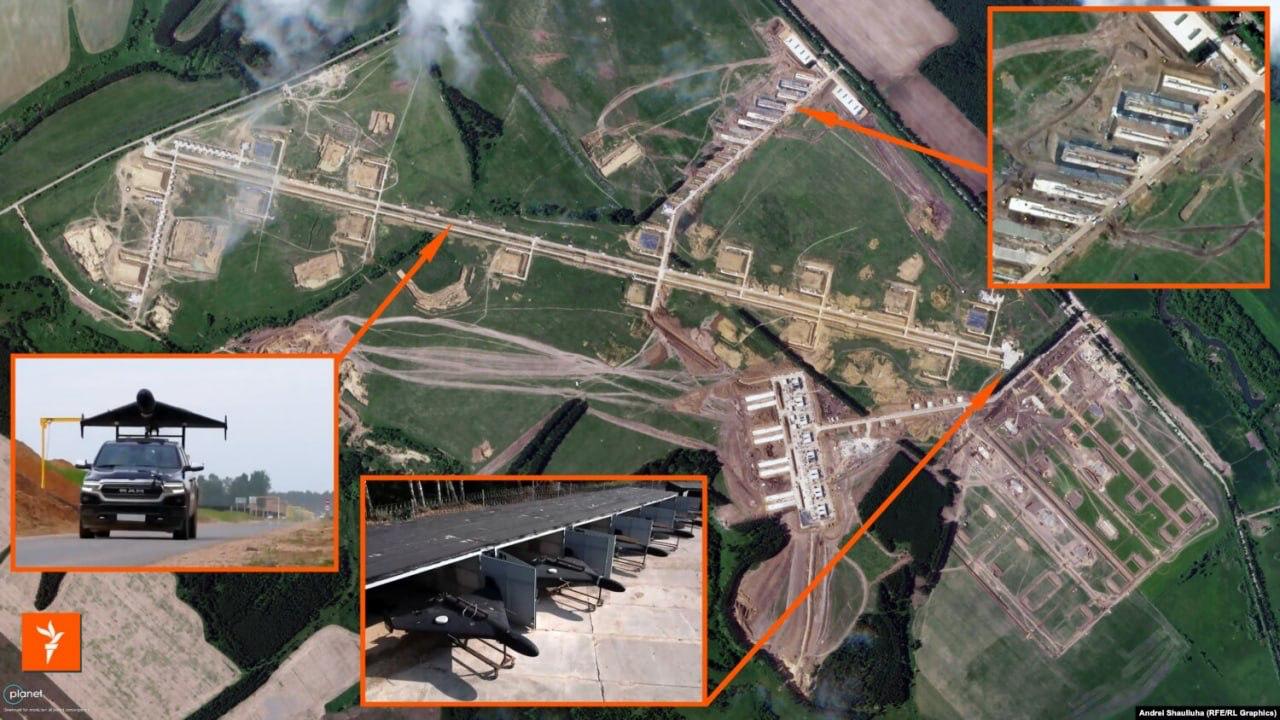
The Russian Federation has established a comprehensive infrastructure for the preparation, launch and support of «Shahed/Geran»-type attack UAVs in the immediate vicinity of the Belarusian border. The main purpose of creating this «corridor» is to direct large numbers of drones past Ukrainian air defences through Belarusian airspace or along its border, which significantly complicates the work of the Ukrainian Armed Forces’ monitoring systems and mobile fire groups.
In May 2026 alone, more than 100 instances of unauthorised incursions by Russian drones were recorded in Belarusian airspace.
Key elements of the new infrastructure
Satellite images have revealed the expansion of five major military sites in the Bryansk, Oryol and Smolensk regions of the Russian Federation.
1. The Tsymbulov Complex (Oryol Region) — «The world’s largest drone port»
-
Coordinates: 53.36858° N, 35.8166° E
-
Distance to Belarus: ~200 km (335 km to Gomel)
-
Status: It has been in active use since autumn 2024.
-
Features: This is a large-scale facility, the area of which nearly doubled in the spring of 2026 alone and now measures approximately 2 by 4 kilometres. Russian propaganda openly refers to it as «the world’s largest drone port». There are large storage facilities here capable of holding hundreds of UAVs at once. In addition to standard «Shaheds», launchers up to 80 metres long have been deployed at Tsymbulova, designed for new jet-powered variants («Geranium-5»).
2. Shatalovo Military Airfield (Smolensk Oblast)
-
Coordinates: 54.33892° N, 32.47221° E
-
Distance to Belarus: 46 km (the closest point to the border and NATO countries)
-
Status: Active construction began in early 2025, with launches taking place every week.
-
Features: Since May 2026, the number of fixed launchers here has risen to ten. Analysts have identified distinctive black marks on snow and ground imagery — the result of testing and combat launches of jet-powered drones from rail-mounted platforms. The facility is protected by its own air defence systems.
3. The «Navlya» Sports Complex (Bryansk Oblast)
-
Coordinates: 52.85476° N, 34.50651° E
-
Distance to Belarus: 127 km
-
Status: Built from scratch on a forest clearing. In April 2026, the Ukrainian Defence Forces carried out strikes against it, but as of June, construction is still ongoing.
-
Features: It has three fixed launch pads and around 16 protected hangars for storing fuel and spacecraft.
4. Seshcha Airfield (Bryansk Oblast)
-
Coordinates: 53.71538° N, 33.34548° E
-
Distance to Belarus: ~45 km
-
Status: It is used as a logistics hub and transit centre. In addition to direct launches, it serves as a coordination centre for the routing of flight missions.
5. The «Asovitsa» Launch Complex (Bryansk Oblast)
-
Coordinates: 52.32268° N, 34.50236° E
-
Distance to Belarus: 163 km (just 35 km from the Ukrainian border)
-
Status: The newest facility in the «belt», the roll-out of which began in the summer of 2025. It is currently reaching the operational readiness stage.
The anatomy of the four circuits
Military analysts point out that these facilities do not operate in isolation. A comprehensive architectural system has been established, organised into four functional circuits:
-
Start-up sequence: Fixed rail-mounted and mobile road-based catapults (Shatalovo, Tsymbulova, Navlya).
-
Storage and logistics: Bunkers and secure lightweight hangars for the rapid assembly of «Shaheds» from kit components.
-
Routing: The use of Belarusian airspace as a «grey zone» where Ukrainian mobile units are unable to engage targets due to political and security constraints.
-
Control and relay: The use of dedicated escort aircraft or ground-based communication towers along the border to coordinate large-scale air raids (so-called «swarm attacks»).
Conclusion of the monitoring groups: The expansion of this network is indicative of the Russian Federation’s long-term strategy to maintain a high level of aerial terror through the use of cheap kamikaze drones, whilst Belarus remains, in practice, a fully-fledged logistical base for the Russian army.