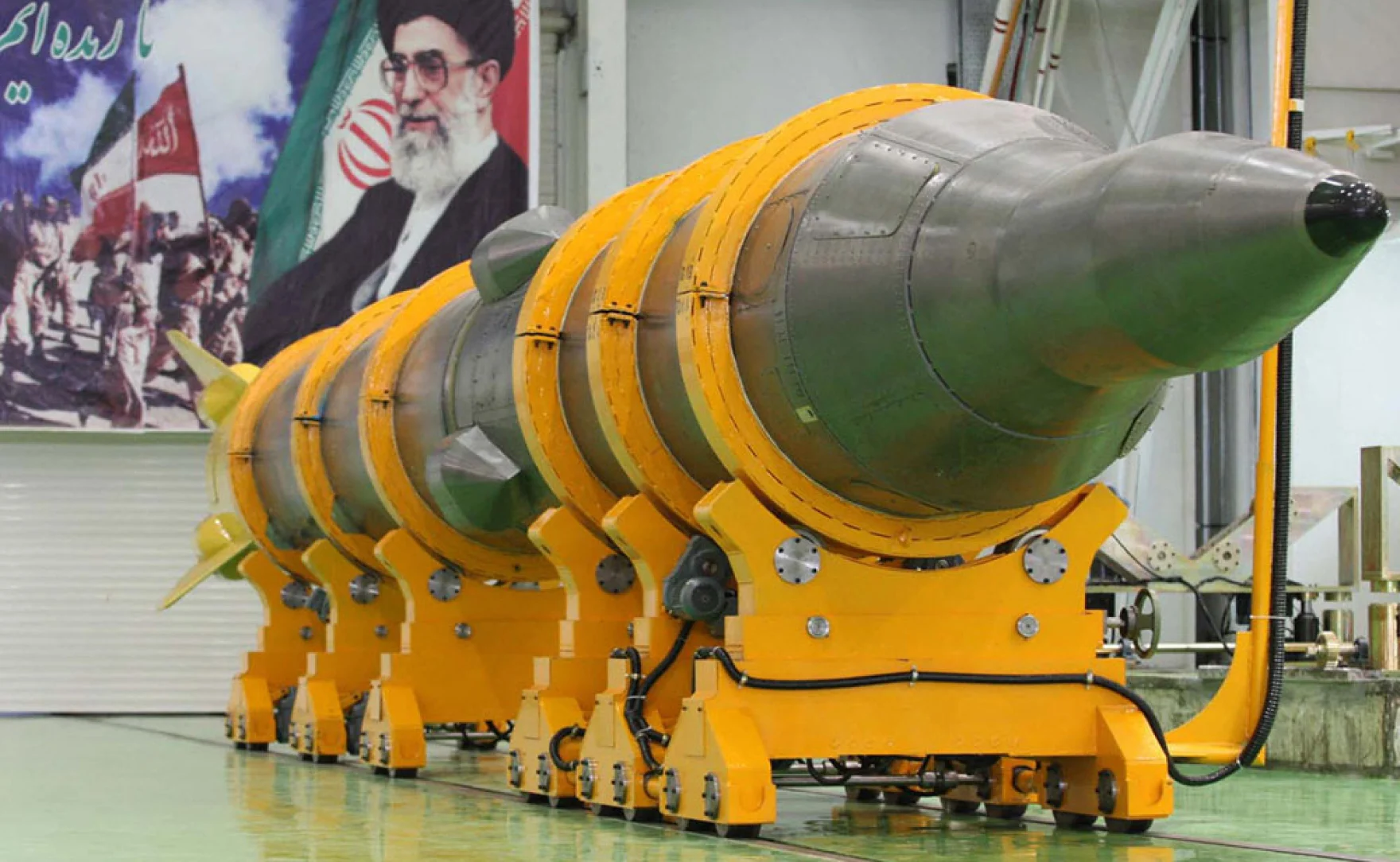
Iran has medium-range ballistic missiles in its arsenal which, if launched from the northern or north-western regions of the country, are capable of reaching Ukrainian territory. These primarily include the Ghadr, Emad, Sejjil and Khorramshahr systems, according to Defense Express.
The stated or estimated range of these missiles is between 1,600 and 3,000 kilometres. Defense Express also reports on tests of the Khorramshahr over a distance of around 4,000 kilometres; however, independent Western sources generally estimate its confirmed range to be between 2,000 and 3,000 kilometres.
Which Iranian missiles are capable of reaching Ukraine?
Iran has built up the largest and one of the most diverse missile arsenals in the Middle East. It includes short-range tactical missiles, medium-range ballistic missile systems, cruise missiles and unmanned aerial vehicles.
A threat to Ukraine depends not only on the maximum range, but also on the location of the launch site, the weight of the warhead and the chosen trajectory. Launches from north-western Iran make it possible to reduce the distance to the southern and eastern regions of Ukraine.
| Rocket | Range | Combat unit | Fuel | Number of steps |
|---|---|---|---|---|
| Ghadr | approximately 1,600–1,950 km | approximately 750 kg | liquid | 1 |
| Emad | around 1,700–1,800 km | approximately 750 kg | liquid | 1 |
| Sejjil | up to 2,000 km | approximately 700–750 kg | solid | 2 |
| Khorramshahr | 2,000–3,000 km; some estimates put the figure at up to 4,000 km | up to 1,500–1,800 kg | liquid | 1 or 2 |
The figures given are estimates based on information from open sources. The actual range depends on the variant, the weight of the warhead and the flight profile.
Ghadr: the development of the North Korean design
The Ghadr is a further development of the Iranian Shahab-3, which was based on the North Korean Hwasong-7. The latter, in turn, is technologically derived from the Soviet R-17 missile of the «Elbrus» complex.
The rocket is a single-stage design and uses liquid fuel. It is approximately 16.5 metres long and has a launch mass of around 19 tonnes. The warhead separates during flight and can carry a payload of approximately 750 kilograms.
According to Iran Watch, the range of the Ghadr is estimated at 1,600 kilometres. The CSIS handbook quotes a figure of up to 1,950 kilometres.
Liquid fuel complicates operations and may increase the time required for launch preparation. At the same time, a mobile launch platform makes it possible to change position and conceal the system’s preparations.
Emad: a guided combat unit
The Emad is also derived from the Shahab-3 and is similar in its key specifications to the Ghadr. It is a single-stage, liquid-fuelled missile approximately 16 metres long, with a warhead weighing around 750 kilograms.
The main distinguishing feature of the Emad is its detachable warhead with aerodynamic surfaces. According to Iran, it is capable of manoeuvring during the final stage of flight. This capability is intended to improve accuracy and make it more difficult to predict the point of impact.
The Emad’s range is estimated at 1,700–1,800 kilometres. During one of the tests, the missile travelled approximately 1,800 kilometres.
Iran claims that this system is highly accurate, but it is difficult to independently verify all its specifications. Iran Watch estimates the Emad’s circular error probability to be within 500 metres.
Sejjil: a two-stage solid-fuelled rocket
Sejjil is a more technologically sophisticated system. Unlike Ghadr and Emad, it uses solid fuel and has two stages.
This provides an important tactical advantage: the missile does not need to be fuelled for a long time immediately before launch. A solid-fuelled system can be prepared for launch more quickly, and the time it spends at the launch pad will be shorter.
The Sejjil is approximately 17.5 metres long and has a launch weight of around 26.5 tonnes. Its range is estimated at 2,000 kilometres.
At its maximum range, the missile can carry a warhead weighing approximately 700–750 kilograms. Defense Express notes that at a distance of around 1,000 kilometres, its payload can increase to 1,500 kilograms.
Khorramshahr has the greatest potential range
The Khorramshahr was first unveiled to the public in 2017. Its design is believed to be linked to the North Korean BM-25 Musudan, which is derived from the Soviet R-27 naval ballistic missile.
The range depends on the weight of the warhead
The Khorramshahr’s basic range is estimated at 2,000 kilometres. With this flight profile, the missile can carry a warhead weighing up to 1,500–1,800 kilograms.
The version with a lighter warhead is theoretically capable of flying further. CSIS estimates the maximum range of various configurations at 2,000–3,000 kilometres. Defense Express reports that the Khorramshahr has demonstrated a range of approximately 4,000 kilometres.
A combat unit equipped with sub-munitions
The Khorramshahr can be equipped not only with a conventional high-explosive warhead, but also with a cluster munition assembly. Defense Express reports that it is possible to carry up to 20 individual submunitions, which scatter over a considerable area upon separation.
Such equipment is designed to engage dispersed or area targets. It also complicates missile defence: the most effective approach is to intercept the main warhead before it separates.
Could Iranian missiles reach Ukrainian cities?
Launches from northern Iran enable missiles with a range of around 2,000 kilometres to reach certain regions of Ukraine.
Which areas might fall within the coverage area?
The specific area will depend on the launch site. The southern and south-eastern regions of Ukraine are the closest to Iran. Longer-range missiles are theoretically capable of covering a much larger part of the country’s territory.
The Khorramshahr, with a range of 2,000–3,000 kilometres, has a wider potential range of action. If the version with a range of around 4,000 kilometres is indeed operational, the whole of Ukraine could fall within its strike zone.
However, maximum range does not necessarily mean that the heaviest warhead can be used. To increase the flight range, the missile usually has to be fitted with a lighter payload.
Technical capability does not imply that an attack is being prepared
At present, there is no publicly confirmed information regarding Iran’s deployment of missile systems to attack Ukraine. Nor have there been any reports of launchers being moved to the relevant areas or of preparations being made for specific launch sites.
The assessment therefore focuses on the potential capabilities of Iran’s arsenal. Threats Statements by officials or media sources do not constitute confirmation of a decision to use missiles.
How can Ukraine intercept such missiles?
Specialised missile defence systems capable of operating at high altitudes and intercepting warheads travelling at high speeds are required to counter medium-range ballistic missiles.
Patriot has limited capabilities
Ukrainian complexes Patriot Equipped with PAC-3 missiles, they are capable of intercepting certain types of ballistic targets in the terminal phase of their flight path. They have already been deployed against Russian «Iskander» missiles and «Kinzhal» aeroballistic missiles.
However, the medium-range Ghadr, Emad, Sejjil and Khorramshahr missiles may have a higher re-entry speed and a more complex flight profile. In this scenario, the Patriot system provides only limited local defence, and the outcome depends on the target’s speed, the direction of the attack, the manoeuvres of the warhead, and the battery’s location.
It would therefore be too categorical to claim that Ukraine has no means of countering such missiles at all. At the same time, there is no evidence in the open-source data to suggest that Ukraine possesses specialised systems capable of providing a fully-fledged, multi-layered defence against such missiles.
What systems are needed for protection?
Defence Express lists the following as essential equipment:
- the American THAAD system;
- the Israeli Arrow-2 and Arrow-3 systems;
- maritime and land-based systems equipped with SM-3 missiles;
- additional Patriot PAC-3 systems for the final line of defence.
THAAD is designed to destroy ballistic missiles during the terminal phase of their flight, either within the atmosphere or beyond it. Arrow-3 can intercept warheads whilst they are still outside the atmosphere, whilst the SM-3 is used by the Aegis system for high-altitude interception.
It is precisely the combination of several defence lines that makes it possible to launch a second missile strike if the first interceptor fails to hit its target. There is no public confirmation that Ukraine has THAAD, Arrow or SM-3 systems in service.
A new threat will require a different level of missile defence
Iran does indeed possess the technical capability to reach Ukrainian territory under certain conditions without the need to deploy missiles in other countries. The greatest threat comes from the Sejjil, due to its rapid launch preparation, and the Khorramshahr, due to its heavy warhead and potentially greater range.
At the same time, publicly available assessments of the capabilities of Iranian missiles vary, and the maximum claimed performance figures are not always corroborated by independent observations. The mere existence of such weapons does not, however, prove that Tehran is preparing to use them.
If such a threat were to become a reality, Ukraine would need not only more Patriot systems, but also a separate high-altitude layer of missile defence — THAAD, Arrow or other systems of a similar class.