The Thai government has revived the Land Bridge project, worth 1 trillion baht ($30.45 billion), which aims to create an alternative logistics corridor linking two deep-water ports on either side of the country to relieve pressure on the congested Strait of Malacca. The project involves a railway line and transport infrastructure that will reduce transport times and costs, but has drawn criticism from local residents and environmentalists due to its potential impact on the environment and traditional ways of life.
- Thailand is planning a 30-billion corridor between two seaports to bypass the Strait of Malacca.
- The project involves the construction of a railway and roads to reduce logistics costs and journey times.
- Local residents and environmentalists have criticised the project because of its impact on the environment and local communities.
- Investors are cautious due to high costs and geopolitical risks.
Parameters and objectives of the Land Bridge project
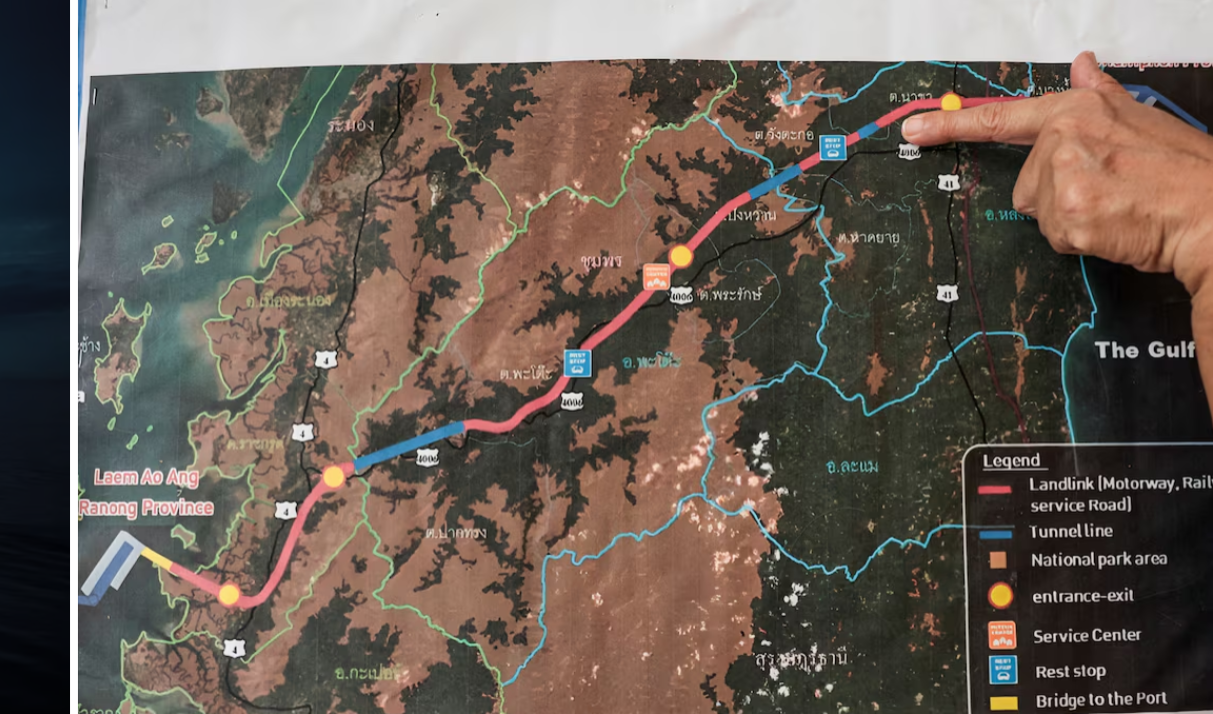
Project. Land Bridge envisages the creation of a logistics corridor costing 1 trillion baht ($30.45 billion), which will link two new deep-water ports — Chumphon on the coast of the Gulf of Siam and Ranong on the coast of the Andaman Sea. At its heart lies a 90-kilometre standard-gauge railway line, capable of handling up to 20 million twenty-foot equivalent units (TEUs) per year.
According to an internal government presentation, the corridor could reduce logistics costs by almost 30% and cut transit times by 14 days for freight travelling between southern China and the Indian Ocean. In addition to the railway, the project involves the development of a road network and connections to the national rail network.
Logistical significance and competition with the Strait of Malacca
The Strait of Malacca is a key maritime route between Asia, the Middle East and Europe, through which around 80% of transit containers pass, which are not destined for local markets. Thailand plans to attract a share of this transit traffic, particularly shipments in medium-sized containers that are transhipped between smaller-capacity vessels.
It is estimated that transporting goods between the two seaports via the Land Bridge could be 10% cheaper and 6 days faster than comparable routes via Singapore, due to lower pressure on the infrastructure.
Resistance from local communities and environmental challenges
Local residents, particularly fishermen and farmers in the project area, are voicing strong opposition. They fear the loss of their traditional sources of income and the destruction of ecosystems, particularly the mangrove forests surrounding the area.
Entrepreneurs from the Fato district, home to durian and coffee plantations, emphasise the economic value of agriculture without the need for large-scale industrialisation. Due to differing assessments of the project’s environmental impact, regulators are demanding a new comprehensive environmental and health assessment.
Financial and geopolitical risks
Investors remain cautious due to the project’s enormous cost and the complex geopolitical context. Chinese state-owned companies are reluctant to invest without guarantees of control, which could provoke political opposition in Thailand. Experts emphasise that success requires cooperation between shipping lines, port operators, financial institutions and developers.
The government commission responsible for assessing the project is due to present its findings by the end of July. The response from neighbouring countries and the reaction of the international community will also influence the initiative’s future.
Strategic importance for Thailand
Analysts point out that the Land Bridge is unlikely to compete with the Strait of Malacca as a global transport corridor, but could become an important national security asset and contribute to the development of the country’s exports to the West. The project has the potential to provide more resilient energy routes and strengthen Thailand’s logistics infrastructure, which is of great importance given the regional instability.