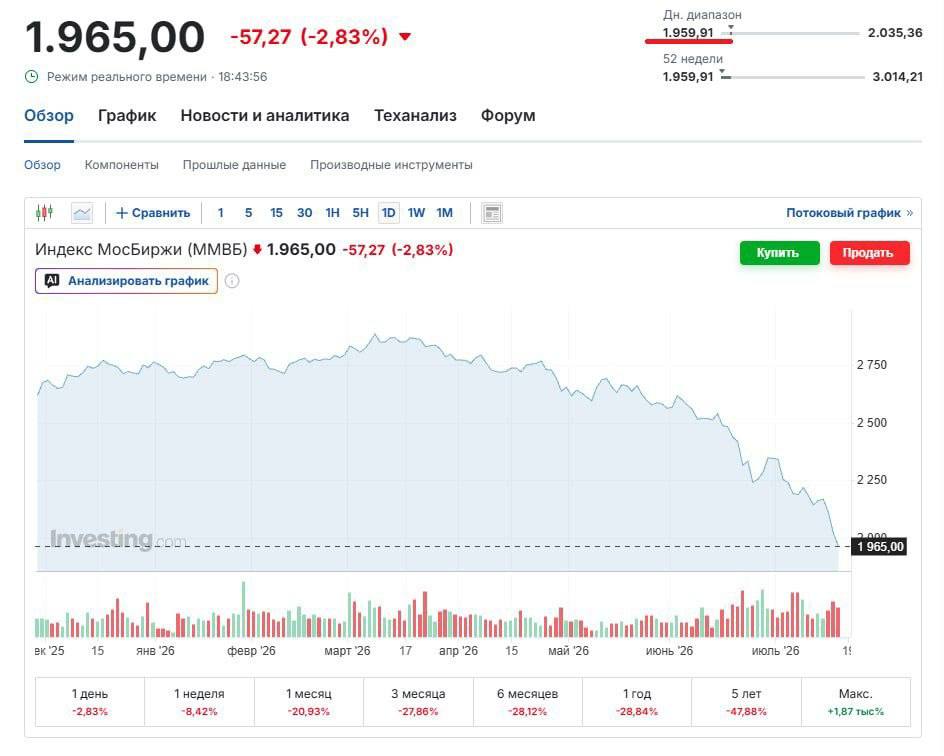
The Moscow Exchange Index has been falling for 18 consecutive weeks — the longest uninterrupted run since the start of the available data series in 1997, according to calculations by the broker «KIT Finance». At the close of trading on 17 July, it fell by 2.83% to a new three-year low. The Bank of Russia attributed the pressure on the market to geopolitical risks, the oil market situation and expectations regarding the key interest rate.
Briefly about the main points
- The Moscow Exchange Index has been falling for 18 consecutive weeks, according to KIT Finance.
- Since the start of April, the index has lost nearly 30%.
- On 17 July, the index fell by 2.83% to a three-year low.
- Gazprom shares fell by 6.1% to 78.37 roubles.
- Private investors bought a record amount of corporate bonds in June.
A record-breaking run and a slump in the biggest shares
Over the past month, shares in a number of Russia’s largest companies have fallen by 20–50%, including, in particular, Gazprom, VTB and Aeroflot. On 17 July, Gazprom shares fell by 6.1% to close at 78.37 roubles — stock exchange data show this as an all-time low.
Analysts at KIT Finance have recorded the longest run of weekly declines in the index since 1997.
The Bank of Russia has identified the factors causing pressure
In its June risk review, the Bank of Russia cited escalating geopolitical risks and a deterioration in economic conditions as among the reasons for the fall in stock indices the oil market and a reassessment of expectations regarding the future path of the key interest rate.
On 19 June, the regulator cut the key rate by 25 basis points to 14.25% per annum. At the same time, it emphasised that future decisions would depend on inflation, inflation expectations and domestic and external risks. Consequently, it is not only the level of the rate that is important for the market, but also the uncertainty surrounding the pace of its further reduction.
Private investors’ funds are shifting towards debt
Against the backdrop of falling share prices, Russian retail investors purchased a record 162 billion roubles’ worth of corporate bonds in June, according to the Bank of Russia. Their demand for these securities significantly exceeded the public’s demand for OFZs and shares.
According to KIT Finance, in June, private individuals were net buyers of shares, whilst fund managers and non-residents from friendly jurisdictions were net sellers. This indicates not only that some market participants are exiting the equity market, but also a shift in domestic demand towards fixed-income instruments and other more conservative assets.
Sanctions-related uncertainty adds to the risk premium
On 14 July, a group of US senators tabled an updated bill on sanctions against Russia. The document provides for sanctions against Russian officials and potential tariffs of up to 100% for the largest buyers of Russian oil and gas. As of 18 July, it had not been adopted, but the very emergence of the initiative could have heightened risk assessments of Russian assets.
Previously. Ukrmedia News reported that Russian billionaires are moving billions of dollars abroad due to fears of confiscation, an economic downturn and risks to the banking system.