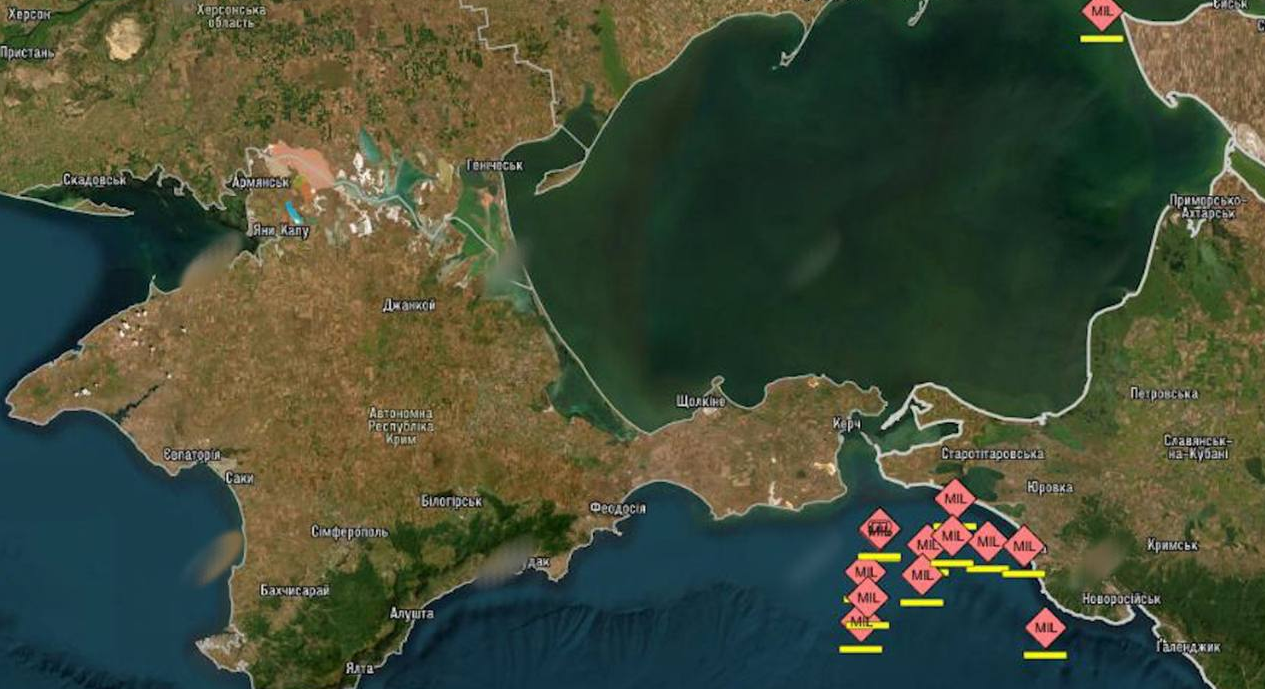
The Unmanned Systems Forces have reported that 13 vessels have been struck over the past 24 hours in the Black and Azov Seas as part of Operation «MoLoChKa». According to Robert Brovdi, commander of the Unmanned Systems Forces, the total number of vessels struck over the 13 days of the operation has reached 172: 118 in the Sea of Azov and 54 in the Black Sea.
Briefly about the main points
- The SBS reported that 13 vessels had been hit over the past 24 hours.
- The targets listed include eight dry cargo ships, two tankers and a tugboat.
- The list also includes two floating cranes.
- The reported outcome of the operation is 172 vessels hit.
- The SBS links the operation to pressure on Russian maritime logistics.
Which vessels were named among the new targets?
According to the statement Roberta Brovdi, over the past 24 hours, eight dry cargo ships, a tanker, a gas tanker, a tugboat and two floating cranes have been hit. The commander did not specify their names, cargoes or the nature of the damage.
The SBS emphasises that the aim of the operation is to stop oil transport, fuel and other cargoes, which, according to the Ukrainian side, Russia is using to circumvent international sanctions. Brovdi stated that attempts are being made to disable the vessels in such a way as to prevent an oil spill at sea.
The new daily report shifts the focus to the Black Sea
As of 17 July, the SBS had officially reported that 159 vessels affected Since the start of the operation on 6 July: 117 in the Sea of Azov and 42 in the Black Sea. At the time, the command reported that 12 vessels had been destroyed in the Black Sea.
The current figure of 172 vessels represents, in purely arithmetical terms, an increase of 13 vessels. It follows from the breakdown provided by the SBS that, over the last reporting period, the number of vessels struck in the Black Sea rose by 12, and in the Sea of Azov by one. This may indicate an intensification of operations specifically in the Black Sea.
The attacks are putting pressure on maritime transport
Brovdi had previously explained that the operation is primarily aimed at small and medium-sized vessels used by Russia to deliver fuel to occupied Crimea and to tranship it for onward transport.
In mid-July, Reuters, citing an industry source, reported that commercial vessels were unable to enter or leave the Sea of Azov via the Kerch Strait and the Azov-Don Canal. The Russian side also stated that passage had been halted or restricted following the attacks.
The agency noted that around a quarter of Russia’s grain exports pass through the Sea of Azov. Consequently, restrictions on traffic could affect not only fuel shipments but also Russia’s wider freight logistics.
Russia accuses Ukraine of attacks on shipping
Russian Foreign Minister Sergey Lavrov described the Ukrainian attacks on shipping in the Sea of Azov as «terrorism». At the same time, the Russian Ministry of Agriculture acknowledged the possibility of redirecting some export flows via alternative routes.
The results reported by the SBS for 18 July are currently based on information from the Ukrainian command. The reports use the term «hit»: this does not automatically imply that the vessels have been destroyed or sunk. The stated tactic is primarily aimed at rendering the vessels inoperable.