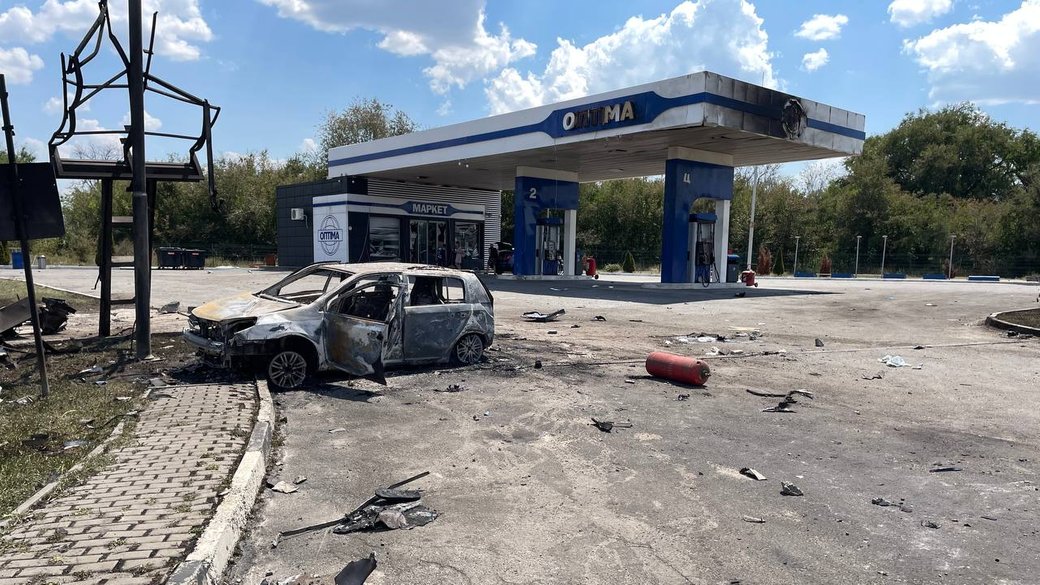
Since March 2022, 297 strikes on 236 petrol stations across Ukraine have been confirmed. Around 3% petrol stations across the country have been hit, though in frontline and border areas, attacks may leave certain routes without fuel. The government states that there is no nationwide shortage, whilst operators are adjusting their logistics and operating procedures.
Briefly about the main points
- A total of 297 strikes at 236 petrol station locations have been confirmed.
- The Dnipropetrovsk region has recorded 60 attacks, followed by the Donetsk and Kharkiv regions.
- In the Nikopol district, 59% active stations have been affected.
- The attacks are not the main reason for the recent rise in fuel prices.
- «Ukrnafta» is purchasing petrol tankers to speed up the transport of fuel.
Attacks are concentrated near the front line and the border
The highest number of confirmed attacks was recorded in the Dnipropetrovsk region — 60. Next in terms of the absolute number of strikes are the Donetsk and Kharkiv regions. The majority of these incidents occurred in six frontline and border regions.
According to WOG’s estimates, the full restoration of a single station costs between 50 million and 70 million UAH. The data from the Centre for Information Resilience only takes into account attacks with confirmed geolocation.
National statistics do not reflect the situation in individual regions
There are around 8,000 petrol stations in Ukraine. In its latest inflation report, the National Bank estimated that 4% of petrol stations had been damaged and noted that the loss of sales was being offset by petrol stations in the hinterland.
At the same time, local fuel availability has already become an issue. In the Nikopol district, the attacks affected 59% operational petrol stations, whilst in the Sumy region, more than a quarter of the network was affected. Significant proportions of petrol stations destroyed or damaged have also been recorded in the Kramatorsk, Bohodukhiv and Kherson districts.
A member of the Kharkiv Regional Council reported that there were no functioning petrol stations left on the route between Kharkiv and Poltava. His assessment includes not only those that have been destroyed but also those that have been closed, which is why it exceeds the CIR figures.
There are several reasons for the rise in fuel prices
No significant price discrepancies have yet been recorded in the frontline regions. Since May, the price of A-95 petrol in Ukraine has risen by 10%, whilst in the Sumy and Kharkiv regions it has risen by 11.6–12%. The exception is the Donetsk region, where a litre of diesel costs around 100 UAH.
Over the past few weeks the price of diesel has gone up by more than 15 UAH per litre, and petrol by more than 6 UAH. Among the factors cited for this surge are complications in maritime logistics, the shallowing of the Danube, a shortage of diesel fuel in the European Union, and seasonal demand from farmers. Attacks on petrol stations are one of the factors, but probably not the main one.
Carriers are changing their schedules and delivery methods
WOG is closing some of its petrol stations in high-risk areas at night and suspending operations during air raid alerts. Ukrnafta is purchasing 100 lorries for transporting fuel in order to move supplies between regions more quickly.
The Naftogaz Group lost 37 petrol stations in 2026. In Trostyanets, in the Sumy region, fuel has started to be sold directly from tankers. Industry experts are proposing that this model be legalised across the entire frontline zone.
The authorities are discussing the protection of stations and risk insurance
The government insists that there is sufficient fuel nationwide. At the same time, the authorities are discussing with the business community additional protection for petrol stations and mechanisms for insuring against war risks.
Some of the planned events are not being publicised for security reasons.