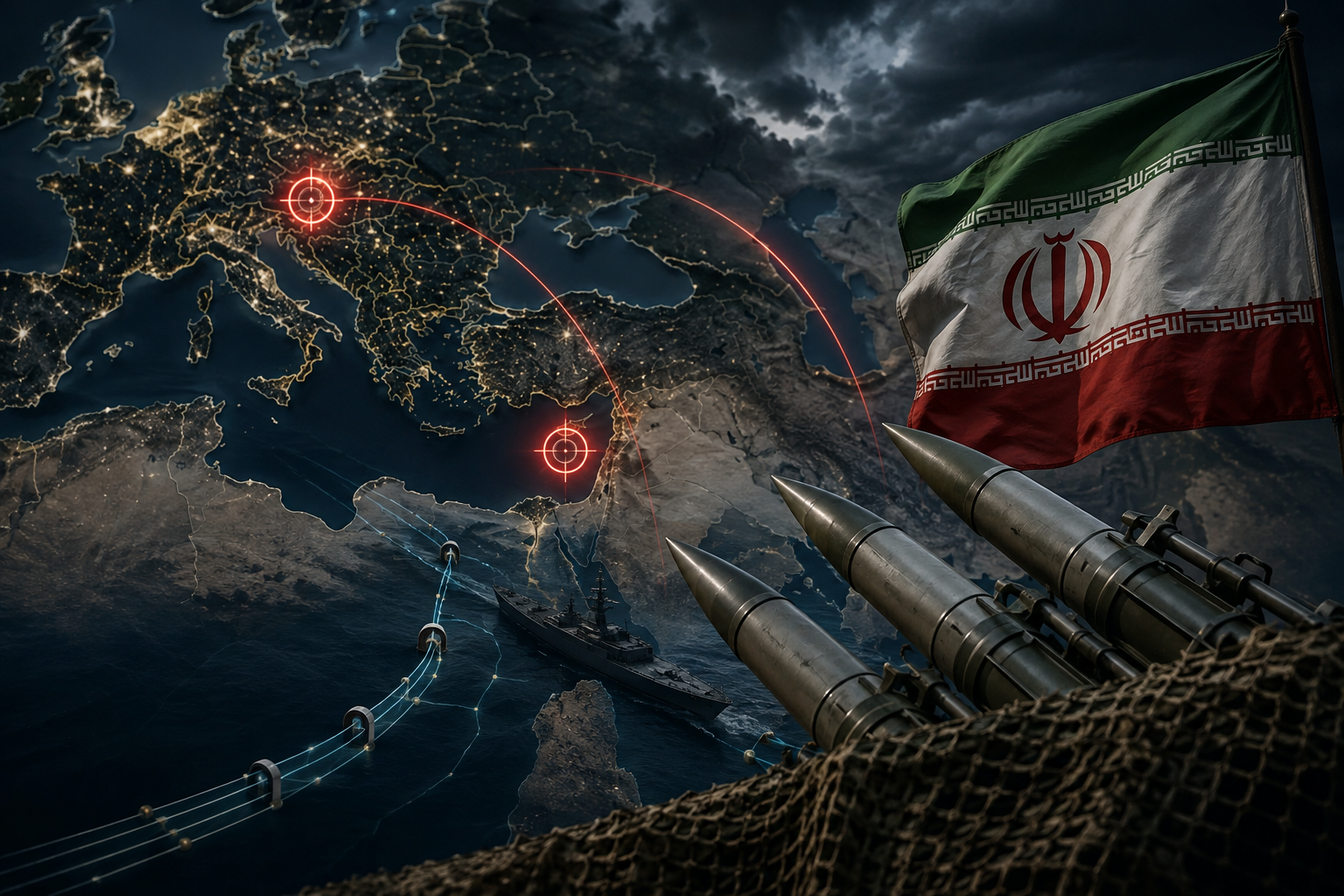
The Iranian military is considering the possibility of strikes against US military installations in Europe should the US proceed with further escalation of the war, the Financial Times reported on 19 August, citing sources close to the Iranian leadership. The newspaper cites Bulgaria and Cyprus as potential targets; Tehran has also been considering attacks on fibre-optic cables in the Strait of Hormuz.
Briefly about the main points
- The FT reports on the development of scenarios, not an order to attack.
- Bulgaria and Cyprus have been identified as potential destinations.
- Bezmer is being used by American refuelling aircraft on a temporary basis.
- Iran has been investigating attacks on cable infrastructure in the Strait of Hormuz.
- The range and effectiveness of Iranian strikes remain a limitation.
Bulgaria has found itself in the spotlight because of the Bezmer base
The Financial Times lists American facilities in Bulgaria and Cyprus amongst the locations that the Iranian military have been investigating. According to the publication, particular attention was paid to Bulgaria following the authorisation in July for American refuelling aircraft to use the Bezmer airbase.
The Bulgarian Parliament has authorised the deployment of up to eight KC-135s, up to 250 US military personnel and airfield equipment at the base from 24 July to 1 October. On 31 July, the Bulgarian Ministry of Defence confirmed the arrival of the first two aircraft.
Sofia had previously stated that no direct military operations relating to the Middle East conflict would be conducted from its territory. According to the Iranian news agency IRNA, Iran’s Foreign Minister Abbas Araghchi warned that countries involved in a military attack on Iran would be held responsible for the consequences.
The cable scenario primarily concerns communications between the Gulf states
Separately, Tehran was investigating the possibility of attacks on undersea fibre-optic cables cables in the Strait of Hormuz area. Representatives of the Islamic Revolutionary Guard Corps have previously stated publicly that a response to any new attacks could target energy and internet-related infrastructure.
According to estimates by the International Cable Protection Committee, there are five segments of cable systems operating in the strait. Less than 1% of global international bandwidth passes through them, but this route is important for communications in the Gulf states; the networks have alternative routes for rerouting traffic.
The tensions have already had an impact on maritime traffic. Lloyd’s List Intelligence recorded 78 vessels passing through the strait between 3 and 9 August, compared with 95 the previous week.
The report concerns planning, not an approved attack
The FT report outlines a list of potential targets and options for a military response, rather than a decision to launch a strike against Bulgaria, Cyprus or any other country. A direct attack on a US facility on the territory of a European country would signify a geographical expansion of the conflict.
At the same time, the Financial Times highlights the limitations of such a scenario: Iran’s previous attempts to use weapons against very distant targets have not always been successful. Therefore, Tehran’s ability to effectively strike targets at such ranges remains uncertain.