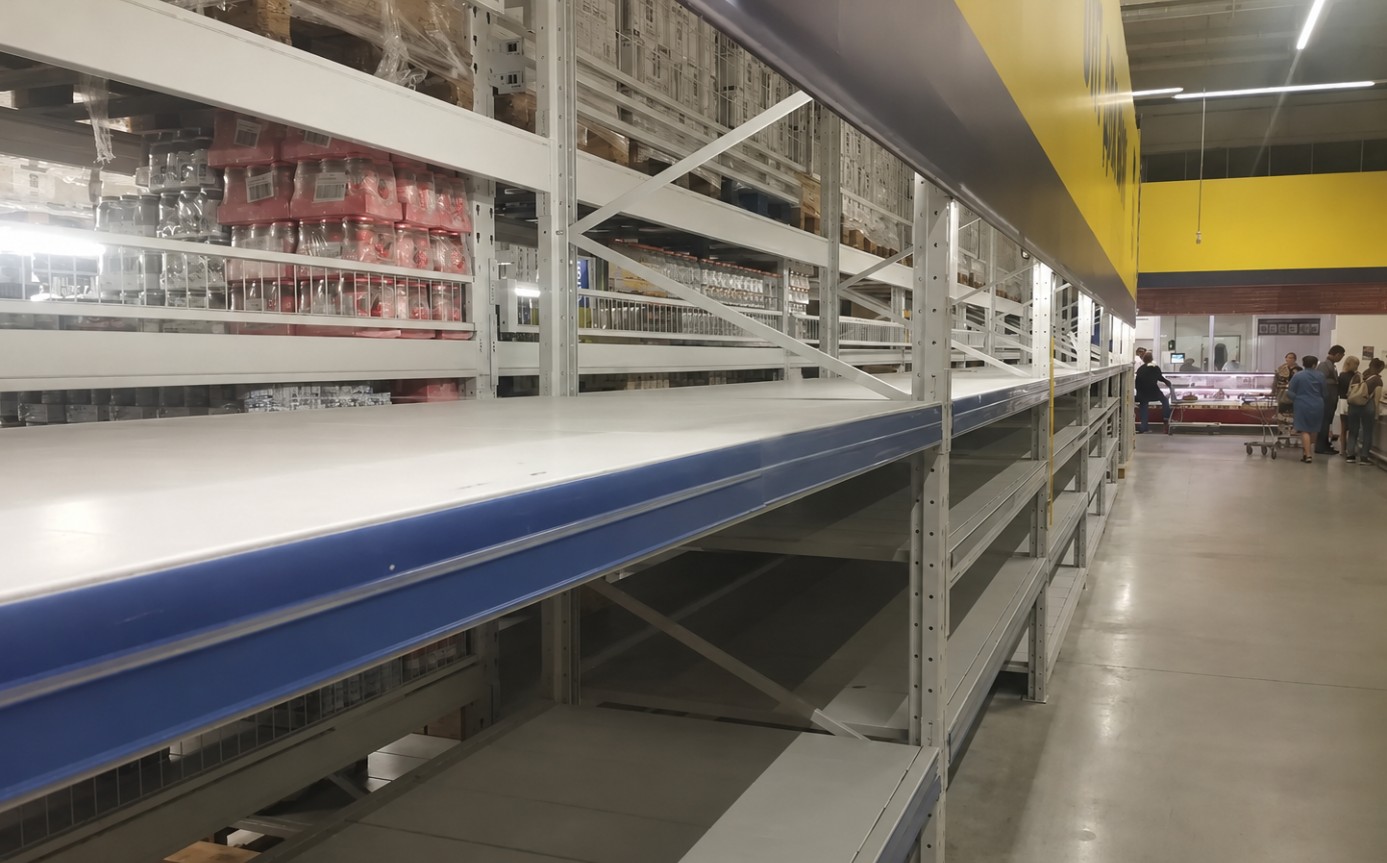
Russian strikes on warehouses, distribution centres and food industry facilities are causing localised disruptions to supplies to supermarkets across Ukraine. Shoppers are reporting empty shelves with only a few items remaining in several cities, whilst the Ministry of Agrarian Policy has reported large-scale disruptions to food supply chains. The government says that basic foodstuffs should remain available, although the range of products on offer may be reduced.
Briefly about the main points
- In Lutsk, the shelves containing cereals were found to be almost empty at one «Silpo» store.
- Social media reports indicate a shortage of goods at METRO stores in Lviv and Odesa.
- The Ministry of Agrarian Policy estimates the losses incurred by retail chains’ logistics operations at approximately 90%.
- In August, attacks damaged 10 of Fozzy Group’s distribution centres.
- The government is forecasting fluctuations in product availability, rather than an actual shortage of food.
Shortages are already evident in shops in several towns
On 30 August, «Volyn 24» published images from one of the «Silpo» supermarkets in Lutsk: the shelves stocked with cereals there were noticeably empty. The publication attributed this to supply disruptions following Russian strikes on the Fozzy Group’s logistics infrastructure.
Videos and photos from METRO stores in Lviv and Odesa are also circulating on social media, showing shoppers pointing out shortages of certain non-perishable goods. At the time of publication, no official comment from the chain regarding the situation at these specific shopping centres could be found.
Some NOVUS shops in Kyiv have reported shortages of bread, potatoes, apples, porridge, chicken and frozen foods. According to media reports, «ATB» has introduced limits on the quantity of certain items that can be purchased by a single customer. These instances point to supply disruptions at individual outlets and within retail chains.
Networks are losing their distribution centres and re-routing their services
Minister for Agricultural Policy Taras Vysotsky On 28 August, he stated that Russian attacks destroyed approximately 90% logistics vehicles food products, which retail chains had been using. According to him, retailers are switching to direct deliveries from manufacturers, «direct-from-vehicle» transport, smaller warehouses and the re-routing of supply flows between regions.
One example is the Fozzy Group, which comprises Silpo, Fora, Thrash! Trash! and Fozzy. During August, 10 of its distribution centres were damaged by strikes. The company reported the loss of part of its logistics and production infrastructure, stock, and a significant increase in delivery costs.
On 5 August, a single attack damaged four of the group’s centres. The new «Fory» centre, which specialises in fresh produce, had been operational for about a week before it too came under attack. This is forcing companies to resume supplies at a time when new logistics solutions are also being targeted.
The attacks are affecting warehousing, production and delivery
On the night of 30 August, in the Odesa region, a Russian strike damaged a warehouse containing food supplies. The fire spread across around 3,000 square metres, and three people were injured. Local sources linked the facility to the infrastructure of «ATB», although the authorities did not officially name the owner of the warehouse.
On the same day, in the Mykolaiv region, a Shahed drone damaged a warehouse belonging to a food processing company, where a major fire broke out. Local media outlets suggested a link between the facility and Sandora, although there has been no official confirmation of the company’s name.
Following the attack on Mila in the Kyiv region, the company «Chysta Voda» announced that it was temporarily suspending the production and delivery of bottled water due to significant losses. Consequently, every link in the supply chain – from production to the transport of goods to retail outlets – is being affected.
Why is the shortage most noticeable among non-perishable goods?
Cereals, flour, sugar, oil and tinned goods are usually handled in large batches via centralised distribution centres. The loss of such a hub means not only damage to stocks, but also a halt to the sorting of tens of thousands of items before they are dispatched to shops.
Manufacturers and retailers have to transport smaller consignments either directly to retail outlets or via temporary warehouses. This requires more vehicles, routes, fuel, drivers and staff. Consequently, a product may be physically available in the country but may not reach a specific shop on the required day.
This effect is exacerbated by stockpiling following the appearance of photos of empty shelves and reports of further attacks. Given the reduced stock delivered to the shop and the increased demand, supplies may run out more quickly than under normal circumstances.
The government expects supply fluctuations, not famine
The Ministry of Agrarian Policy has ruled out the possibility of widespread famine or a physical shortage of staple foods. Vysotsky stated that such goods should remain available thanks to alternative routes and «direct-to-consumer» deliveries.
At the same time, replacing large warehouses with direct deliveries increases costs for manufacturers and retail chains. Should the attacks continue, consumers may increasingly face a limited choice, temporarily empty shelves and more expensive logistics. Retailers will have to operate with lower stock levels and, increasingly, source goods directly from manufacturers.