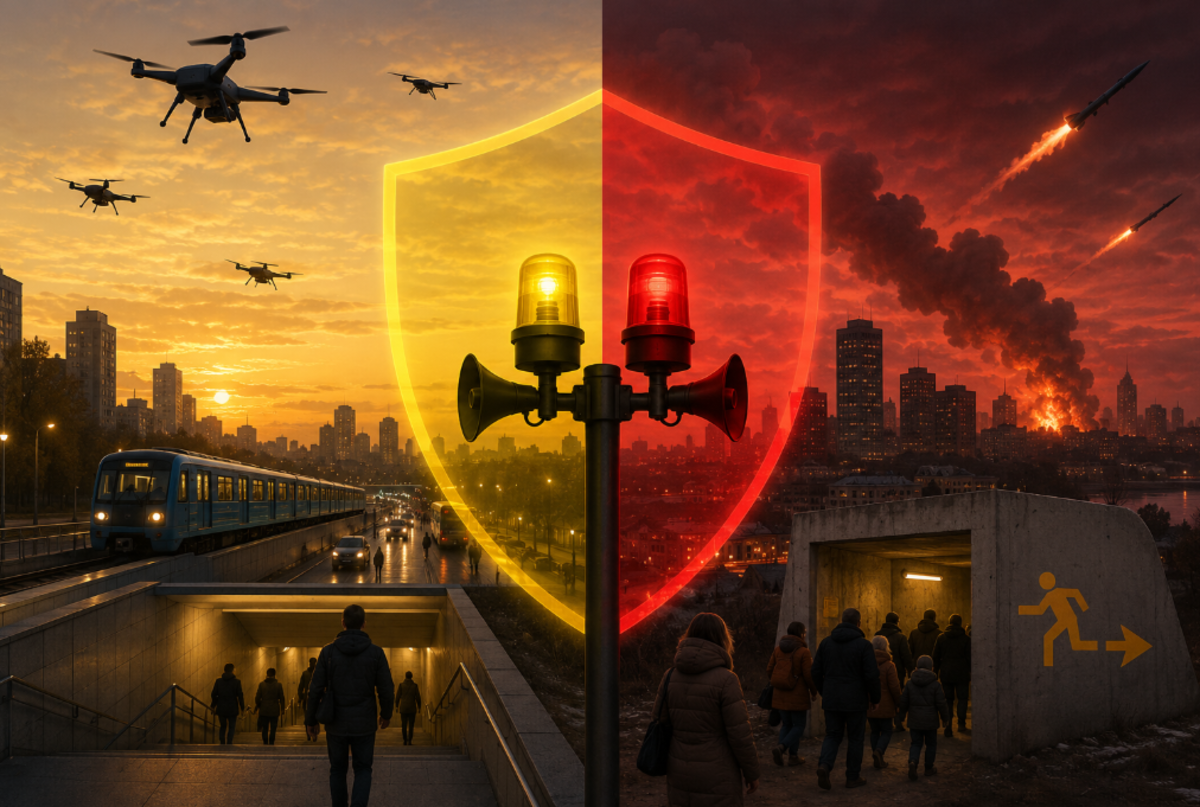
The Cabinet of Ministers has approved two levels of air threat in Ukraine — yellow and red. Generally, the first will be applied during drone attacks, and the second in the event of a missile, ballistic or combined threat. The alert level will determine how businesses, organisations and transport operate: at the highest threat level, people must take shelter.
Briefly about the main points
- The yellow alert level will generally be triggered in the event of a threat of drone attacks.
- Businesses will only be able to operate if people have access to shelters.
- The red alert involves the closure of businesses and organisations.
- The criteria for classifying threats will be reviewed on a weekly basis.
- The Kyiv Metro has been advised to operate as normal whilst the yellow alert is in force.
Yellow level: work is only possible if access to shelter is available
Yellow level will serve as a basis for situations where there is a threat of a drone attack. According to the Prime Minister Sergey Koretsky, under such arrangements, enterprises and businesses will be able to continue operating whilst strictly adhering to safety requirements.
The key requirement is that staff and visitors must have access to shelters. The government has given businesses that have not yet provided such facilities three months to resolve the issue.
This regime does not remove the need to respond to danger. It provides for a different course of action, under which work is permitted to continue where people’s safety can be ensured.
Under what circumstances will a red alert be declared?
Red level will generally be applied in the event of missile threat, the dangers posed by the use of ballistic missiles, a massive air strike or a combined attack using various weapons.
Under this regime, businesses and organisations must cease operations, and people must take shelter. The President Volodymyr Zelenskyy He explained the need for change by pointing out that a single signal for different types of danger no longer reflects the realities of war.
According to him, the new model should provide people with more information about the nature of the threat and the necessary actions.
The criteria and alert signals will be reviewed on a weekly basis
The classification will not be a fixed system whereby every drone attack automatically triggers a ‘yellow’ alert and every missile attack a ‘red’ one. Specific criteria will be determined each week by the General Staff and the Air Force, in conjunction with the government, the Ministry of Defence, the Ministry of Internal Affairs and the State Emergency Service.
This approach should make it possible to take into account changes in Russian tactics, the types of drones and missiles used, and the nature of large-scale strikes.
Different audible warnings are planned to be introduced for both levels. Alarms and associated restrictions are also to be applied more precisely in areas where there is a genuine threat. The siren will not be sounded again once the all-clear has been given.
Kyiv’s metro and surface transport during the yellow alert
The Cabinet of Ministers has recommended ensuring the Kyiv Metro operates at full capacity during a ‘yellow’ alert, and increasing the number of surface transport services where necessary. This is intended to maintain connections to workplaces, hospitals, railway stations and metro stations during prolonged drone attacks.
Traffic arrangements on the various lines in the capital were previously managed separately. In particular, the green line is to operate in full under the ‘yellow’ alert level. If traffic is restricted on certain sections for safety reasons, the city must step up its ground transport services.
Local authorities have been advised to amend the curfew and provide additional shelters
The government links the reform to prolonged and repeated drone attacks, which can cause air raid alerts in major cities to last for hours. Under such circumstances, businesses, shops, public institutions and public transport come to a standstill, even though the nature of the threat differs from that of a massive missile strike.
According to Koretsky, the system should combine the protection of people with the ability to prevent the paralysis of cities, the economy and critical infrastructure.
Local authorities were also advised to review the duration of the curfew and, if the security situation permits, to install it from 01:00 to 05:00. Local authorities should speed up the installation of additional mobile shelters.