Russia has established a cycle whereby new variants of drones and missiles are tested in the war against Ukraine, and successful designs can enter mass production within a matter of weeks, according to The Wall Street Journal. The publication believes that Moscow is ahead of Ukraine and the US in terms of the pace of adaptation and scaling up; the new systems are estimated to cost approximately $100 thousand per unit.
Briefly about the main points
- Russia standardises successful modifications following combat use within a matter of weeks.
- The Main Intelligence Directorate estimates the range of the «Gerani-5» rocket to be up to 950 kilometres.
- «Ukrainian intelligence classifies the »Banderol’ as a cruise missile.
- Chinese engines, modems and Western electronic components have been identified.
- Ukraine is quick to develop technology, but Russia has greater manufacturing capacity.
Data from the front line is quickly translated into operational changes
According to the WSJ report, Russia is deploying a new variant and analysing its accuracy, losses and how it is countered by air defence and electronic warfare systems. Engineers then make adjustments to the navigation, communications, propulsion system or operational tactics. Solutions that have proven effective are standardised and put into production.
The Centre for Strategic and International Studies (CSIS) refers to this practice as a continuous cycle of adaptation: feedback from the front line can influence factory operations within weeks. This differs from the traditional Western defence cycle, where tendering, development, testing and the awarding of a major contract often take years.
The «Geran-5» missile system reduces the time taken to intercept
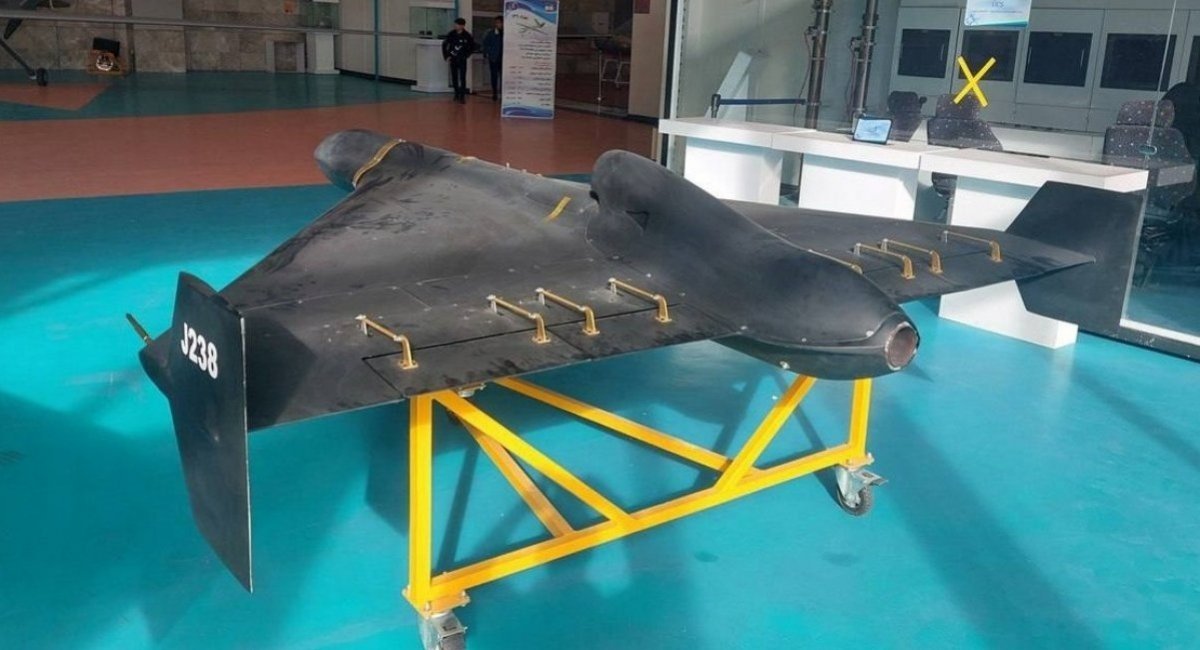
Russia has started to use «Geranium-5» in early 2026. According to the Main Intelligence Directorate, the missile has a maximum take-off weight of around 850 kg, a warhead weighing approximately 90 kg, a range of up to 950 km and a cruising speed of 450–600 km/h.
The classic piston-powered «Gerani» drones move several times more slowly. The jet aircraft passes through the dangerous section more quickly, so mobile fire support units have less time to react. The Financial Times has also reported on improvements to the guidance and communications systems of the new «Gerani» missiles and their better adaptability to Ukrainian electronic warfare capabilities.
Cheap missiles are exacerbating the problem of interception costs
Ukrainian intelligence classifies the S8000 «Banderole» as a cruise missile. The concept behind it is to create a long-range, high-precision weapon that is cheaper than the Kh-101, the «Kalibr» and their Western counterparts.
The WSJ estimates the cost of a «Banderole» and a jet-powered drone at approximately $100 thousand per unit, whilst the American Tomahawk costs over $2 million. Even if these figures do not represent contract prices, this ratio highlights a problem for air defence: a relatively cheap target sometimes has to be shot down with a missile that costs several times as much. The economics of interception have become one of the key aspects of warfare.
The components are sourced from China and Western countries
The Main Intelligence Directorate (GUR) has identified a Chinese TELEFLY TF-TJ2000A turbojet engine, a Xingkay Tech Mesh modem and other components on the «Geran-5». On the «Banderole», intelligence sources confirmed the use of another Chinese engine — the SW800Pro-A95.
Microchips from the US firms Texas Instruments, Monolithic Power Systems and CTS, as well as transistors from the German firm Infineon, were also found in the jet-powered UAV. Some of these components were manufactured after the full-scale war had already begun. The presence of a Chinese component does not prove direct supply by the Chinese authorities: goods may be entering Russia via intermediaries and re-export schemes.
As of 10 September, the GUR’s War&Sanctions database had catalogued over 6,100 foreign components in 207 weapon models used by Russia and its partners. The Russian «Geran» programme originated from the Iranian Shahed-136, but the new model has been standardised with the Russian range and adapted to its own production facilities.
Innovation in Ukraine is held back by the scale of production
The WSJ emphasises that Ukraine is rapidly developing new technologies and is one of the world leaders in the use of FPV drones, maritime unmanned vessels, long-range strike UAVs, ground-based robotic platforms and digital control systems. At the same time, the sector consists largely of private manufacturers, who are not always able to scale up immediately from hundreds to tens of thousands of units.
Russia has greater state resources, factories, production facilities and the ability to consolidate orders. American industry, for its part, was geared towards complex and expensive systems produced in smaller batches. According to the WSJ, the US and its allies are investing tens of billions of dollars in cheaper counter-drone and strike capabilities.
The pace of mutual adaptation could prove decisive: Russia is capable of changing flight paths, flight altitudes, antennas, modems, guidance systems or engines, whilst Ukraine and its allies need to scale up their own low-cost interceptors and strike systems just as quickly.