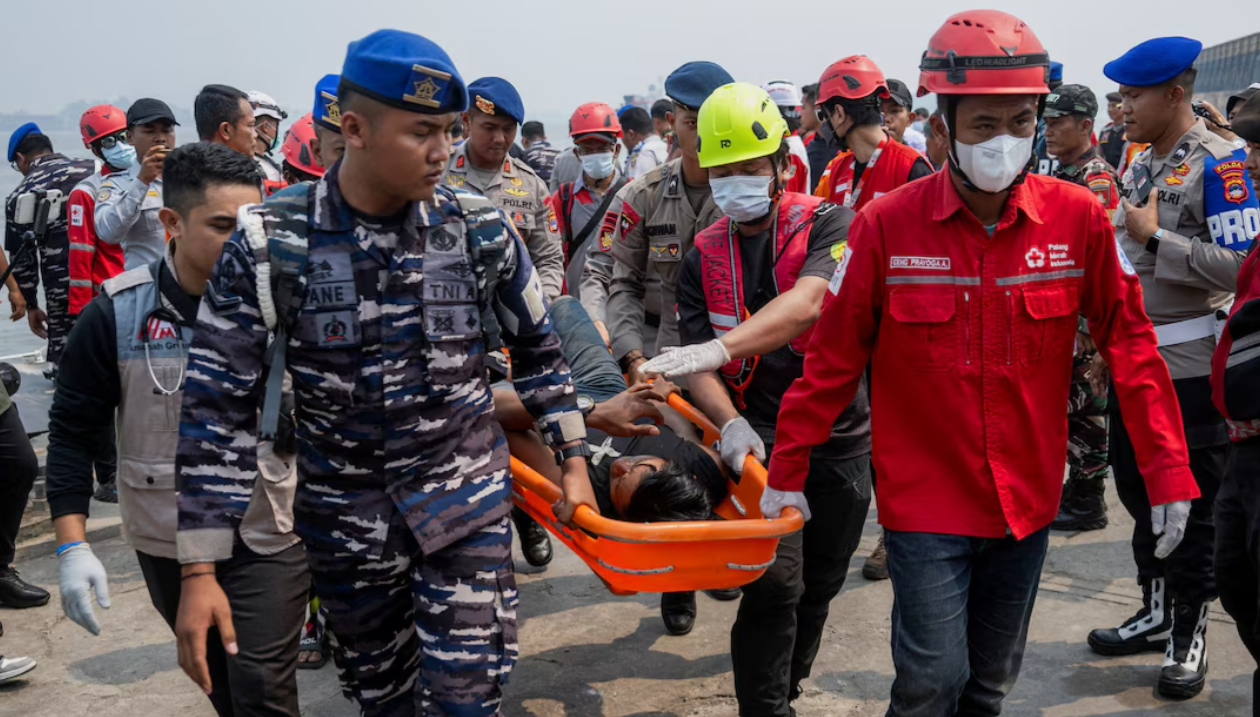
In Indonesia, five days after the Virgo Transport 8 ferry capsized in the Java Sea, 129 people remain missing. Six have died, whilst 108 passengers and crew members have been rescued. Around 60 military and rescue divers are attempting to reach the sunken vessel, but their efforts are being hampered by strong currents, waves and the complex structure of the hull.
Briefly about the main points
- The ferry capsized on 13 September on the Surabaya–Banjarmasin route.
- The vessel sank completely after staying afloat for some time.
- The current has weakened, but it is still stronger than the safe working limit for divers.
- The owner began lifting and levelling the building to gain access to the premises.
- The operation has been classified as a rescue operation due to the possibility of air pockets.
The vessel capsized whilst sailing between Java and Kalimantan
The Virgo Transport 8 capsized on 13 September whilst travelling from Surabaya on the island of Java to Banjarmasin in South Kalimantan. There were 243 people on board. The vessel encountered severe weather conditions and capsized within a matter of minutes.
On the day of the accident, rescue workers located everyone they had managed to find so far. After capsizing, the ferry remained partially afloat for some time, but subsequently sank completely and now lies on the seabed. According to Basarnas, on the evening of 17 September, the hull was at a depth of around 29 metres and had drifted approximately 453 metres south-east of its original position.
Currents and waves are hampering the underwater part of the search
Immediately after disasters The current speed near the vessel reached almost seven knots. A current of up to approximately 1.5 knots is considered a safe benchmark for divers. It subsequently weakened to between 1.8 and 2 knots, enabling the military divers to approach the ferry.
The operation is also being hampered by waves up to 2.5 metres high and strong winds. Around 1,100 people, 17 vessels, five helicopters and other aircraft are involved in the search. The search area has been extended to 6,120 square nautical miles.
The corridors and decks of the ferry pose an additional risk to divers
The Virgo Transport 8 was a roll-on/roll-off vessel that carried both passengers and vehicles. Cars were stowed on the lower decks, whilst the passenger accommodation was situated above. The high, enclosed sides and the internal layout make it difficult to gain access to the flooded compartments.
Once inside the hull, the divers will have to navigate unfamiliar corridors and cabins with virtually no visibility. Sealed compartments with possible air pockets pose a particular danger: opening them underwater could cause a sudden influx of water and a change in pressure, which would be dangerous for the rescuers and anyone potentially still inside.
The owner has begun raising the hull, whilst the search continues in three directions
On 18 September, the owner company, PT Virgo Karya Shipping, began operations to raise and right the sunken ferry. The Indonesian Navy, the Maritime Police and the National Search and Rescue Agency are involved in the operation. Righting the vessel should facilitate access to the interior; military divers have already recovered personal belongings from the area around the vessel.
The search is being conducted simultaneously from the air, on the sea surface and around the hull. The operation officially retains its rescue status due to the possibility of air pockets in the compartments. Indonesian law stipulates that search and rescue operations must continue for at least seven days, whilst relatives of the missing are waiting for news at the ports and are calling for all available underwater and military resources to be deployed.