On 4 November, the archives of the communist secret services, which have remained classified for decades, will be opened to the general public for the first time in Hungary. The documents contain the names of approximately 50,000–60,000 people linked to the state security apparatus during the socialist dictatorship. The new government’s decision could shed light on unknown chapters in the history of thousands of Hungarian families whose relatives collaborated with the secret services or were under their control.
- On 4 November, Hungary will open the archives of the secret services from the era of the communist dictatorship.
- The documents contain the names of approximately 50,000–60,000 people linked to state security.
- Among the informers were people who informed on their friends, neighbours and relatives.
- Some citizens were forced to cooperate through blackmail or threats against their families.
- Around 9,000 detailed personal files will be made public in February 2027.
Hungary is to set up a public database of intelligence agents
The state security archives will be made available via a dedicated online platform, Nyitottaktak.hu, which is due to launch on 4 November.
The database will allow users to search for information on former security service staff, undercover informants and people who were approached for recruitment. The documents contain personal details, agent codenames and information on the activities of the state surveillance network.
The decision was adopted by the Prime Minister’s government Peter Magyar, whose party, «Tisa», won the parliamentary elections in April 2026, bringing an end to Viktor Orbán’s long reign.
The declassification of documents was one of Madyar’s election pledges. In September, Parliament passed the relevant law by 149 votes, with no votes against.
Initially, the archives were due to be opened in time for the 70th anniversary of the 1956 Hungarian Uprising, but the deadline was postponed due to the need for further verification and preparation of the documents.
Minister for Social Affairs and Culture Zoltán Tarr stressed that a democratic society has the right to know its own past.
Tens of thousands of Hungarians spied on their neighbours and relatives
Between 1945 and 1989, the Hungarian communist state security services established an extensive network of informants to monitor the population and suppress political dissent.
Informants passed on information to the secret services about colleagues, friends, neighbours and even members of their own families. Political opponents of the regime, members of the intelligentsia, representatives of religious communities and individuals suspected of disloyalty to the authorities were kept under particular surveillance.
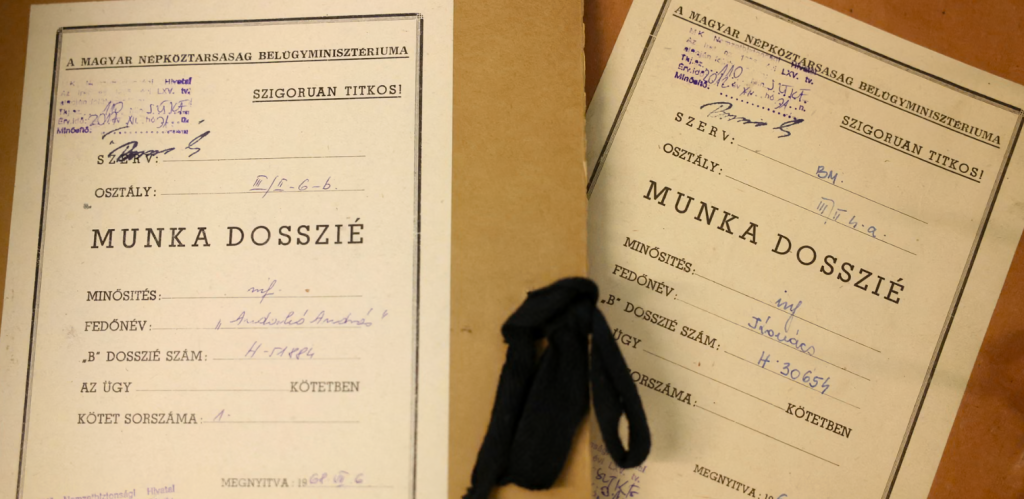
Some citizens agreed to cooperate voluntarily, hoping to gain career advantages or other privileges. Others were recruited through blackmail, threats or pressure exerted on their loved ones.
According to historians’ estimates, between 50,000 and 60,000 people are listed in the surviving archives. Approximately 10% of them may still be alive.
At the same time, the mere presence of a name in documents does not always prove voluntary cooperation with the security services. The files also included individuals who were under investigation or had been the subject of recruitment attempts.
«There were traitors in every family»: what the victims of the regime have to say
The decision to open the archives has provoked a mixed reaction amongst Hungarians who suffered under the repressive communist regime.
Miklós Kish, a former prisoner of a Hungarian forced-labour camp and head of an association of victims of repression, believes that the documents should have been made public many years ago.
He warns that once the archives are opened, people may discover that their relatives, neighbours and acquaintances collaborated with the security services.
At the same time, historians emphasise how difficult it is to assess such cases. Some informants acted under duress, and refusing to cooperate could have put their families at risk.
Journalist Alexander Faludi, the grandson of a Hungarian writer György Faludi, who spent more than three years in a labour camp on trumped-up charges, spoke to The Guardian about his own experience of working with the archives.
In one of the documents, he discovered a denunciation written by a woman who had been on friendly terms with his grandmother. At first, the discovery caused outrage, but later the journalist noticed references in the file to the informant’s elderly parents, who had remained in Hungary. This led him to reassess the circumstances surrounding her collaboration with the authorities.
Some of the documents were destroyed even before the fall of communism
The archives of the Hungarian secret services have not been preserved in their entirety. A significant proportion of the material was destroyed during the anti-Soviet uprising of 1956, whilst other documents disappeared in the late 1980s, as the communist regime gradually lost power.
Historians warn that some files do not contain sufficient information to establish the circumstances of a particular person’s recruitment or their actual activities.
Detailed personal files have been preserved for approximately 9,000 people. These are due to be made public during the second phase, on 25 February 2027.
Before publication, any confidential information relating to health, addictions, private life and any information that could infringe the rights of victims of repression will be removed from the documents.
Gergely Bendeguz Cseh, Director-General of the Historical Archive of the Hungarian State Security Services, cautioned against placing unquestioning trust in records compiled by the authorities of the dictatorship. According to him, the materials may contain inaccuracies and require careful historical analysis.
How other European countries opened up their secret service archives
Following the collapse of the communist regimes, the countries of Central and Eastern Europe adopted different approaches to the issue of access to documents held by the former state security services.
In Germany, the archives of the East German secret service «Stasi» were opened to the public as far back as 1992. The Czech Republic made a significant proportion of the relevant material available in 2003, whilst Latvia published the KGB agents’ archive files in 2018.
In Hungary, however, access remained restricted for a long time, mainly to researchers and relatives of victims of political repression.
Since the early 2000s, unofficial lists of suspected informants have periodically surfaced in the country, featuring politicians and well-known artists. The publication of such material has repeatedly sparked political scandals.
Once the new database is launched, members of the public will, for the first time, be able to search for information themselves in the state archives, which cover more than four decades of activity by the communist secret services.