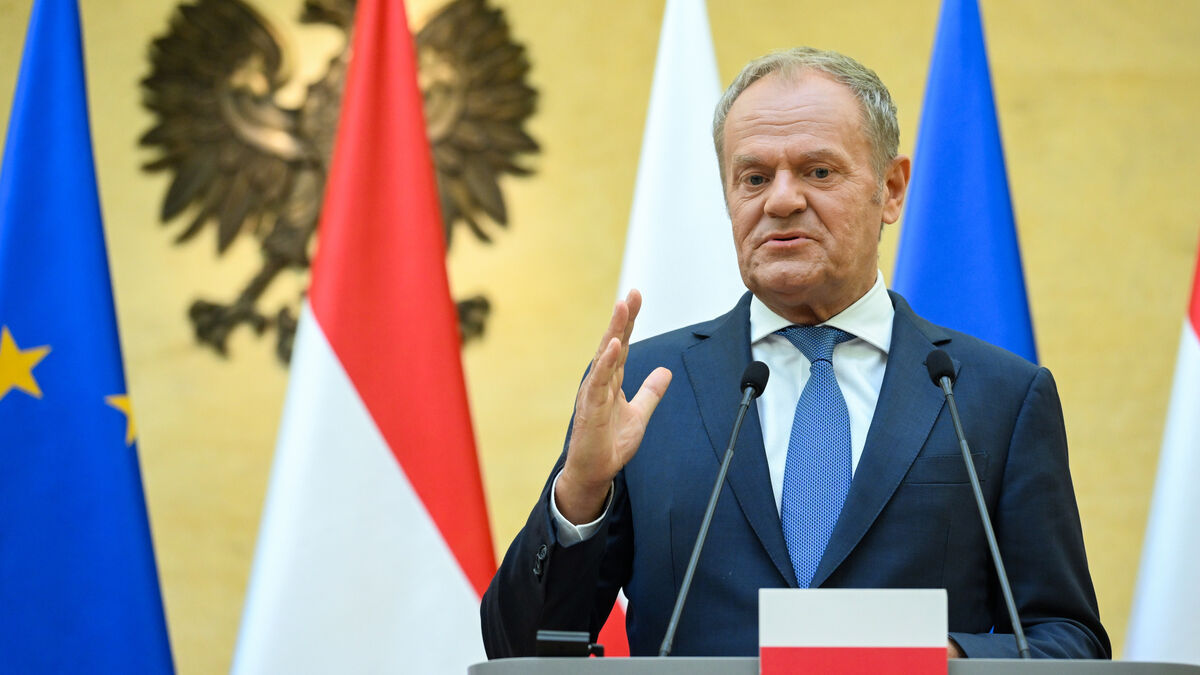
Polish Prime Minister Donald Tusk stated that the intelligence services are assessing as a likely scenario hybrid attacks by Russia using drones and missiles against countries that support Ukraine, in particular Poland. Speaking in the Sejm on 17 September, he emphasised that this was a risk assessment, rather than information about a specific date or targets for an attack.
Briefly about the main points
- Tusk outlined the Polish security services’ assessment of possible provocations by Russia.
- Moscow may carry out strikes in response to random incidents.
- The aim may be to drive a wedge between allies and test NATO’s reaction.
- Tusk described late autumn and winter as critical for Ukraine.
- Poland is stepping up security at six border crossings and its state of readiness.
The scenario may be designed to capitalise on doubts regarding NATO’s response
According to Tuska, Russian drones or other munitions could enter the territory of one or more states on NATO’s eastern flank, causing destruction, whilst Moscow would subsequently attempt to pass this off as an accident.
The Polish Prime Minister believes that such an approach could weaken unity amongst allies, to test their willingness to act in unison and to create the impression that Article 5 of the North Atlantic Treaty is «more theoretical than practical».
Article 5 stipulates that an attack on one member of the Alliance is regarded as an attack on all. At the same time, each state determines the form of assistance in accordance with the treaty and its own procedures.
Tusk described late autumn and winter as the most critical period
Tusk expects further intensive Russian strikes on major Ukrainian cities, energy infrastructure, railways and depots. He noted that attacks on energy infrastructure have not ceased following reports of a possible halt to such strikes.
According to the Prime Minister’s assessment, Russia is seeking to cause as much damage as possible to the Ukrainian economy and logistics. He highlighted the particular danger posed by attacks near the Polish-Ukrainian border, where disruptions could affect supply routes.
Poland is fortifying the border crossings through which supplies are being sent to Ukraine
According to Tusk, Russia’s strategy may be aimed at hindering supplies across Ukraine’s western border. The risks relate to the infrastructure at the border crossings used to transport goods, humanitarian aid and other supplies; in winter, logistical problems could increase the pressure on Ukraine.
After of Russian attacks A few kilometres from the Polish border, Warsaw has begun to further reinforce its border infrastructure. Near the border crossings at Dorohusk, Medytsia and Korchova, the military are erecting defensive structures, observation posts and security posts.
The reinforcement covers six border crossings. Air defence systems are being deployed there, and protective structures are being erected for border guards and military personnel.
Polish services are operating at heightened security alert levels
On 13 September, following a Russian strike approximately two kilometres from the Polish border, Tusk held a special meeting with security officials. At the time, he stated that Russian activity could intensify significantly in the coming weeks and months, and did not rule out the possibility of the escalation spreading to Poland.
The country has maintained heightened levels of terrorist and cyber preparedness. The CHARLIE alert level is in force for part of the railway infrastructure, whilst the BRAVO and BRAVO-CRP alert levels are in force across the rest of Poland and in cyberspace until at least 30 November. The Polish Ministry of the Interior attributes these measures to Russian and Belarusian hybrid activities.
Tusk stated that Poland must be prepared for serious provocations and incidents and maintain unity with its NATO allies.