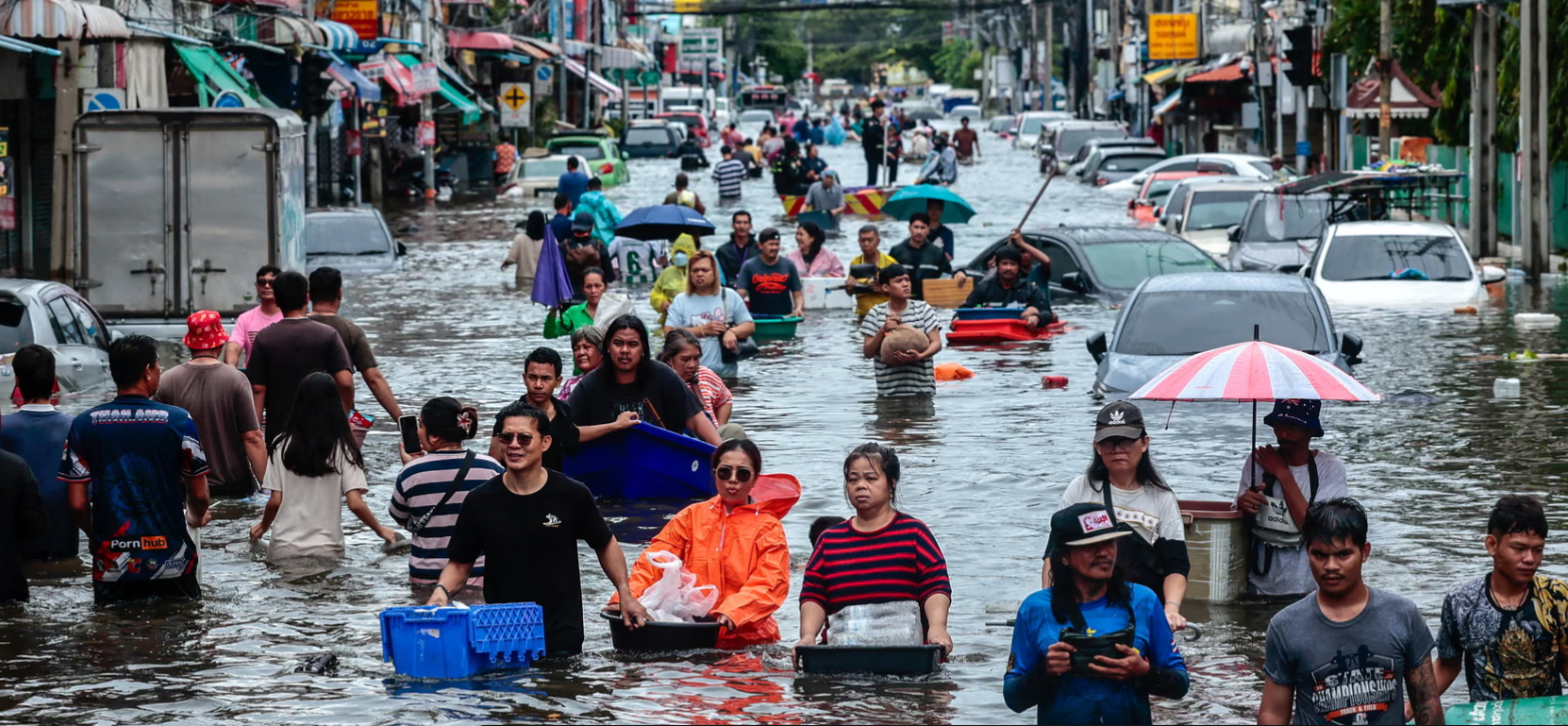
Bangkok is experiencing one of the worst floods in recent years: in some parts of the Thai capital, around 300 mm of rain fell in roughly two days, turning residential areas and roads into stagnant pools of water. According to government figures, around 40 people have died as a result of flood-related incidents, thousands of residents have been forced to move to temporary shelters, and the authorities have declared all 50 districts of the city disaster zones.
- In one part of Bangkok, around 300 mm of rainfall fell over a period of approximately two days.
- Around 40 people have died as a result of the floods and related incidents.
- All 50 districts of the Thai capital have been declared a natural disaster zone.
- The floods have disrupted the running of schools, public transport and Suvarnabhumi Airport.
In two days, London received half a year’s worth of rainfall
For Bangkok, strong tropical downpours is not uncommon. During the rainy season, some roads regularly turn into rivers for short periods, after which the water gradually drains away via a system of canals and pumping stations.
This time, the scale was different. In some parts of the city, around 300 mm of rain — this is roughly equivalent to half of London’s average annual rainfall. The rain did not last for just a few hours, but fell almost continuously for days on end. The drainage system could not cope with the volume of water, so instead of brief flooding of the streets, large pools of standing water formed in residential areas.
Around 40 people have died and thousands are in shelters
According to the Thai authorities, the death toll from flood-related incidents has reached approximately 40 people. The causes of death cited include drowning and accidental electrocution. Thousands of residents were forced to leave their homes. More than 230 temporary accommodation centres.
The situation became particularly dire in the low-lying neighbourhoods. In some places, the water level reached waist height; cars were almost completely submerged, and people used plastic paddling pools, boats and other improvised means to transport their belongings and food.
Once the water had receded, residents were faced with another problem — rubbish, mud and a pungent smell from the stagnant water.
Why is Bangkok so vulnerable to flooding?
Bangkok is built on the vast floodplain of the Chao Phraya River. Historically, water was drained from the city via an extensive network of canals — klongs. However, decades of rapid urban development have altered the natural drainage system. Some of the canals have been filled in or narrowed, whilst large areas of land have been covered with concrete and tarmac, meaning that water is absorbed by the ground much more slowly.
Today, the city relies on pumping stations, canals, dykes and other engineering structures. According to experts, standard drainage channels can cope with approximately 60 mm of rainfall per hour, whilst modernised sections can cope with approximately 80 mm.
During the recent storm, localised rainfall exceeded the system’s capacity, and between successive waves of rain, the system was unable to drain the accumulated water in time.
The airport and transport services have come under pressure
The flooding did not affect residential areas alone. There were serious disruptions at Bangkok’s main international airport Suvarnabhumi. At one point, around half of Thai Airways’ staff were unable to get to work due to flooded roads. This led to flight delays and cancellations, whilst thousands of pieces of luggage piled up in the terminals.
Classes have been suspended in many schools across the capital. There were major traffic jams on the roads, and residents of even relatively dry areas were unable to get to work or return home for hours.
The authorities are preparing for a new spell of rain
Prime Minister of Thailand Anutin Charnwirakul announced the establishment of a special crisis management team to coordinate the response to the aftermath of the natural disaster.
The danger to the capital has not yet passed. Some water continues to flow in from the northern regions of the country, and meteorologists are forecasting further heavy rain. Pumping stations are operating at full capacity, but in the most severely flooded areas it may take several more days to drain the water completely. The government has also instructed local authorities to prepare for a new wave of rainfall, specifically to check pumps, evacuation centres and stocks of food and medicines.
The floods have also affected neighbouring countries
The same weather system caused devastation not only in Thailand. Neighbouring Myanmar was also affected by flooding and landslides. In the southern part of the country, rescue workers were pulling people from the rubble following a major landslide. There were reports of fatalities and people missing. Rescue operations there are further complicated by the civil war, damaged roads and restrictions on the work of humanitarian organisations.
For Bangkok, the recent natural disaster has served as yet another warning: this metropolis, home to millions of people, is increasingly facing rainfall that exceeds the capacity of infrastructure designed for a different climate.