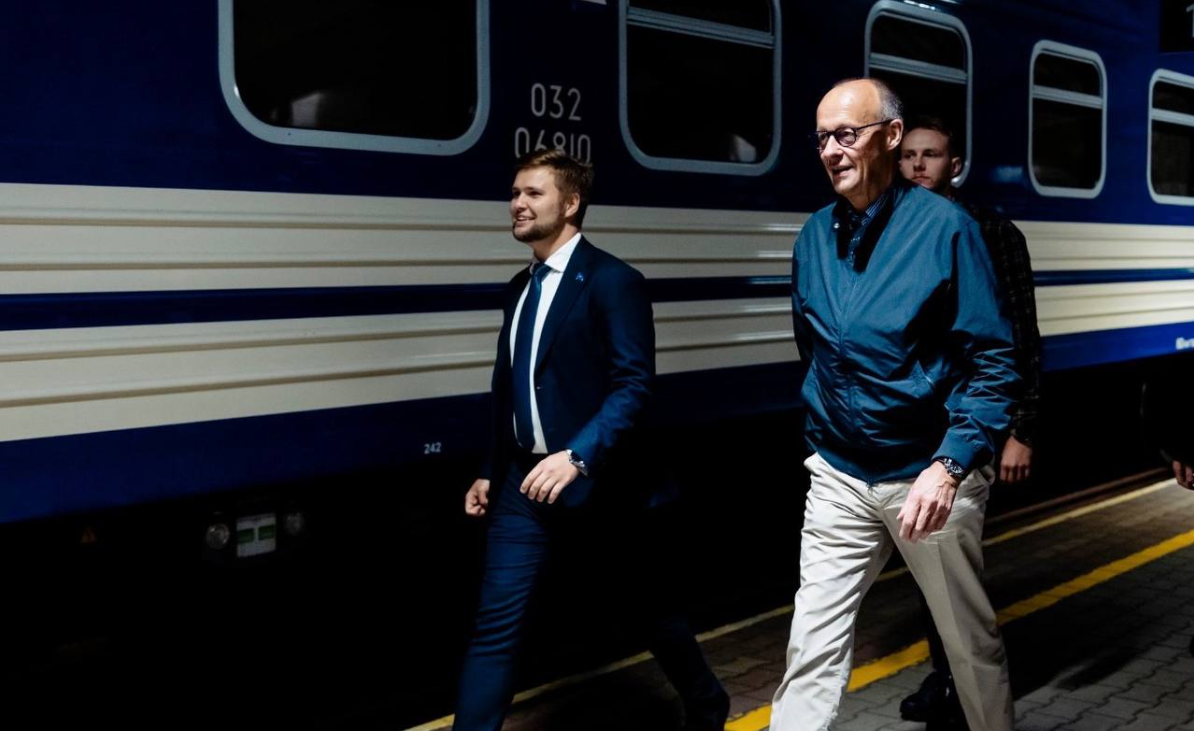
German Chancellor Friedrich Merz arrived in Kyiv on 4 October on an unannounced visit, against the backdrop of intensifying Russian attacks. He stated that Ukraine is facing «decisive weeks», and that the outcome of the war has a direct impact on Germany’s security. During the visit, Berlin plans to announce €1 billion in military aid and €350 million for the reconstruction of Ukraine’s energy sector, as well as finalising agreements on the joint production of drones.
- Friedrich Merz arrived in Kyiv on an unannounced visit.
- Germany is preparing €1 billion in military aid for Ukraine.
- A further €350 million is set to be allocated to the restoration of energy infrastructure.
- Ukraine and Germany are set to finalise an agreement on the joint production of drones.
- Merz stated that Germany’s own security also depends on the outcome of the war.
Merz: Ukraine needs all the support it can get in the coming weeks
Chancellor Friedrich Merz arrived in the Ukrainian capital by train. The German Minister for Economic Affairs and Energy travelled to Kyiv with him Katerina Reiche, as well as representatives of major German defence and energy companies.
Among the members of the delegation were senior officials Siemens Energy, Hensoldt, Diehl Defence and Quantum Systems. The visit is not only political in nature, but also has a distinct defence and industrial dimension.
On his arrival, Merz stated that the coming weeks would be particularly important for Ukraine.
«I came to Kyiv today because Ukraine needs all our support in the coming weeks.».
The Chancellor also emphasised that Russia continues to launch attacks on Ukrainian cities, residential buildings and thermal power stations. According to him, if Russian aggression is not stopped, the threat could eventually spread to other European countries. Separately, Merz stated that Germany’s security also depends on the outcome of this war.
Germany is preparing €1.35 billion in support
During his visit, Merz is expected to announce a package of measures that includes €1 billion in military aid. More €350 million Germany plans to allocate funds for repairs and the restoration of Ukraine’s energy infrastructure, which in recent days has once again become one of the main targets of Russia’s large-scale attacks.
Thus, the total amount of military and energy support being discussed during this visit amounts to €1.35 billion. Merz stated that during a meeting with Volodymyr Zelenskyy is to personally confirm the continuation of German aid to Ukraine.
Ukraine and Germany are to produce drones together
Another key aspect of the visit is expected to be the finalisation of agreements on joint production of drones.
The parties are discussing several types of drones. Particular attention is being paid to systems capable of countering the new high-speed Russian strike UAVs.
The German company Quantum Systems is already collaborating with the Ukrainian firm WIY Drones as part of their joint venture, Quantum WIY Industries. One of their areas of focus is the production of Strila interceptors and other air defence technologies.
The parties are also working on the development of long-range systems. Detailed technical specifications and future production volumes are not being disclosed for security reasons.
Germany links its support for Ukraine to its own security
Merz has increasingly emphasised that, for Berlin, support for Ukraine is not merely a matter of solidarity. The German government regards Russian aggression as a long-term threat to European security as a whole. In previous speeches, the Chancellor has also warned of the risk of more extensive hybrid attacks Russia versus the European states.
That is precisely why Berlin is simultaneously increasing its defence spending, expanding its own arms production and deepening its cooperation with the Ukrainian defence industry.
Mertz’s visit comes at a time when Russia has sharply intensified its attacks on Ukraine’s energy sector, transport infrastructure and major cities. Germany, for its part, is demonstrating its willingness not only to fund arms supplies, but also to move towards joint production of systems directly with Ukraine.