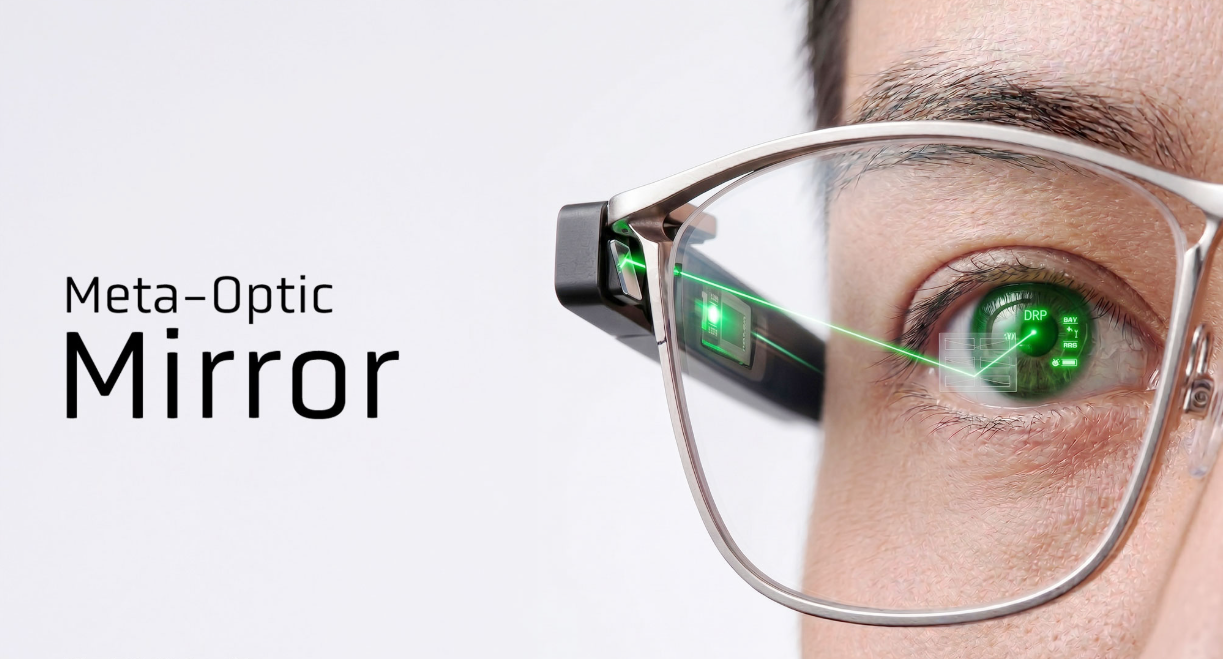
Japan’s TDK has unveiled a technology that could radically change the future of smart glasses. Instead of the traditional miniature screen in front of the eye, the system directs light straight onto the retina. The key component is a transparent meta-optic mirror, just 150 nanometres thick, which can be built directly into the lens of a pair of ordinary-looking glasses. The company describes the development as the world’s first demonstration of direct projection onto the retina in smart glasses using such an optical element.
- TDK has unveiled technology for projecting images directly onto the retina for smart glasses.
- An ultra-thin meta-optic mirror, just 150 nanometres thick, is integrated into the lens.
- The transparency of the element is around 80%, so the glasses can look almost like ordinary ones.
- The current prototype operates in monochrome mode; the next stage is set to be full-colour imaging.
The image is formed directly on the retina
The technology is called Direct Retinal Projection, or DRP. Its operating principle differs significantly from that of most modern AR glasses. Instead of looking at a small display or an image projected in front of the eye, the user receives a light-based image directly onto the retina.
In effect, a miniature laser system generates a light beam, and the optics direct it to the correct point in the eye. QD Laser compares the principle to a planetarium: just as a projector projects a starry sky onto a dome, the optical system «projects» a digital image onto the retina using light. This means that a traditional screen, in the usual sense, is no longer needed in front of the eyes.
All the magic lies in a layer 150 nanometres thick
TDK’s main new product — the so-called meta-optic mirror. This is no ordinary mirror. Its surface consists of nanoscale structures that control the direction in which light is reflected. As a result, this flat component can perform the tasks of much larger and more complex optical systems. It is only 150 nanometres. By way of comparison, it is a hundred times thinner than a human hair.
At the same time, TDK states that approximately 80% visible light transmittance. As a result, the component remains almost transparent and can be integrated directly into the lens. The result is a pair of glasses that, in appearance, could potentially look very little different from ordinary ones.
The old systems were hampered by cumbersome optics
Direct projection onto the retina did not appear on its own in 2026. The problem until now has been the design. Such systems used curved mirrors positioned in front of the eye. These took up space, complicated the frame design and made the device look distinctly like a technological prototype rather than a pair of ordinary glasses.
TDK is attempting to remove this very limitation. The nanostructures in the new mirror alter the angle at which light is reflected, depending on where it strikes the surface. As a result, this flat and almost invisible component could replace the traditional curved mirror. And this potentially paves the way for significantly thinner smart glasses.
Other people won’t be able to see your screen
According to TDK, the image seen by the wearer of the glasses should not be visible to the person opposite. In other words, the person you are talking to will see the wearer’s eyes and the transparent lenses, but not the text, messages or other digital information projected onto the retina.
This could be important for future AI glasses. Notifications, navigation, assistant prompts or other personal information will remain visible only to the device’s owner.
There’s no need to focus on the virtual screen
Another advantage of the technology being developed by QD Laser, — the so-called ‘focus-free’ principle. In traditional head-mounted displays, the eye must focus on a specific virtual plane. With direct projection, the system directs light onto the retina in a different way. As a result, the image can remain visible without the same focusing mechanism required by a conventional display.
For compact XR glasses, this is important for several reasons: it allows for a smaller optical system, reduced power consumption and a simpler design. It is precisely these properties that QD Laser cites as the key advantages of the technology for the next generation of XR devices.
But there is an important limitation
The technology has not yet reached the mass-market stage. The prototype of the new meta-optic mirror currently supports monochrome image.
TDK’s next goal is to make the system full-colour.
The company already has a compact, full-colour laser module and laser control technology that is potentially capable of operating at resolutions of up to 4K. Back in June 2026, TDK and QD Laser signed an agreement to jointly develop a new generation of RGB modules and optical systems for XR glasses.
It is precisely the combination of these technologies in a compact housing that could be the next big step.
The first pair of glasses will be unveiled on 13 October
You won’t have to wait long for a live demonstration. TDK plans to bring a prototype of its smart glasses, featuring a new mirror, to CEATEC 2026, which kicks off in Japan on 13 October.
The next demonstration is scheduled to take place at the electronica trade fair in November. The company also mentions the possibility of mass-producing the technology over the next few years. Another feature could help achieve this: the meta-optic mirror can be manufactured using processes similar to those used in semiconductor production. In the long term, this could potentially make the design cheaper than the complex optical waveguides used in some modern AR displays.
For now, it’s still just a prototype. But if TDK manages to incorporate full RGB colour, maintain the transparency of the lenses and bring the technology to mass production, future smart glasses could look completely different: not like a computer in front of your eyes, but almost like a normal pair of spectacles, inside which only the wearer can see the digital image.