In Latvia, on 7 October, the Riga City Court sentenced pro-Kremlin activist Polina Kamleva to six years’ imprisonment for financing Russian military personnel taking part in the war against Ukraine. The criminal case was based on a transfer of approximately 43 euros to purchase equipment for jamming drone signals. In addition to the prison sentence, the court ordered the woman to serve three years’ probation. Kamlyova herself admitted that her actions were a mistake, but denied any intention to support the Russian army.
Briefly about the main points
- On 7 October, a court in Riga sentenced Polina Kamleva to six years’ imprisonment.
- A woman has been found guilty of funding the Russian army to the tune of approximately 43 euros.
- The court sentenced him to six years’ imprisonment and three years’ probation.
- Kamlova did not admit to criminal intent. The verdict can still be appealed.
Six years for 43 euros: the Latvian court’s ruling
The Riga City Court has recognised a resident of the town of Rēzekne Polina Kamlyova guilty of financing an armed conflict. The verdict was handed down by the judge Anita Dzerve.
The prosecution had sought an eight-year prison sentence for the woman. The court sentenced her to six years’ imprisonment and an additional three years’ probation. The time Kamlova had already spent in custody was deducted from her sentence. She therefore has five years, one month and 25 days left to serve.
The preventive measure of remand in custody has been upheld until the sentence becomes final. The convicted person has the right to appeal against the decision to the Riga District Court.
How the money ended up in the hands of the Russian military
According to the investigation, in December 2024, Kamleva exchanged correspondence via WhatsApp with an acquaintance from Russia who is associated with the «Kaskad» military-patriotic training centre.
The person she was speaking to suggested she help raise funds to purchase a mobile electronic warfare system. Such equipment is designed to jam signals from drones and was to be handed over to Russian military personnel fighting against Ukraine.
As it was not possible to make a direct bank transfer from Latvia to Russia, Kamleva enlisted the help of an acquaintance living in Belarus. The intermediary transferred 157 Belarusian roubles — approximately 43 euros — from her account. It was this transfer that became one of the key pieces of evidence in the criminal proceedings.
In December 2025, Kamlev was detained by the Latvian State Security Service (VDD).
In court, Kamleva described the transfer as a mistake
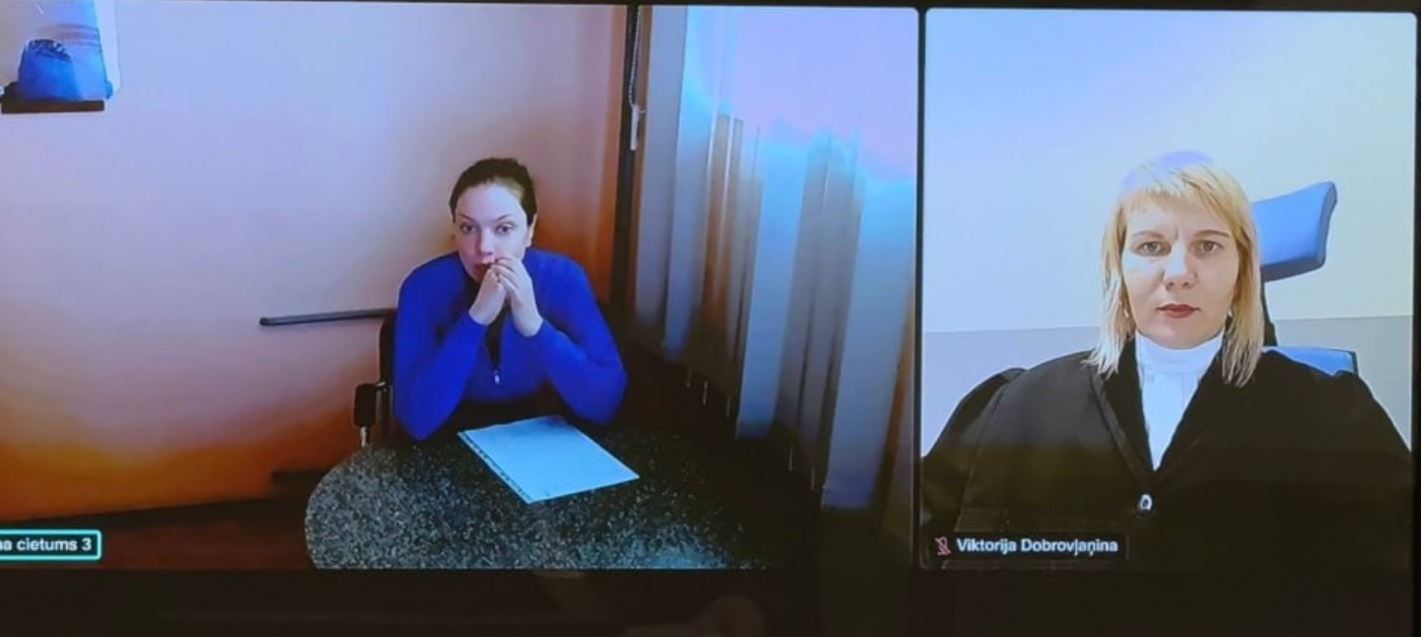
The defendant’s closing statement lasted around 40 minutes. She took part in the hearing remotely from Ilgyuciy prison, where she was being held in custody. Kamlova stated that she had not realised the consequences of her correspondence and had no intention of funding the Russian army. She attributed her actions to being overly trusting and to a difficult emotional state. According to the woman, she had made a mistake, but believed that this did not prove the existence of criminal intent.
Prosecutor Roberts Urdzins rejected these arguments. He emphasised that the defendant’s guilt had been proven during the trial. According to him, the amount of the transfer is not decisive when it comes to the financing of the Russian armed forces.
Who is Polina Kamleva?
Polina Kamlova is known in Latvia for her involvement with pro-Russian political activists. According to the Latvian television channel TV3, she is linked to the political party «Russian Union of Latvia».
During the court hearing, representatives of this political circle were among those present, having come to support the defendant. Her party colleague, Andrejs Pagors, had also been present at previous hearings. He publicly supported Kamleva and organised a fundraising campaign for her legal defence.
Journalists report that Kamleva objected to the trial being filmed. However, the judge allowed cameras in, citing the public interest.
What is the penalty for financing a war?
Latvian criminal law provides for liability for the financing of armed conflict, in particular for channelling funds to support military formations. Under the relevant section, the maximum penalty is ten years’ imprisonment. Probationary supervision for a period of up to three years may also be imposed.
The Kamlova case demonstrates that criminal liability may arise even for the transfer of a relatively small sum, provided it is proven that the funds were intended to finance military activities.
In this case, the court deemed the evidence presented by the prosecution to be sufficient and imposed a custodial sentence. However, the decision of the court of first instance is not yet final, as the convicted person retains the right to appeal.