The administration of US President Donald Trump has begun direct contacts with Myanmar’s military-backed government, Reuters reports, citing current and former US officials and other informed sources. An American delegation visited Naypyidaw on 15–16 September 2026; the confirmed reason for the visit was to facilitate the release of businessman Adam Castillo.
Briefly about the main points
- A US delegation visited Naypyidaw on 15–16 September to secure the release of Adam Castillo.
- Castillo was released and deported from Myanmar on 16 September.
- Reuters described scam centres as the main topic of discussion.
- Access to rare-earth resources is described by Reuters as a broader topic of discussion.
- Myanmar’s leader, Min Aung Hlaing, remains subject to US sanctions.
The visit ended with the release of an American businessman
On 17 September, Reuters reported on a rare visit by US officials to Myanmar to facilitate Castillo’s release. The businessman was detained at Yangon airport on 11 June, and on 16 September the Myanmar authorities released and deported him; this was also confirmed by the Associated Press, citing the country’s state media.
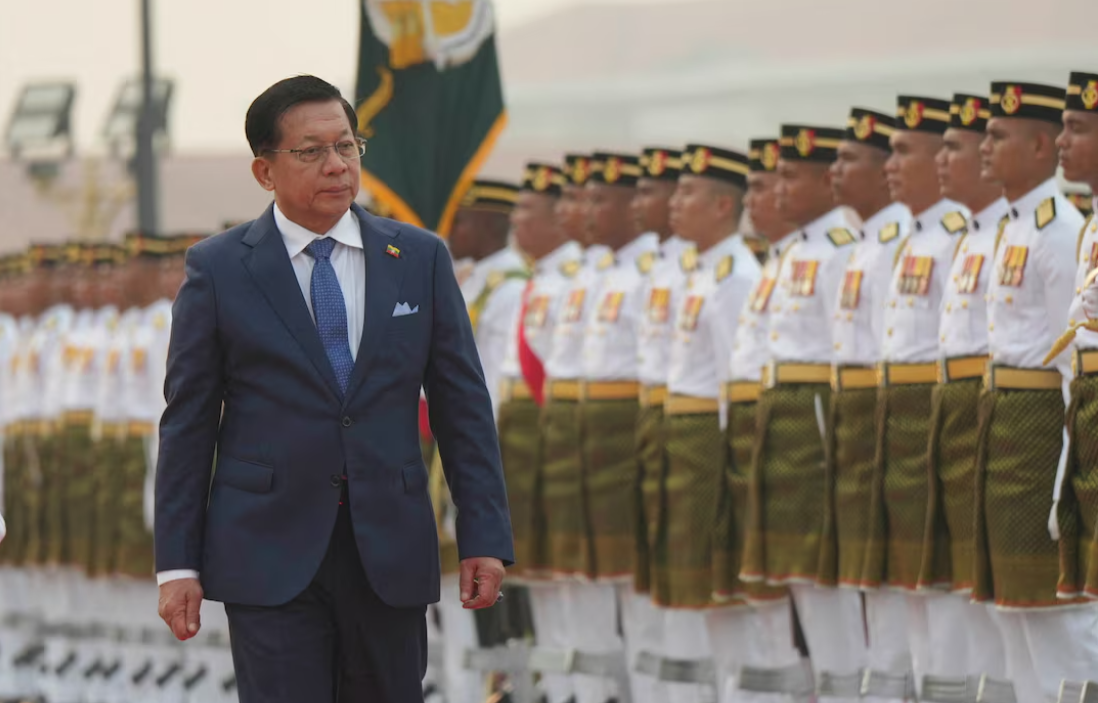
У in the new material Reuters reports that the meetings in Naypyidaw marked the highest-level contact between the US and the military-backed government since the 2021 coup. The news agency notes that the broader context of these contacts and Washington’s possible course of action have not been publicly disclosed.
Reuters reported on Michael Vance’s role
At a meeting with Min Aung Hlaing took part Michael Vance — Assistant Secretary of State for Intelligence and Research. The publication, citing mainly unnamed sources, reports that he played a prominent role in establishing contacts.
Vens’s appointment is confirmed by official US documents: the Senate confirmed him to the post in August 2026. However, the claim that he shaped Washington’s policy towards Myanmar remains a report by Reuters rather than a publicly stated position of the State Department.
Fraud centres and rare-earth minerals
Reuters describes the closure of the centres as the main practical issue under discussion online fraud in Myanmar, which, according to the publication, had defrauded US citizens. The problem has been confirmed to be regional in scale: the UNODC has reported hundreds of such centres in South-East Asia, whilst the US Treasury Department previously estimated the losses suffered by American victims of these schemes at more than $10 billion in the previous year.
Future discussions may focus on access to Myanmar’s substantial deposits of heavy rare-earth elements, which are required, in particular, for electric vehicles and wind turbines. According to the US Geological Survey, in 2024 Myanmar exported 27,000 tonnes of rare-earth elements, expressed as oxides, to China.
There is no publicly confirmed agreement on resources between the US and Myanmar. Reuters notes that some of the deposits are located in areas controlled by ethnic armed groups, and that China is currently the main importer of this raw material.
The talks are taking place against a backdrop of sanctions and new casualties in Rakhine
Min Aung Hlaing remains subject to US sanctions. In 2022, the US State Department stated that members of the Myanmar military had committed genocide and crimes against humanity against the Rohingya Muslims.
According to the UN, on 28 September, near a market in Kyautaw, Rakhine State, at least 50 people were killed and dozens more were injured as a result of an attack reportedly carried out by the military. The State Department told Reuters that the US is engaging with various groups in Myanmar on matters of American interest and is raising the issues of ending the violence and the release of political prisoners.
Against this backdrop, Reuters describes these direct contacts as a departure from the generals’ previous isolation. However, no specific agreements, nor the scope or duration of a possible new format for relations, have been publicly announced.