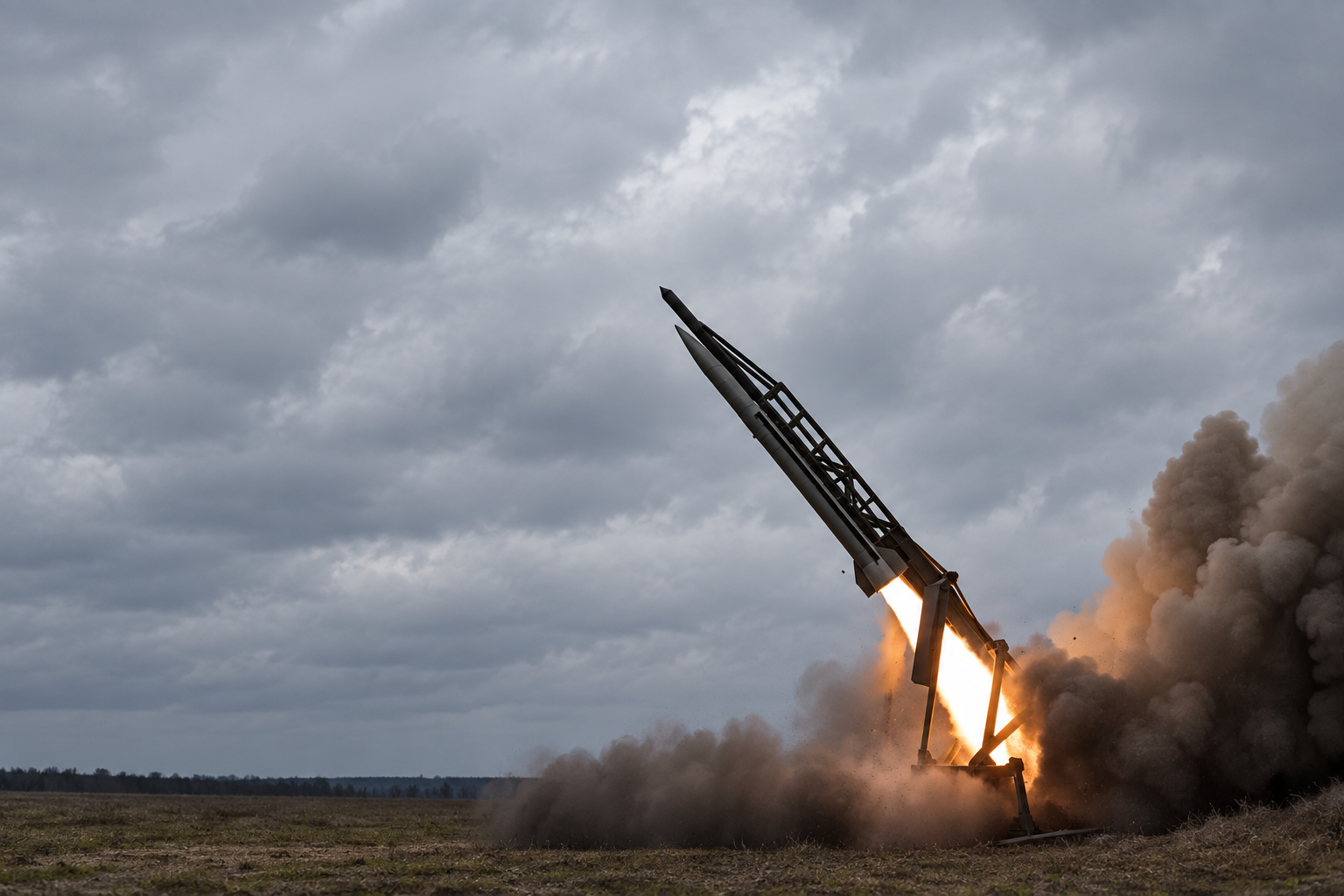
President Volodymyr Zelenskyy announced the first combat use of the Ukrainian Pelican ballistic missile, which is linked to the development of the FP-7 by Fire Point. According to him, the new weapon was used during a large-scale long-range operation against targets in the Moscow region. The FP-7 underwent military trials back in September, and the manufacturer stated that it was «weeks, not months» away from combat use.
- Zelenskyy announced the operational deployment of the Pelican.
- The missile is believed to be the FP-7 ballistic missile.
- It was developed by the Ukrainian company Fire Point.
- The stated range of the FP-7 is up to 200–300 km.
- The combat unit weighs up to 150 kg.
Zelenskyy announced the first use of Pelican
According to the President, Pelican was among the Ukrainian long-range weapons deployed during the night-time operation against Russian targets.
Zelenskyy had previously confirmed damage to one of the key enterprises the Russian Federation’s oil industry and a logistics facility in the Moscow region. During the operation, he said, the following systems were used: FP-1, RZ-100, MICH-2000, «Palyanitsa», Vendetta, «Lyuty», «Bars», «Flamingo», «Sichen» and Pelican.
The mention of Pelican is particularly interesting, as the FP-7 had previously been at the military testing stage. Back on 10–14 September, Fire Point’s director, Iryna Terekh, reported that the missile had passed two stages of testing and was moving on to military trials as part of the codification procedure. At the time, she said that operational deployment could take place within a matter of weeks.
However, as at the time of publication, there is no independent confirmation of a specific FP-7 launch over the Moscow region.
What is known about the FP-7 Pelican
FP-7 — a Ukrainian ground-launched tactical ballistic missile developed by the company Fire Point, which also manufactures the FP-1 long-range drones and the FP-5 «Flamingo» cruise missile.
FP-7 was first publicly announced in September 2025. In February 2026, Fire Point released a video of its test launch from a ground-based launch pad.
Title Pelican / «Pelican» Speculation about a link to FP-7 began in the spring of 2026, when Fire Point filed applications for the relevant trade marks. At that point, the company had not yet officially confirmed that FP-7 would be given this name.
Official website Fire Point currently describes the FP-7 as a ballistic missile capable of delivering a payload of up to 150 kg over a range of up to 200 km.
| Characteristics | Published data |
|---|---|
| Type | tactical ballistic missile |
| Developer | Fire Point |
| Launch | ground-based platform |
| Fuel | solid |
| Range | up to 200 km according to official data from Fire Point; in some later statements — up to 300 km |
| Combat unit | up to 150 kg |
| Maximum speed | around 1,500 m/s |
| Accuracy | The stated CEP is approximately 14 m |
| Maximum flight time | up to 250 seconds |
The performance figures for speed, accuracy and flight time were disclosed by Fire Point during the early presentations of the FP-7 and were reiterated following the February trials.
The range of the FP-7 raises questions about an attack on Moscow
There is one important point to bear in mind.
The official Fire Point website still lists the maximum range of the FP-7 as 200 km. In August, Defence News, citing company representatives, had already reported on the possibility of a flight of approximately up to 300 km, depending on the weight of the warhead.
This is not enough to launch direct attacks on Moscow from most of the areas controlled by Ukraine.
Therefore, if reports that the Pelican was deployed specifically during the attack on the Moscow region are confirmed, this could mean that either the combat version has different specifications to those previously disclosed, or that a different launch scenario is involved. There is currently no public data available to establish this with certainty.
That is precisely why one should not automatically assume that the FP-7 has a range of 500–600 km: the manufacturer has not published any confirmed specifications to that effect.
Why is the FP-7 referred to as the Ukrainian alternative to the ATACMS?
Fire Point positioned the FP-7 as a relatively inexpensive tactical ballistic system for rapid strikes against medium-range targets.
In terms of class, it is often compared to the American one ATACMS, although they are not exact equivalents. The FP-7 has its own design, a different warhead, range and launch system.
Defence News reported that one of the project’s aims is to develop cheaper weapons that Ukraine can produce independently in large quantities, without being dependent on political decisions regarding the transfer of Western missiles.
Open-source reports have also indicated that the FP-7’s design incorporates certain features associated with the 48N6 family of missiles for the S-300/S-400 systems. At the same time, representatives of Fire Point emphasised that a significant proportion of the missile’s components and systems are new Ukrainian designs.
The FP-7 has already been developed in a version for missile defence
The FP-7 formed the basis not only of a cruise missile.
Fire Point is simultaneously developing FP-7.X — a missile interceptor for a future European-Ukrainian system Freyja.
In June, the company conducted a controlled test flight of the FP-7.X. European defence companies are involved in the project, working on radars, guidance systems, the command post and other components.
Fire Point aims to make Freyja a cheaper alternative to using Patriot against ballistic targets. According to Reuters, the company expects the cost of a single interceptor to be less than €1 million.
It is important not to confuse FP-7/Pelican impact-resistant from FP-7.X. The first is designed to engage ground targets, whilst the second is being developed as an interceptor missile.
Fire Point is developing the much more advanced FP-9
The next stage of the Fire Point missile programme is FP-9.
According to the manufacturer’s official figures, FP-9 designed for a range of up to 855 km and combat load up to 800 kg. According to the published specifications, this particular missile already belongs to a class capable of striking targets much deeper within Russian territory.
The FP-9 is currently undergoing testing.
The simultaneous emergence of the FP-7, FP-9, «Flamingo» and a series of long-range unmanned aerial vehicles indicates that Ukraine is developing not just a single multi-purpose missile, but a whole range of systems with varying ranges, speeds and payloads.