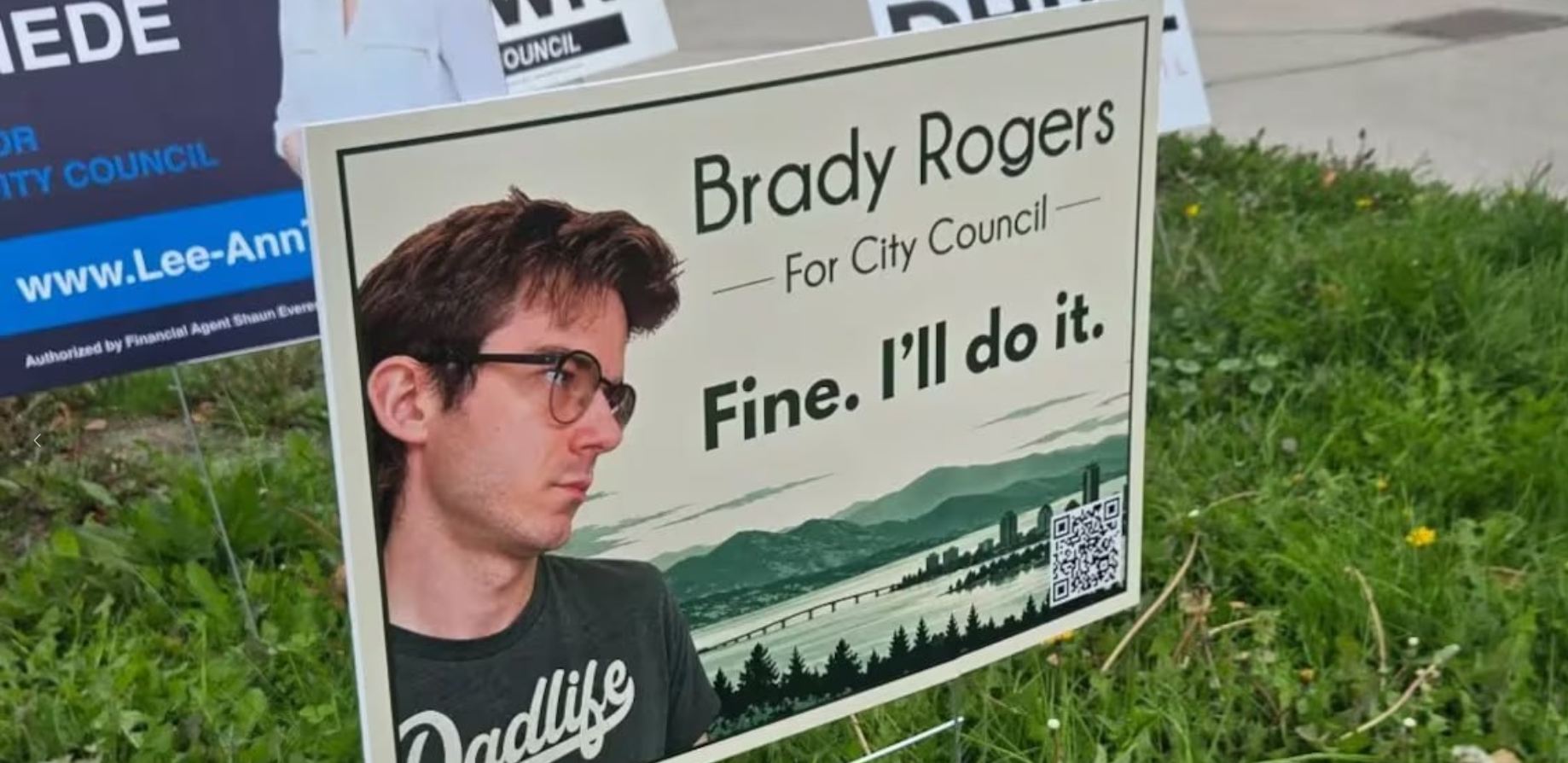
In the Canadian city of Kelowna, in the province of British Columbia, 33-year-old Brady Rogers won the local elections following an unusual election campaign built around jokes about his own reluctance to become a politician. Instead of the usual campaign promises, he put up posters with slogans such as «I don’t really want to do this», «All right, I’ll do it» and «How hard can it be?». His campaign went viral on social media and attracted the attention of the international press. According to the official results of the vote on 17 October 2026, Rogers received 12,637 votes and came fourth out of 37 candidates, securing one of the eight seats on the city council.
A candidate who had no intention of entering politics unexpectedly won the election
Brady Rogers He decided to stand for election to Kelowna City Council, even though he had never previously considered a career in politics as a possible path for himself.
Instead of the usual election promises and serious photographs, he opted for self-deprecating humour. One of his campaign posters bore the inscription:
«I don’t really fancy doing that.».
Another poster read:
«All right, I’ll do it.».
Another one invited voters to reflect on the question:
«How difficult can it be?»
These slogans differed significantly from the advertising used by other candidates. Photos of the posters began to be widely shared by social media users, and the unusual campaign attracted international attention.
However, the biggest surprise came after the votes had been counted: The man who joked about not wanting to serve as an MP has in fact been elected.
«I don’t like politics and I don’t know what I’m doing»: what Rogers wrote on his website
The candidate’s official page proved to be no less ironic.
At the start of his website, Rogers posted a brief introduction in which he openly mocked traditional political presentations. He posed three questions: whether he liked politics, whether he knew what he was doing, and whether he had the relevant qualifications. He answered ‘no’ to all three. Despite this, the candidate went on to explain in detail the reasons for his participation in the election.
Rogers grew up in Kelowna, has lived in the town for many years and is well acquainted with its problems. He is an engineer by training and, prior to his political campaign, worked in the field of robotic automation. He later went on to run his own manufacturing business with his wife.
According to Rogers, the idea of standing for election initially struck him as ridiculous. However, after giving it some thought, he came to the conclusion that his professional experience could be of benefit to the town.
Fourth place out of 37 candidates: official election results
The local elections in Kelowna took place on 17 October 2026. Thirty-seven candidates stood for the eight council seats. Rogers received 12,637 votes and came fourth.
The city council approved the official results on 21 October.
| Indicator. | Result |
|---|---|
| Vik Rogers | 33 years |
| Candidates for the city council | 37 |
| Parliamentary seats | 8 |
| Votes for Rogers | 12 637 |
| Rank by number of votes | 4 |
| Voter turnout | 31,4% |
A total of 38,976 residents of the city took part in the vote.
Kelowna’s electoral system provides for the election of eight councillors from a city-wide list of candidates: seats are allocated to those who receive the highest number of votes.
So, fourth place was enough for Rogers to win.
Behind the jokes lay a perfectly serious election manifesto
Despite the campaign’s unusual style, Rogers put forward specific ideas for Kelowna’s development.
His priorities included:
-
Affordable housing. Exploring ways to increase the number of affordable homes and reduce housing costs.
-
Public transport. Creating conditions under which residents would be less likely to use their own cars.
-
Local taxes. A review of approaches to the taxation of land and property, although some of the proposed changes will require decisions by the provincial authorities.
-
The problem of homelessness. Finding practical solutions regarding housing, social support and safety.
-
Support for small businesses. Improving conditions for local entrepreneurs.
Rogers explained that most people understood his jokes and, after reading the manifesto, recognised the specific proposals behind them. He also emphasised the need to involve younger people in local government, as they are directly affected by the rising cost of living and housing problems.
Why did Rogers’ campaign become popular?
Political commentators have noted the unusual combination of humour and concrete proposals.
Lecturer at the School of Communication and Culture, Royal Roads University David Black In a comment to the CBC, he described the campaign as an example of genuine satire. In his view, this form of communication enabled the candidate to stand out from his numerous rivals and offer voters an alternative to traditional political rhetoric.
Rogers himself explained that his campaign slogans should not be taken literally. In fact, he takes his future responsibilities seriously and is keen to be of service to the city.
Now it’s time to get down to work: what lies ahead for the new MP
Following his victory, Rogers admitted that the public attention was something new for him, although people’s reactions had been largely positive. The newly elected councillor acknowledged that he still had to get to grips with the day-to-day workings of local government.
The official swearing-in ceremony for the new Kelowna City Council is scheduled for 2 November 2026. The first regular meeting is due to take place on 9 November.
And so, Rogers’s main pre-election joke became a reality: He promised, «All right, I’ll do it.» — and now I really must do it.